
Battery power vs energy capacity is the difference between how fast a battery can move electricity and how much electricity it can deliver before it must be recharged. Power, measured in kilowatts, limits the load the system can support at one moment. Energy capacity, measured in kilowatt-hours, limits how long a given output can continue. A nameplate energy figure does not, by itself, state the usable energy at the meter.
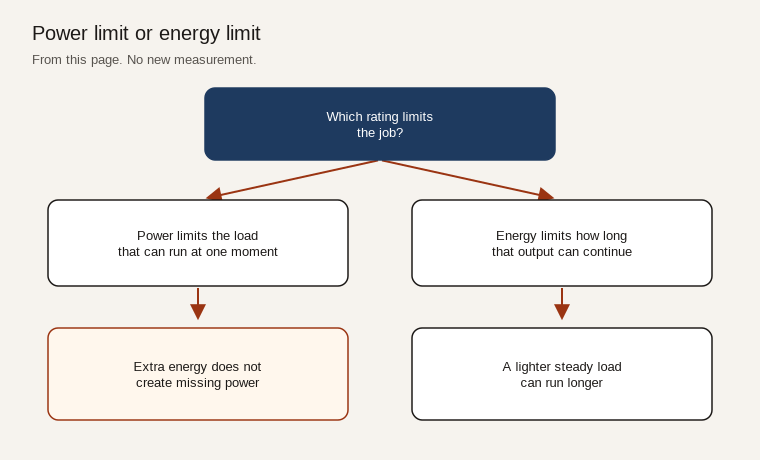
Power limits the load that can run at one moment, energy limits how long that output can continue, and a larger store of energy does not supply a load the power rating cannot carry.
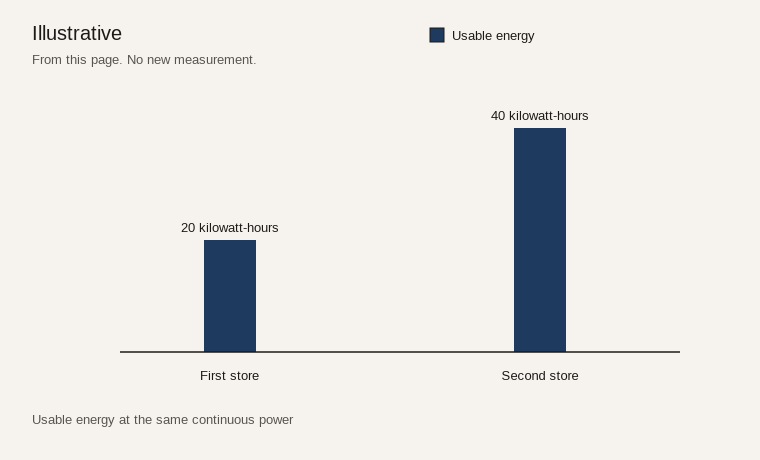
The bars repeat the labeled illustrative pair of usable energy amounts held at the same continuous power, and those figures are illustrative.
Power limits the load; energy limits the time
The U.S. Energy Information Administration separates the two ratings for electricity storage. Power capacity is the maximum instantaneous electric power the system can generate on a continuous basis. Energy capacity is the total amount of energy that can be stored or discharged. Two systems with the same energy capacity can still be built so that one produces high power for short periods and the other produces less power for hours. The Department of Energy draws the same line for storage paired with solar. Energy capacity is how much can be stored. Power capacity is how much can be released at a given time. Short-duration storage can steady output through a passing cloud. A larger store of energy extends supply when production stays low. Storage is never fully efficient, because some energy is lost when it is converted and retrieved.
A power conversion system, usually an inverter, turns direct-current battery power into alternating-current power a building or the grid can use. Its continuous rating, the conductors, the battery management system, and a utility import or export limit can each cap power below what the cells could support.
Charge power and discharge power are separate ratings, and a short start is not the continuous rating. Tesla’s 2025 Powerwall 3 datasheet for the United States and Canada lists nominal alternating-current output as a configured value, with steps up to 11.5 kilowatts. Maximum continuous charge power for the unit alone is 5 kilowatts, or 8 kilowatts with up to three expansion units. A higher off-grid discharge figure applies only under the sheet’s stated conditions for rating, temperature, and conductors. Load-start capability is listed apart from continuous output, so a motor start can fail while energy remains.
A duration label is a quotient
People compress the two ratings into a label such as “two-hour” or “four-hour.” In a September 2023 report, the National Renewable Energy Laboratory defines duration as the length of time a storage system can generate at full output before it needs to recharge. A 2021 laboratory report uses the same idea: the number of hours a device can provide continuous output at its rated capacity. Neither definition tells an owner which duration to buy.
The April 2016 protocol from Pacific Northwest National Laboratory and Sandia National Laboratories ties the hour-count to the allowed window. Duration is the discharge time at rated power from the upper state-of-charge limit to the lower limit specified for the application. Stored energy in that protocol is rated power multiplied by discharge time at rated power. Rated power is the power performance for a particular application, not a property of the cells alone.
The quotient is meaningful only when both figures share a boundary. The 2021 report treats energy and duration as usable quantities available to the operator, after energy held for state-of-charge limits, and it states that usable stored energy equals the net power rating multiplied by that duration. Nameplate direct-current energy divided by inverter alternating-current power is a different pair, and mixing them misstates what the meter will show. A C-rate on a cell sheet ties discharge current to rated ampere-hour capacity for a stated test. It does not set continuous alternating-current power for a building.
Why two-hour and four-hour systems are different decisions
Hold continuous power constant and double the usable energy, and simplified duration at that power doubles. Hold usable energy constant and double the power, and the system can carry a larger load for less time. At the same continuous power, a four-hour system covers a longer peak or a longer outage of loads inside that power, and it adds modules, space, weight, and often recharge time if charge power does not rise with the energy. A two-hour system at that power fits a brief high load and runs out sooner if the event lasts. A short spike stresses power. A long plateau stresses energy.
The September 2023 report describes several wholesale regions using a four-hour capacity rule: storage of at least that duration could receive full firm-capacity compensation, with no extra capacity revenue for a longer duration, and it ties part of the 2021 and 2022 build pattern to that rule. The 2021 report adds that high capacity credit can require only a few hours in some locations on the grid of that period, and multiple days on a future grid with very large renewable and storage deployment. That is wholesale planning context, not a building requirement in Maryland, Northern Virginia, or the District of Columbia, and not a substitute for the current tariff.
Recharge time is the other half. In the 2016 protocol, round-trip efficiency is useful energy out divided by energy in, including parasitic energy such as heating or cooling, and auxiliary loads include controls, fans, pumps, and heaters. The September 2023 report illustrates the gap with its own example: an eight-hour device at 80 percent round-trip efficiency needs 10 hours to fully charge. That figure is the report’s illustration, not a product measurement. The same report separates power-related cost, including the converter, from energy-related cost, and its footnote defines that kilowatt-hour as usable energy after state-of-charge limits and conversion to alternating current.
What the nameplate does not say about usable energy
Nameplate, nominal, rated, and usable are not synonyms. The December 2023 Federal Energy Management Program evaluation method, prepared at the National Renewable Energy Laboratory, treats rated energy as a stated capacity, often estimated as ampere-hours times nominal voltage. Demonstrated capacity is the largest amount of energy inferred from metered charge and discharge. A minimum state-of-charge setpoint, used so the battery is not emptied, reduces how much of the rated figure is cycled. In the method’s worked example, a floor of 20 percent still lets demonstrated energy at 80 percent of rated confirm the rating. The example interprets a controller limit. It is not a reserve or a backup policy to copy.
Alternating-current energy at the inverter is smaller than direct-current cell energy after conversion losses. If the sheet already states usable alternating-current energy, do not apply an efficiency factor again. The evaluation method treats one round-trip figure as an approximation because efficiency depends on rate and temperature, so a mild-air test is not the result in a hot enclosure. The 2016 protocol repeats a beginning-of-life reference test to track degradation, and no single fade rate belongs in a general page. The Energy Information Administration publishes gross and net generation because storage uses electricity to recharge and to run itself.
On the 2025 Powerwall 3 datasheet, nominal battery energy is 13.5 kilowatt-hours alternating current, at 25 degrees Celsius, beginning of life, and a charge and discharge power of 3.3 kilowatts. Performance may be reduced above 40 degrees Celsius. The solar-to-battery-to-home-or-grid figure of 89 percent is a typical solar-shifting case under that same note. Expansion units add nominal battery energy on a direct-current voltage range and raise listed charge power, without replacing the configured alternating-current output. A comparable proposal states the boundary, the state-of-charge window, the test conditions, whether the figure is beginning of life, and whether auxiliaries sit inside the number.
An illustrative runtime, with the assumptions visible
The following arithmetic is illustrative. It is not a Soleil Energy project, a product recommendation, or a prediction for any address. Assume usable energy is already measured at the alternating-current terminals, the load is steady, nothing is held in reserve, auxiliaries draw nothing, conditions are beginning of life, and temperature does not limit output. Under those assumptions only, energy divided by power gives hours.
Two systems can each deliver 10 kilowatts continuously. The first has 20 kilowatt-hours of usable energy at that boundary. The second has 40. Then 20 kilowatt-hours divided by 10 kilowatts is 2 hours, and 40 kilowatt-hours divided by 10 kilowatts is 4 hours. A steady 15-kilowatt load is outside both systems, and the extra energy does not create the missing power. A steady 5-kilowatt load sits inside both power ratings, so the simplified runtime is about four hours on the smaller store and about eight hours on the larger one.
Hold usable energy at 20 kilowatt-hours and change only power. At 10 kilowatts the simplified runtime is about two hours. At 5 kilowatts it is about four hours, and any load above 5 kilowatts is unsupported. A reserve or auxiliary draw shortens that result.
The job decides which rating binds first
Outage backup is not a property of kilowatt-hours. Grid-tied solar is generally designed to stop when the grid is down, unless the equipment is built to island and serve selected loads. The questions that matter are which circuits must run, whether running and starting power fit, and how long those circuits must run before a recharge. Soleil Energy’s guide to whether solar panels operate in an outage separates shutdown from backup. The guide to whole-home backup versus essential circuits covers which loads belong on the battery, and the guide to a home battery and a generator compares runtime and refueling.
Demand management fails if battery power is below the slice of peak to be offset, or if energy runs out before the billed interval ends. Charging can create a new peak. The guide to demand charges, solar, and batteries covers the bill mechanics. On a retrofit, the existing inverter and the interconnection rules set deliverable power, which the guide to adding a battery to existing solar takes up. Maryland commercial storage questions sit in Soleil Energy’s commercial storage guide.
A listing is not a duration choice. UL 9540 is the system safety standard. UL 9540A is a fire-propagation test method, and NFPA 855 is an installation standard many authorities use. UL Solutions says the 2026 edition of NFPA 855 emphasizes large-scale fire testing and that adoption will take time. The same article gives January 1, 2027, as the effective date for edition 6 of UL 9540A. Those dates are not proof of local adoption. This page states no energy threshold and no spacing rule. A qualified professional and the authority having jurisdiction must assess the site, including which edition applies in Maryland, Northern Virginia, or the District of Columbia.
What to line up before comparing quotes
Leave a cell blank when the vendor has not defined the number. The table is a reading aid, not a sizing method.
| Question | Why it changes the comparison |
|---|---|
| Is energy direct current, alternating current, or already usable? | The hour label is only as good as the pair being divided. |
| What temperature, power, and state-of-charge window were used? | A gentle test can overstate field energy. |
| Is the figure beginning of life, and is a later condition stated? | Fade is equipment-specific. |
| What are continuous discharge, charge, and short-duration power? | Similar stored energy can serve different loads. |
| What auxiliary power is drawn, and what energy is withheld? | Both shrink energy left for the job. |
| Which loads must run, for how long, and when can the battery recharge? | Power meets simultaneous demand. Energy meets the event and the refill window. |
A homeowner can start from the circuit list and from whether an outage, a bill, or both motivated the project. A facility manager can start from interval data and the tariff’s definition of demand.
Questions that change the comparison
Why can two batteries with similar stored energy support different loads and runtimes?
The inverter and the service equipment often set the height of the power curve more tightly than the cells do. Higher continuous power runs a larger load and exhausts that energy sooner. Lower continuous power may run a small load longer and still refuse a motor start. State-of-charge limits and temperature can change delivered energy when the headlines match.
Does a four-hour nameplate run the building for four hours?
Only if the load equals the power in the quotient, the energy is usable at the delivery point, and the illustrative assumptions hold. A lighter steady load can last longer. A heavier load may not run. A reserve or heat derating shortens the result.
If the sheet already says usable, is the nameplate gap closed?
Only for the conditions next to that word. On the Powerwall 3 sheet, nominal energy is alternating-current energy at a stated temperature, at beginning of life, and at a stated test power. It can still leave out later degradation, energy held for an outage, and auxiliary draw. Two usable figures match only when the footnotes describe the same boundary.
Do extra modules raise backup power and backup time together?
They raise stored energy the controller can use, so runtime can grow for loads the inverter already carries. Continuous power rises only if the converter and the allowed mode rise too. On the Powerwall 3 datasheet, expansion units add energy and listed charge power, while alternating-current output stays a configured inverter rating.
Is a two-hour system the wrong system?
Not as a category. Two hours at a stated power can match a short peak inside that power, and it fails if the event outlasts the usable energy. Four hours at the same power covers more of a long event and still fails if power was the limit. The longer durations discussed in the 2021 and 2023 reports are grid planning context, not a default for a building in Maryland, Northern Virginia, or the District of Columbia.
Does a large energy rating mean the battery runs in an outage?
No. Outage operation depends on islanding equipment, the circuits connected to it, and an arrangement that avoids energizing a downed line. A battery installed only for grid-tied operation can sit idle when utility service drops. A qualified professional has to assess the installation.
Bring the load and the ratings into the same conversation
For backup, list the circuits, their running and starting demand, and the outage length that matters. For a demand charge, identify the height and length of the peaks the tariff bills. For solar shifting, state how much energy must move and when the system may recharge. Nameplate energy is an input to that check, not the result.
Soleil Energy works with homeowners and businesses on battery storage in Maryland, Northern Virginia, and Washington, DC, including systems paired with new solar and batteries added where solar is already present. Soleil Energy’s battery storage practice is the place to request a battery sizing and compatibility assessment. Bring the circuit list or the interval data, the existing inverter model if solar is already installed, and the priority: outage support, demand management, or shifting solar energy. A qualified professional can then compare power and usable energy with that site. The conversation does not replace the authority having jurisdiction.
Project requirements depend on the site, equipment and applicable rules. Confirm design and installation decisions with the appropriate qualified professional.
