
Battery revenue stacking means using one battery for more than one grid service or customer-bill use, rather than dedicating it to a single job. The battery can serve different purposes at different times, but the same stored kilowatt-hour cannot be committed to two discharges at once. Whether the uses can be combined depends on power and energy limits, the wholesale market or retail tariff, and the priority the operator actually enforces.
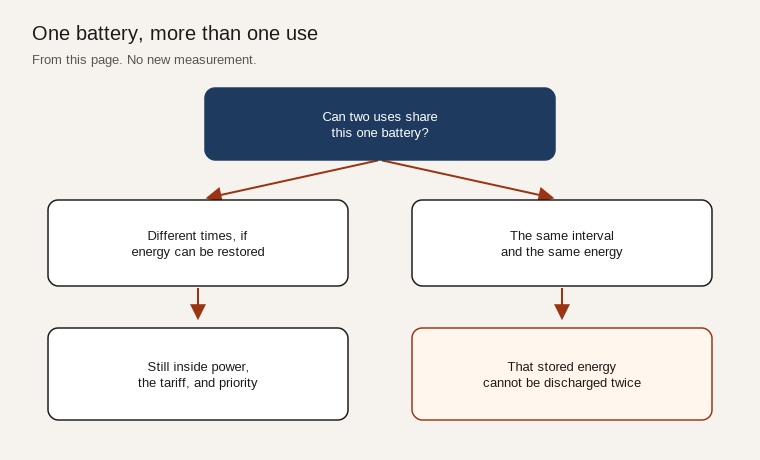
Two services can share one battery at different times, but the same stored energy cannot be discharged twice in one interval, and a wholesale credit is not the same ledger as a retail bill.
| Question | What the battery can do | What it cannot do |
|---|---|---|
| Timing | Serve different purposes at different times | Commit the same stored energy to two discharges at once |
| Same interval | Split only the remaining output when rules allow | Give the full output to two services together |
| Ledgers | Change a retail bill or settle a wholesale product | Treat one of those results as the other |
| Regulation and reserves | Clear one of those products in an interval | Clear real-time reserves and regulation together |
| Outage holdback | Keep energy for islanding | Also sell or use that same energy to cut a peak |
A shared battery is not a sum of benefits
Power is how fast a battery can charge or discharge. Energy is how much it can deliver before it must charge again. Revenue stacking, also called value stacking, is the attempt to use both for more than one service: a lower retail demand reading, a shift in when energy is purchased, a wholesale energy sale, regulation, reserves, a capacity commitment, or energy held for an outage.
A wholesale settlement runs through a market participant and the grid operator. A retail bill line runs between the customer and a utility or supplier. Listing both does not add them. Megawatts and stored energy have to be assigned to one obligation in each interval.
The U.S. Energy Information Administration’s September 22, 2025 summary of its annual generator survey covers utility-scale batteries only. Operators reported that 66 percent of that capacity had price arbitrage among its uses, 41 percent used arbitrage as the primary use, and 24 percent used frequency regulation as the primary use. Those shares are not a clearing price or a description of a building in Maryland, Northern Virginia, or Washington, DC.
The same kilowatt-hour can be discharged only once
Stored energy is an account. Discharge subtracts from it, and charge adds less than was drawn from the grid once losses are counted. The Federal Energy Management Program’s battery evaluation method, prepared for the Department of Energy and dated December 2023, defines efficiency as energy discharged divided by energy charged over many cycles, so the starting and ending state of charge matter less in the result. A discharge also carries into the next hour. Energy sent into the building is not available to inject, energy injected is not available on site, and energy reserved for an outage is available to neither.
Counting nameplate energy once for peak shaving, again for a wholesale sale, and again for backup counts the same unit three times. The inverter is a second limit in the same moment: output given entirely to one service is not also available in full to another. A split exists only within the remaining output, and only when the controls, the interconnection limit, and the market rules allow it. The evaluation method measures an operating system. It does not forecast earnings.
Wholesale products and retail bills use different ledgers
In the PJM region, as of November 2026, those ledgers are different documents. Energy, regulation, and reserves are in PJM Manual 11, Energy and Ancillary Services Market Operations, Revision 137, effective July 28, 2026. A Pepco Maryland bill follows Pepco’s Maryland tariff and the customer’s supply arrangement. A lower billed demand is not itself a PJM credit. A PJM credit is not itself a lower distribution charge.
Under 18 CFR 35.28(g)(9), on the eCFR display of Title 18 current as of November 19, 2026, each Commission-approved regional transmission organization must provide a participation model for electric storage resources. The resource must be eligible for every capacity, energy, and ancillary service it is technically capable of providing. The model must enable dispatch, and price-setting as seller and buyer when those rules allow, and bidding parameters must reflect the resource’s physical limits. Section 35.28(g)(9) says the model’s minimum size requirement must not exceed 100 kW. Energy it buys and then resells is priced at the wholesale locational marginal price.
“Technically capable” is eligibility, not permission to deliver every product with the same megawatt at once. Telemetry and testing can still exclude a battery. The regulation does not approve a project or set a retail rate. It defines an electric storage resource as equipment that receives grid energy and stores it for later injection, and it treats a behind-the-meter resource as a distributed energy resource. Aggregation rules require coordination with the distribution utility and the retail regulator. If the utility distributed 4 million megawatt-hours or less in the previous fiscal year, aggregator bids for its customers are not accepted unless that regulator allows them. Which utility is over that line has to be checked for the year.
In Manual 11, an Energy Storage Resource participates in the energy, capacity, and/or ancillary services markets as a market participant. The model is optional. The participant opts in and commits its own energy within the limits it submits. Cutting a building’s purchases does not, by itself, put the battery in that model.
What PJM will not award twice in one interval
Manual 11, read on November 22, 2026, states the overlap directly. Resources cannot clear real-time reserves and regulation for the same interval. Regulation is filled first. A resource that offers both in the same hour, and is economic for both, is committed for regulation rather than reserves. A resource on regulation is deselected from reserve commitment while that condition lasts.
A later hour is a different interval only if energy remains or can be restored and no other obligation still applies. Dispatch honors regulation assignments while optimizing remaining reserves with energy, so those megawatts are not a second product.
The model uses an hourly mode: continuous, charge, discharge, or unavailable. Charge mode only withdraws. Discharge mode only injects. An hour offered as discharge-only cannot also charge from the grid inside the model. The hourly state-of-charge entry does not enforce the energy limit. In Revision 137 it is optional, participant-submitted, and informational only, for PJM research. The participant still has to keep the battery inside its real limits. If that account is not kept, the same kilowatt-hour can be promised twice.
Regulation will show the miss. The resource must follow the automatic generation control signal, with output telemetered as PJM accepts. Manual 11 disqualifies a resource whose historic performance score falls below 40 percent, and a five-minute score below 25 percent forfeits regulation credit and lost opportunity for that interval. Manual 11 sets a 0.1 MW capability floor. Those are rules in this revision, not a predicted score. Energy spent on a retail peak, or held for an outage, can be why the signal is missed.
Economic load response can qualify for regulation through a curtailment service provider. If that resource is on regulation and is called for a mandatory emergency or pre-emergency load management event, Manual 11 de-assigns the overlapping regulation from the notice time unless PJM approves otherwise. The overlap is not both services. A building battery may instead be only a load change, a demand-response registration, part of an aggregation, or unregistered. Interconnection is separate. PJM Manual 14H, New Service Requests Cycle Process, Revision 07, effective August 19, 2026, covers studies up to the request for construction. It does not clear a market product or a retail demand charge. Manual 11’s mixed-technology example that must be one hybrid resource is storage not studied to charge from the grid, or that physically cannot.
A retail demand line measures import
On a tariff, the battery changes the bill only by changing billed quantities. The Department of Energy method separates peak shaving, which discharges to cut the instantaneous peak, from load shifting, which discharges when the retail rate is high and charges when it is lower. It also names reactive power and backup to critical loads. Each draws on the same state of charge, and none is a PJM settlement unless a registration says so.
Pepco’s Maryland tariff update effective November 1, 2026, read on November 22, 2026, shows how specific the retail test is. Schedule GS distribution service, on the pages read, is a customer charge plus kilowatt-hour charges, not a kilowatt charge. An account on Pepco Maryland Schedule GS whose maximum 30-minute demand equals or exceeds 25 kW in one or more of twelve billing months, or that crosses the schedule’s energy thresholds, moves off Schedule GS.
Schedule MGT LV II includes accounts whose maximum 30-minute demand is at least 25 kW and below 1,000 kW. Distribution service includes a kilowatt-hour charge and a kilowatt charge, and the maximum billing demand is the highest 30-minute demand in the month. Supply charges, whether standard-offer service or another supplier, are a separate line. Modeling only the distribution kilowatt charge misses part of the bill.
This is Pepco Maryland only. Baltimore Gas and Electric, SMECO, Dominion Energy Virginia, and Pepco in the District of Columbia use other tariffs. On MGT LV II the billed demand is the monthly 30-minute maximum, not an instantaneous spike and not a five-minute PJM interval. Another half hour can still set the maximum, and charging can set a new one. Net energy metering, standby, and other riders can change the result for a specific account. This page does not interpret those riders.
Outage supply is another mode, not spare energy. The Department of Energy’s solar and resilience page, updated May 18, 2026, explains that ordinary grid-tied solar is designed to stop when the grid is out, and that carrying load through the outage takes a configured inverter and storage that can island. Energy kept for that island cannot also be sold or used to shave a peak.
An illustrative hour
This arithmetic is illustrative. It is not a Soleil project, a reconstructed bill, or a wholesale clearing result. Losses, a backup reserve, and any interconnection cap are omitted so the double count is easy to see.
The illustrated battery has 80 kWh usable at the AC point and can deliver 80 kW. One hour at that output consumes the stored energy once:
80 kW × 1 hour = 80 kWh.
If that hour holds down site import, nothing is left to inject in the same hour. If the full 80 kW is regulation instead, the output follows that signal and cannot also clear real-time reserves for the interval. Using part on site and the rest for a wholesale discharge still sums to the same 80 kWh. A later hour can be a different job only after a recharge that does not set a worse 30-minute demand and that leaves any cleared product whole. Ignoring the state of charge between hours is what makes the stack look larger than the battery.
What the operating plan has to settle
Two jobs that can overlap need a written winner. Retail demand reduction has to cover the interval that would set billed demand without creating a new one by charging. A retail energy shift has to match the account’s rate hours after losses. A PJM offer has to be qualified and cannot clear a second product where the manual bars it. A capacity commitment, if one is made, has to be checked in the current capacity manuals, and the energy it needs is not free for other jobs. Outage supply is subtracted first. A load-management call gives up overlapping regulation when the manual says so.
The controller enforces that order. A device that changes battery output is operational technology. NIST Special Publication 800-82, Revision 3, published in September 2023, is guidance for securing that class of system. It is not a PJM test or an installer certification. As checked on November 22, 2026, a Revision 4 draft was open for comment through November 30, 2026. This page does not set parameters or judge a site design.
Before comparing proposals, gather the schedule and the bill line each retail use is meant to change, interval history and any load it misses, the outage reserve, whether anyone will register the battery with PJM, and whether interconnection is a utility study, a PJM new service request, or both. Soleil’s Maryland commercial battery guide covers project context. The demand-charge guide separates demand from energy. The commercial interconnection guide covers Maryland utility interconnection for commercial solar, not PJM clearing.
Questions that change the project
Why does a stacked total overstate the battery?
The usual reason is that one store of energy was assigned to two discharges, or the full inverter was assigned twice in one interval. Hours that do not overlap can still be a valid sequence if the battery can recharge and still meet anything already cleared. Ask for the overlapping hour. An annual total can hide the hour the battery is empty.
Can a retail peak and PJM regulation share an hour?
Only with whatever output and energy remain after one of them is served, and only if the battery is qualified for regulation. They cannot each take the full inverter. A peak that lands inside a regulation hour is a choice. It is not a second payment that appears on its own.
Does a lower bill show wholesale participation?
No. A bill change is the retail tariff and the supply contract. Wholesale settlement needs a registration under the PJM tariff. Either result can exist without the other, because they are calculated on different meters and different documents.
Does the federal rule sign a behind-the-meter battery up?
It requires a participation model and requires that model to reflect physical limits. It also sets a ceiling on the model’s minimum size. A building battery still needs the applicable path, which may be an individual resource, demand response, an aggregation, or none of these, plus the distribution utility and the retail regulator where the rules call for them. The regulation does not set a local rate or skip interconnection and testing.
What is different outside this example?
Manuals are revised, and the retail schedule depends on the utility, the class, and the riders. The wholesale rules cited here are PJM’s as of November 2026. The demand example is Pepco Maryland, not a Virginia or District of Columbia account. The utility confirms the account. A licensed electrical engineer confirms the equipment, the islanding design, and the site limits. This page is not a dispatch instruction or a finding that a project qualifies.
Bring the interval data and the priority
A stacked case stands only when the order of jobs fits inside the energy account. As of November 2026, wholesale products in this region follow PJM’s current rules, and retail value is whatever the account’s own tariff measures. Prices, cleared quantities, and bill results move with location, offer, performance, and that tariff. A list of services does not fix them.
Soleil Energy can look at interval load data and the operating priorities for battery storage at homes and businesses in Maryland, Northern Virginia, and Washington, DC, including a battery added to solar already installed. Start with the bill line or the outage circuits that must be served first, and say whether a wholesale registration is actually being pursued. That discussion checks the physical limit against the site. It does not create a market position, a tariff outcome, or an equipment choice.
Project requirements depend on the site, equipment and applicable rules. Confirm design and installation decisions with the appropriate qualified professional.
