
DC fast charging delivers direct current from equipment outside the vehicle straight to the battery, so the car’s onboard charger is not converting grid power from alternating current. Level 2 charging does the opposite: the station supplies alternating current, and a device in the vehicle makes the conversion. How fast a session goes still depends on the vehicle, the charger, and the electrical service. A nameplate is not a site design.
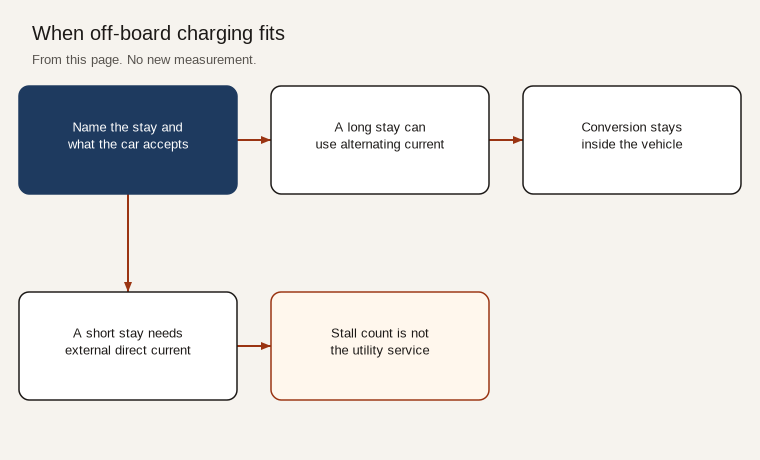
Use alternating current when the vehicle can stay long enough, and off-board direct current when the stay is short and the car can accept it, while stall count and the utility service stay separate.
The conversion sits outside the car
A traction battery stores direct current, and utility service supplies alternating current. 23 CFR 680.104 puts the converter in different places. AC Level 2 equipment, on a 208-volt to 240-volt circuit, transfers alternating current to a device in the vehicle that recharges the battery. A direct-current fast charger delivers direct current directly to the battery. The large converter is in the station.
The car still agrees voltage and current with the charger, and its battery management system can refuse a level the pack should not take. “Directly” means the onboard alternating-current charger is not the limit. It does not mean the cabinet forces its printed rating into the pack.
The U.S. Department of Energy’s Alternative Fuels Data Center says session time depends on state of charge, battery size and type, the vehicle’s internal charger, and the equipment and service. It says direct-current equipment can provide up to 500 kW, and that power varies by vehicle and state of charge. As read on November 22, 2026, that 500 kW figure describes equipment, not a building service.
Level 3 is a nickname, not a scope
The same page says direct-current fast charging is also called Level 3 charging. Part 680 does not. It defines AC Level 2 and direct-current fast charging as different machines. “Level 3” alone names neither the connector nor the power a given car will accept.
The station page puts Level 2 at 2.9 to 19.2 kW, about 25 miles of range per hour, on 240 volts at a typical home or 208 volts in a typical commercial building. It describes direct-current equipment, usually three-phase, at up to 500 kW and about 100 to 200 or more miles per 30 minutes. Those miles are approximations. Power still varies by vehicle and state of charge, many cars cannot charge above 200 kW, and a separate Megawatt Charging System for trucks is still under development. That is the page as read on November 22, 2026, not a local fleet count.
The page says all commercially available electric vehicles in the United States can use Level 1 and Level 2. It does not say that about fast charging. The car needs a matching inlet and the ability to accept external direct current.
Count the port, the connector, and the inlet
The Alternative Fuels Data Center separates the place, the port, and the plug. A port feeds one vehicle at a time even if several cords hang on it, so two connectors are not two sessions.
That page names three U.S. direct-current families. The Combined Charging System, or SAE J1772 combo, adds two direct-current pins under the alternating-current inlet, so many cars use one door at every speed. CHAdeMO is another direct-current interface, tied there to Japanese automakers. J3400, the SAE text for the North American Charging Standard long used by Tesla, works at every level on cars built with that inlet. The page said other manufacturers had announced adoption as early as 2025, while still treating Tesla vehicles as the native users. November 2026 is past that window, so confirm the inlet on the cars you park.
The page says a limited CCS or CHAdeMO adapter supplied with Tesla vehicles supports charging only up to 19.2 kW. That is not a full-rate session, and one connector family misses a car without that inlet or a suitable adapter.
Covered projects add a rule. On the Electronic Code of Federal Regulations as displayed November 19, 2026, and read again November 22, 2026, 23 CFR 680.106(c) requires each direct-current port to charge any Combined Charging System vehicle and to carry a permanently attached CCS Type 1 connector. CHAdeMO may be added only with fiscal year 2022 funds. Private equipment outside the rule can follow the cars on site. A shift toward J3400 is not an amendment.
Capacity is a study, not a catalog number
Direct-current equipment pulls the project toward the service. The Energy Department’s procurement page says to engage the utility early, because trenching, existing wiring, labor, permits, and upgrades move the cost. Those are categories, not a quote and not a transformer size. This page selects neither a service rating nor an upgrade.
The U.S. Access Board’s technical assistance, updated July 17, 2023, defines this charger as equipment on a three-phase 480-volt alternating-current circuit. That definition is not proof every product or utility service is 480 volts. The Energy Department’s “typically three-phase” wording points the same way. The utility and the equipment listing decide the supply. Before a cabinet is named, record the utility, the service already present, how many vehicles charge together, whether dispensers share a cabinet, how long they stay, and which code edition the authority having jurisdiction has adopted. A licensed electrician applies that code.
Shared cabinets break the habit of adding stall ratings. Part 680 calls power sharing, or automated load management, a limit on combined port output. On a covered corridor station, 23 CFR 680.106(d) still requires each port to meet a request up to 150 kW while sharing. That floor is for designated Alternative Fuel Corridors, not a private-lot minimum, and it is not a reason to skip the utility. A lower private cap still needs the permit office and the utility. The engineer studies the managed load, not the sum of the nameplates.
Rooftop solar does not close the file. Charging is a load, and array output follows the weather. August 11, 2025 NEVI guidance allows program funds for an on-site battery only when it directly serves charging. That is eligibility, not proof storage removes a service limit. If the battery or array is a distributed resource, IEEE 1547-2018 covers its interconnection at distribution voltage. The utility’s adopted edition controls, and load service is a different filing from generation interconnection.
Dwell time chooses the equipment class
Fast charging earns its cost when the vehicle cannot stay. The procurement page suggests Level 1 or Level 2 for workplaces and multifamily sites, and Level 2 or direct current for public hosts. That is a heuristic, not a ban on a depot and not a reason to copy corridor gear into a garage. A workday park can take substantial energy at Level 2 rates. A short fleet turn or a highway stop is what the fast charger is for. Study departures and cars arriving together before choosing.
Homes usually stay on Level 2. The station page says most owners charge at home, and Soleil Energy’s guide to Level 2 installation at home covers that job, including a service that may be too small. A workplace or yard should start with the guide to commercial EV charger installation. Short-dwell fleet returns can justify direct current. All-day employee parking usually cannot.
Demand and energy are different bill lines
Energy is kilowatt-hours over time. Demand is the kilowatt rate a tariff may bill from a measured interval. A fast session can look small in energy and large in demand, if the account bills demand at all. The procurement page lists electricity, demand charges, and network fees, with no interval and no price. Maryland, Virginia, and District utilities do not share a schedule. Soleil Energy’s guide to demand charges separates a billed peak from total energy. Read the schedule on the bill.
Illustrative example, not a design and not a Soleil project. One session averages 90 kW for 20 minutes, and nothing else on the meter changes. Energy is 90 kW times one-third of an hour, or 30 kWh. The same 30 kWh could arrive over several hours on Level 2 equipment. If the tariff uses a short interval, the rate can set the peak. The arithmetic does not choose a service, a transformer, or an upgrade.
Second illustrative example, with the same limits. A cabinet capped at 240 kW cannot give two vehicles 180 kW each at once. Whatever split the equipment uses, stall count does not multiply demand, and the cap does not prove the utility service is already large enough.
Federal rules, as of November 2026, cover only some projects
The National Electric Vehicle Infrastructure Formula Program comes from the Infrastructure Investment and Jobs Act. August 11, 2025 guidance says the law appropriates $5.0 billion across fiscal years 2022 through 2026, at $1.000 billion a year. Except where it cites statute or regulation, that guidance is not itself law. It says 23 CFR part 680 applies, that funds begin on designated Alternative Fuel Corridors, and that after a certified finding of corridors fully built out they may serve any public road or other public site. The stated federal share is 80 percent, and each state files a deployment plan. Nothing read here shows an open round or a remaining balance for Maryland, Virginia, or the District. Ask the state department of transportation.
23 CFR 680.102 limits those standards to NEVI projects and to public title 23 chargers treated as federal-aid highway work. A private lot without that money is outside them. Where they apply, the rule includes four ports charging four vehicles at once on a designated corridor, the CCS connector, the 150 kW corridor rating, availability 24 hours per day, 7 days per week on corridor sites, contactless payment without a membership unless charging is free, and a nationally recognized testing laboratory listing. 23 CFR 680.108 adds ISO 15118 behavior, including Plug and Charge as of February 28, 2024, and Open Charge Point Protocol conformance from that date. A funded job checks the current section. The procurement page also suggests protocol version 1.6 or higher so a host can change networks. That suggestion does not bind a site outside Part 680.
The section 30C credit does not cover a new placement. Internal Revenue Service instructions for Form 8911, revised December 2025, say Public Law 119-21 ended it for property placed in service after June 30, 2026. As of November 22, 2026, that date has passed. Inside the old window the instructions describe 6 percent of cost, or 30 percent if wage and apprenticeship conditions are met, capped at $100,000 per depreciable item, and 30 percent capped at $1,000 per item at a main home. A purchase order is not that test. A qualified tax professional applies it. State and utility offers expire on their own calendars, and a grant threshold does not transfer to a site that is not applying.
Access and equipment listing are part of the job
The Access Board says entities under the Americans with Disabilities Act or the Architectural Barriers Act must keep charging usable even though the standards never name a charger. The Barriers Act can cover some non-federal sites built with federal funds, including this highway program. On that page, “must” is an enforceable standard and “should” is a recommendation. One recommendation, not a local code minimum, is a vehicle space at least 11 feet wide and 20 feet long with a 5-foot aisle. Short, heavy cables and differing inlets can force a driver to move around the car, which the site design has to allow.
The procurement page requires the adopted state and local code and a licensed electrical contractor. Intertek’s description of UL 2202 says that standard covers off-board direct-current chargers supplied at up to 1000 volts alternating current or 1500 volts direct current. That is a laboratory summary, not the paid text and not a model listing. Private work still needs a listing that fits the installation. This page certifies neither an installer nor a product.
Decide these points before ordering
| Question | What changes |
|---|---|
| Which vehicles, inlets, and dwell times? | Connector and stay length decide whether direct current helps. |
| How many vehicles charge together? | Simultaneous use, not stall count, drives the study. |
| Will ports share a cap, and who accepts it? | Utility, permit office, and departure times all have to live with the cap. |
| Is federal or state money attached? | Part 680 can require ports, connectors, hours, and payment a private lot would not copy. |
| Which code edition applies? | Electrical, accessibility, and fire review are local. |
Bring a single-line diagram, the utility name, and interval data if you have them. If you do not, say so. A guessed upgrade lets the equipment order run ahead of the utility.
Questions that change the project
Should the specification say Level 3?
Only as a nickname. The Energy Department uses it for direct-current fast charging, and the federal definitions do not. Name the connector, the vehicles, and any funding rule that sets a power floor.
Will the car take the dispenser rating?
No rule says it will. The Energy Department page says power varies with the vehicle and state of charge, and many cars stay at or below 200 kW. Heat or a nearly full battery can cut the rate mid-session. Ask the vehicle maker about your models.
Does on-site solar replace the utility study?
No. Charging often falls when the array is weak. A battery moves energy in time and does not erase the load. NEVI may fund that battery only on an eligible project, and IEEE 1547-2018 covers the resource, not the charger as a load.
Can a late-2026 placement use the federal charger credit?
Not if it is placed in service after June 30, 2026. As of November 22, 2026, that date has passed. A purchase order is not the event named in the Form 8911 instructions. Earlier depreciable items still had wage and apprenticeship conditions a tax professional must apply.
When does a corridor rule control a private lot?
Only when Part 680’s money is in the project. The four-port layout, CCS connector, 150 kW rule, and all-day availability are for those sites. An unfunded home or depot follows the utility and the adopted code. Copying the corridor sheet can overbuild a long dwell. Skipping it can disqualify a funded site.
Start with parking time and the service you have
Soleil Energy’s EV charging page describes home, workplace, and fleet charging, including load management where chargers would compete with the building. That is the right discussion when the question is how many chargers the present service can support. It does not replace the utility’s capacity answer or a licensed design.
Use the Level 2 guide for a house and the commercial guide for a workplace or yard, then test whether any dwell is short enough for direct current. If the utility answer becomes new service equipment, Soleil Energy’s power page covers substation and distribution work, which is separate from setting dispensers. Bring the vehicle list, parking hours, and any service records. A qualified engineer and electrician still assess the site before a nameplate is treated as a plan.
Project requirements depend on the site, equipment and applicable rules. Confirm design and installation decisions with the appropriate qualified professional.
