
An electrical energization plan is the written decision record that settles sequence ownership, hold points, backfeed paths, and who may close before any line or equipment is placed in service. It is not a switching order, a test report, or permission from a drawing. The plan makes those boundaries explicit so voltage is not applied while a source, a clearance, or a remote control is still unresolved. A qualified professional must assess the actual site.
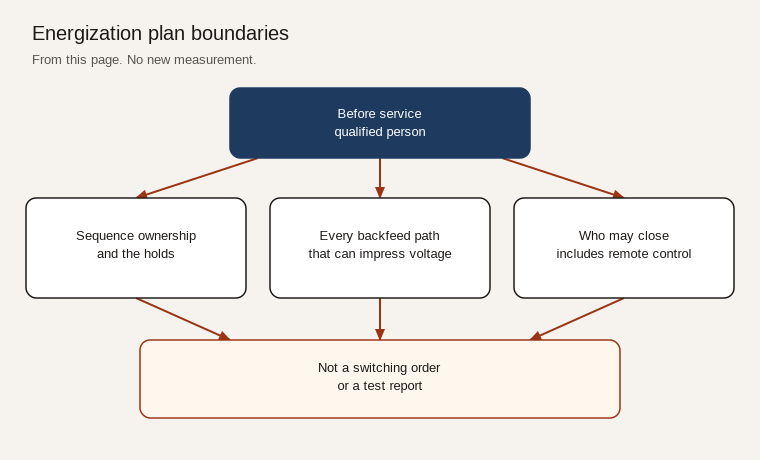
Sequence ownership and holds, every backfeed path, and who may close, including remote control, stay separate before equipment is placed in service, and the record is not a switching order, so a qualified person assesses the actual site.
What the plan has to settle
Energization places equipment in service under a named authority. Several organizations can each think the gear is ready while another still controls a source, a tag, or a remote close.
| Decision | What the record has to name |
|---|---|
| Sequence ownership | Which organization controls each boundary, and who directs action there |
| Holds | Which missing evidence or uncleared condition stops the window, and who may release that stop |
| Backfeed | Every path that can impress voltage, including sources other than the normal utility feed |
| Who may close | The authority for each device, including any remote or automatic control that can close it |
Also name the equipment boundary, the outage the window depends on, and who must be told if status changes. Operating steps belong in the controlling authority’s own procedure. This page is not a switching order and does not describe how to close a breaker.
Who owns the sequence
Sequence ownership assigns control, not a roster of companies on site. The utility may control the source-side disconnect, the owner the customer switchgear, and a generator contractor a transfer device. A protection engineer may be the only person who can accept a setting. A commissioning lead may run the window and still have no authority to operate. “Electrical contractor” is not an assignment.
As of November 2026, 29 CFR 1910.269 sets that structure for covered operation and maintenance of generation, transmission, and distribution. A system operator in charge means one designated employee holds the clearance. With no system operator, one employee performs that function. Multiple crews share one clearance holder or, absent a system operator, keep separate tags and coordinate with each other. Not every building has a utility system operator. The plan says whether one exists. OSHA’s eTool describes the operator as many utilities’ control point and puts the remaining duty on the person in charge at the site when there is none.
Construction is separate. As of November 2026, 29 CFR 1926.950 covers construction and alteration of transmission and distribution lines and equipment. The host employer shares specified installation characteristics and known conditions with contractors. Contractors report hazards, and both sides coordinate work rules. Assuming a shared procedure is not an assignment.
Above the crew, PJM Manual 03, Revision 72, effective November 18, 2026, has transmission owners operate under PJM direction. Actions on bulk electric system facilities need PJM approval unless immediate action is required to avoid loss of life, ensure safety, or protect equipment. Transmission operators keep switching procedures consistent with 29 CFR 1910.269 and direct field switching. That is not authority over ordinary building utilization equipment.
Holds stop the window
A hold is a named condition that stops energization until a named authority releases it. Open clearances, grounds still applied, unaccepted inspections, unreviewed settings, and temporary feeds of unknown status are typical. The record says what stops the work and who may lift the stop.
The Army Technical Manual 5-694, issued February 17, 2006, says a missed, failed, or postponed test should be recorded with its technical consequences and with an evaluation of whether energizing without it affects safety, people, or equipment. That historical manual is not a civilian code or a site procedure. A missing result still stays a hold until the responsible authority records the consequence. An accepted inspection does not release a clearance, and an unrelated punch item does not authorize the window.
Backfeed is not only a generator
Backfeed, here, is any path that can supply voltage to equipment people are treating as isolated or not yet in service. A generator is the familiar case. An inverter, a second feed, a tie, a temporary construction source, or another transformer winding can do it too. Induced voltage is different: it can appear without a conductive source. One drawing review is not proof that every path was found.
For covered deenergizing, 1910.269 requires known supply paths to be open, rendered inoperable unless the design does not permit it, and tagged. The eTool says those paths include backfeed. For Subpart S utilization systems, 29 CFR 1910.333 requires the deenergized test to look for induced voltage or unrelated backfeed even after parts were presumed safe. As of November 2026, those are scoped requirements, not a method this page can hand over.
Dominion Energy Virginia’s Facility Interconnection Requirements, Attachment 3, Revision 8.0, effective October 1, 2025, says its anti-islanding scheme is meant to keep generators from energizing transmission elements inside an island and to prevent unsynchronized reclosing. That governs those Dominion transmission interconnections, not every Maryland, Northern Virginia, or District service. Soleil Energy’s commercial solar interconnection guide treats permits, permission to operate, and wholesale-market participation as separate decisions. Permission to operate a generator is not the plan for first voltage on switchgear or on a bus other crews still treat as isolated.
Who may close, including from a remote desk
Who may close is the role allowed to cause a close after the relevant holds are released. It is not the key holder, the installer, or the nearest person. Name the role, the organization, and what that person must have before directing the operation.
Remote controls belong in the same answer. Under the covered rule, a switch that could reclose an open disconnect is tagged at its control point, and the remote or automatic feature is rendered inoperable unless the design does not permit that. OSHA’s eTool on reclosers and remote devices notes that operators can switch remotely and that automatic reclosing can return voltage to a line.
NIST Special Publication 800-82, Revision 3, Guide to Operational Technology (OT) Security, published September 2023, describes systems that cause a direct physical change. Unauthorized commands could damage equipment and endanger life. The guide does not authorize operation or replace a clearance. Dominion Attachment 6, Revision 13.0, effective October 1, 2025, can assign energizing of certain substations to an option-to-build customer while the transmission owner keeps test review and relay calibration. Confirm the serving utility’s rule. That split is not permission to close outside it.
A switching order is a different document
A switching plan, a switching order, and an energization checklist are different documents. The energization plan settles ownership, holds, backfeed, and authority before anyone is energized. A switching order is the controlling authority’s operating instruction. OSHA’s eTool uses “switching order” for controlling known sources, including backfeed, when a system operator directs deenergizing. A checklist can track evidence. A checked box does not create authority, and a vendor list does not override the operator, the designated employee, or the utility desk. Topic order in the plan is not an operating sequence. Instructions to close devices in order belong with the party allowed to issue them.
Briefings use the plan. They do not replace it. As of November 2026, 1910.269 requires the employee in charge, for covered work, to cover hazards, procedures, special precautions, energy-source controls, and protective equipment before each job, with a further briefing if conditions change or the work is particularly hazardous. Someone working alone still needs the tasks planned as if a briefing were required. 29 CFR 1926.952 uses the same subjects for covered construction.
Tests support the decision; they do not make it
Acceptance testing asks whether equipment is suitable to consider for initial energization. It does not appoint a closer, and a passed report does not release a clearance. The publisher’s description of ANSI/NETA ATS-2025 limits that claim to suitability against applicable standards, manufacturers’ tolerances, and the design. This page uses that public scope only and does not recite licensed methods or values. The contract still names the edition and tests.
The 2006 Army manual only places energizing after evaluated checks, with an independent witness. A missed test needs a recorded safety consequence before it stops being a hold. Settings are separate because they shape events after voltage is applied. Dominion Attachment 3 requires its protection engineering to analyze covered elements before energization, and it sets at least 45 days for settings, drawings, the final model, and manufacturer reports. That interval is from the revision read in November 2026, not a national deadline.
Which work rule applies
Say which safety rule governs each boundary. As of November 2026, 1910.269 covers operation and maintenance of generation, control, transformation, transmission, and distribution, including utilities and equivalent industrial installations accessible only to qualified employees. It excludes most construction and Subpart S work practices. A scope note puts supplementary emergency or standby generation for a workplace under Subpart S. Non-integral equipment inside a generating facility falls under 1910.147 and Subpart S.
1926.950 covers construction of transmission and distribution lines and sends generation-installation work to 1910.269. Before that work, qualified people determine voltages, switching-transient voltages, induced voltages, grounds, circuit locations, and site conditions. The plan records the duty. It does not invent the values.
29 CFR 1926.961 treats conductors deenergized under any other procedure as energized. No one initiates reenergizing until grounds are removed, clearances released, employees clear, and tags removed from that point. 1910.269(m) states the same conditions for the lines it covers. Subpart S has its own, including removal of temporary jumpers, shorts, and grounds, a warning and visual check that people are clear, and removal of each lock or tag by the person who applied it except under a stated absence rule. Those are legal conditions, not operating steps. If the classification is uncertain, that uncertainty is a hold.
Outage windows and unfinished work
The window is often someone else’s outage: a line out, a process stopped, a shared circuit, temporary construction power, or a generator test the same evening. Name those dependencies and who confirms them that day.
Where PJM directs the facility, Manual 03 puts outage coordination on the transmission owner and PJM. New transmission equipment is a regional-model event, not only a decision at the handle. A building change can depend on an outage without being a PJM ticket.
Dominion’s delivery-point attachment, Revision 4.0, effective April 1, 2026, treats the target date as a milestone and asks for load characteristics and equipment information at least 90 days before the feasibility date. That is one transmission process, not a regional deadline. A crew’s ready date is not a plan while those items are open. Covers off, a ground still applied, a test lead left on, or reclosing left enabled can stop the window after the outage is granted. Name who compares the gear with the holds before anyone asks for authority to close.
An illustrative site boundary
Take an illustrative site that is not a Soleil Energy project. The utility owns the property-line disconnect. The customer owns the switchgear. A generator can feed a bus through a transfer device, an inverter can run on a downstream panel, and a workstation can operate one breaker. One crew is still testing cable. Another is removing a temporary feed.
The plan names who directs the property-line device, whether the crews share a clearance, and which alternate sources are blocked and who confirms the block. It records whether the workstation is disabled and tagged. Unaccepted cable results, the temporary feed, and a transfer that can still move remain holds. Releasing one hold does not release the others. A utility outage does not make a remote breaker locally controlled. “The generator is isolated” is incomplete until the device and the person who can release it are named. This example supplies no operating steps.
Questions the record should answer
A checklist can show the open items. It is not authorization. A missing answer is a hold: device control, shared clearances, sources and remote closes, open tests and tags, the outage, and any work rule still unconfirmed.
Common questions
Who is allowed to authorize energization?
The party that controls the device, under that device’s procedure. For covered operation and maintenance, the path runs through the system operator or the employee in charge of the clearance. A utility may still split testing, settings, and energizing. Test reports do not confer authority to close.
How is this different from a switching order?
The plan settles ownership, holds, backfeed, and authority before anyone is energized. A switching order is the controlling authority’s operating instruction. OSHA’s eTool uses that phrase when a system operator directs control of known sources, including backfeed. This page gives neither an order nor a closing method.
What should a hold actually stop?
It stops the decision until the named condition is met and the named authority releases it. “Testing in progress” fails if it does not name the test, the equipment, and who accepts the result.
Does a passed acceptance test mean the gear can be closed?
No. The NETA scope supports a suitability judgment. It does not remove grounds, release another crew, disable a remote close, or name an operator. A missed test still needs a recorded consequence.
Can a generator or inverter energize equipment the utility still treats as open?
Yes, if a path remains and the source can run. Dominion’s anti-islanding language targets generators energizing transmission elements and unsynchronized reclosing. An inverter or temporary feed can raise the same question on a customer bus. Solar permission to operate does not map those paths.
Do regional transmission rules replace the site plan?
No. PJM Manual 03 governs transmission PJM directs. Dominion’s intervals govern the Virginia arrangements in those attachments. A building in Maryland, Northern Virginia, or the District of Columbia may involve neither, one, or another utility’s rule. As of November 2026, the serving utility and a qualified professional identify the regime. A transmission outage does not clear customer holds.
Start from the boundary and the open holds
Bring the utility-customer boundary, the sources that can impress voltage, any remote close that is still available, the open holds, and the outage the window depends on.
Soleil Energy’s power practice includes studies, switchgear and protection, distribution and utility infrastructure, and testing and commissioning coordinated with the utility. A facilities engineer or utility project manager can use that discussion to line up an outage window with the handover records still required before any energization decision. The discussion does not make Soleil Energy the system operator, does not authorize a close, and does not replace the qualified professional who must assess the site and the applicable work rule.
Project requirements depend on the site, equipment and applicable rules. Confirm design and installation decisions with the appropriate qualified professional.
