
EV charging uptime is the share of time a charging port can deliver a charging session. It is not the share of time a dashboard lists the charger as online, and it is not the share of stalls that are empty. A usable figure names the port, the period, which outages are left out, and whether the port actually dispensed electricity.
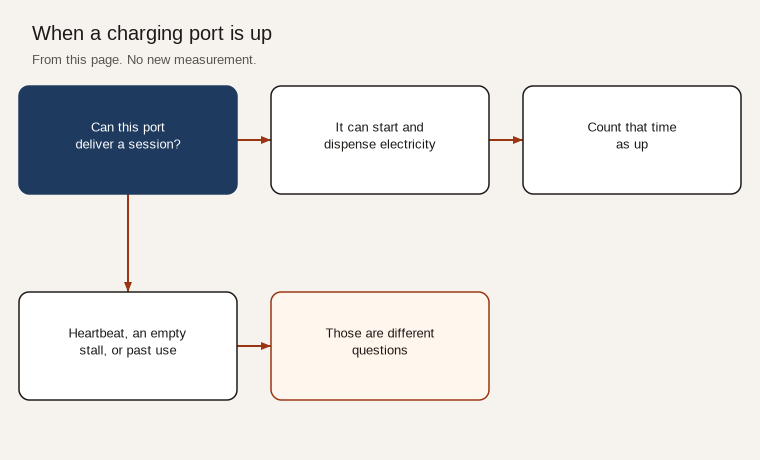
Count a port as up only while it can start and deliver a session, and keep a network heartbeat, an empty stall, and past use on separate questions.
| Question | What it answers | What it does not show |
|---|---|---|
| Uptime | The port can start and deliver a session | Whether a working port is free now |
| Network status | The link answers | That electricity was dispensed |
| Utilization | How often the port was used | That attempts delivered electricity |
| Payment failure | A reader, app, or account blocked the start | A named utility-service exclusion |
| Site power | Utility supply was lost, or a customer-side fault | Which outage happened |
A port is up when it can deliver a session
A charging port is the part of a charger that charges one vehicle at a time. Federal definitions allow a port to carry more than one connector and still count as one port when only one vehicle can take power through one connector at a time. A charger holds the ports. A station is the area around a group of chargers, including parking and the way in and out. A station average can hide one dead port behind several healthy ones.
Uptime here is the share of the measured period in which that port can start and deliver a session. A port already charging a vehicle is up. A free port that can charge the next vehicle is up. A port that answers a network poll and then refuses every session is not.
Nearby figures answer different questions. Availability, in the parking sense, asks whether a working port is free now, so a busy healthy port can show high uptime and low availability. Utilization asks how often the port was used. Session success asks whether attempts actually delivered electricity. A green status icon can still fail the next driver. The contract has to say which question the percentage answers.
Separate charger faults from network, payment, and site power
A missed session has a cause. The cause decides who can fix it and whether a formal score counts the minutes. One label, “the charger is down,” makes the percentage impossible to manage.
A charger fault is inside the port: a failed power module, a breaker in the dispenser, a damaged connector, a dead screen, or software that will not hold the session. A network outage is a lost link to the system that authorizes, controls, or reports the charger. Some chargers will not start without that link. Others can finish a session while it is down. Online proves the link, not the power path. A payment failure is a card reader, app, or account check that blocks a driver at a port that might otherwise charge. Free workplace charging may have no payment step. The log should say whether the fault is the reader, the network, or the account.
Site power splits. An electric utility service interruption is the utility’s supply to the property. A customer-side outage is a tripped building breaker, an overloaded panel, a failed site conductor, or a charger that does not recover when utility power returns. A dark lot does not identify which one happened. A vehicle fault is the car refusing a session the port was ready to deliver.
Classifying a real event takes the session log, the utility record, and a qualified person. The exclusion list below is a scoring filter, not a repair sheet.
What the federal rule requires, and what it leaves out
As of November 2026, the Electronic Code of Federal Regulations display of Title 23, current as of November 19, 2026, and last amended on September 23, 2026, still contains 23 CFR Part 680. The eCFR is the continuously updated online code. It is authoritative but not the annual printed edition. The sentences below are what that display showed.
23 CFR 680.102 applies the part, except where noted, to National Electric Vehicle Infrastructure Formula Program projects and to construction of publicly accessible chargers funded under Title 23 of the United States Code, including a federally funded charging project treated as a project on a Federal-aid highway. That is a funding test, not a duty on every charger in the country.
23 CFR 680.104 defines a charging port as the system within a charger that charges one EV. A port may have multiple connectors, but it can power only one EV through one connector at a time. 23 CFR 680.116(b) tells states or other direct recipients to ensure each charging port has average annual uptime greater than 97 percent, calculated monthly for the previous twelve months. A port is up when its hardware and software are both online and available for use, or in use, and it successfully dispenses electricity at the minimum power in section 680.106(d).
The formula uses a 525,600-minute year. Uptime is that year, minus outage minutes left after excluded minutes are removed, divided by 525,600, then multiplied by 100. Excluded minutes are outages outside the operator’s control, and only if the operator can demonstrate the port would otherwise have been operational. The named reasons are electric utility service interruptions, failure to charge or to meet the customer’s power expectation because of a vehicle fault, scheduled maintenance, vandalism, and natural disasters. Hours outside the station’s identified operating hours are also excluded.
As of this check, the rule does not do several things a quote may imply. It scores each port, so neighboring ports do not repair one result. The formula year is 365 days, with no leap-year adjustment stated, and a result sitting on 97 percent is not greater than 97 percent. The subsection states no cap on consecutive hours down and no minute cap on excluded maintenance. Payment failure, network loss, and a customer-side electrical fault are not named exclusions. Section 680.102 does not put the percentage on a privately funded home charger or on a workplace or fleet that is not a covered project. The rule also does not issue a permit or approve utility service.
The up test also points at power. 23 CFR 680.106(d) sets minima for covered installations only. Corridor direct-current fast chargers serving designated Alternative Fuel Corridors need at least 150 kilowatts continuous and must meet an EV’s request up to that level from each port at once. Power sharing is allowed only while the request is still met. Each covered AC Level 2 port needs a continuous rating of at least 6 kilowatts, supplied per port at the same time. Shared power may go lower only if the customer consents. A covered port that cannot meet the applicable minimum is not up. Whether load management on a real site drops below that line is for a qualified engineer and the funding terms.
23 CFR 680.114(e) requires covered chargers to stay functional if network communication is temporarily disrupted, still starting and finishing sessions at the minimum power. On that equipment, a short network dropout is not supposed to equal a down port. A charger that refuses every session when the link drops is a different design. The clause does not exclude payment problems, and it does not mean every private charger works offline.
Open hours are a different duty. 23 CFR 680.106(e) says corridor stations built for designated Alternative Fuel Corridors must be reachable by the public 24 hours per day, 7 days per week, year-round, while other covered stations follow the host’s business hours. A station can be open and still have a port that cannot charge. 23 CFR 680.112 has states or other direct recipients report quarterly port uptime, outage and excluded minutes, outage length, error codes, energy, peak power, and payment method, with public release aggregated. Section 680.106(i) requires covered chargers to stay in compliance for not less than five years from first operation. Neither duty falls on every private owner, and neither is proof that a given operator has cleared the line.
A state rule can count the same outage differently
The California Energy Commission’s performance-standards summary, read on November 22, 2026, describes a separate standard for certain publicly funded direct-current fast chargers, calculated per port, with exceptions for Level 2 and fleet chargers. On that page, excluded downtime includes vandalism up to 10 days per incident, grid power loss, natural disasters, and planned maintenance up to 72 hours per year. A companion standards page uses slightly different date and funding wording. Both say they summarize the regulation, which was not the text read here. Maryland, Virginia, and the District of Columbia are not under that summary. The comparison still matters: the California page caps excluded maintenance and vandalism, and the federal subsection above does not. A private Level 2 workplace can sit outside both and still need its own definition if a quote uses a percentage.
A one-time test is not a year of uptime
A 2022 study by David Rempel and coauthors, posted as an arXiv preprint, tested open public direct-current fast chargers with Combined Charging System connectors in the San Francisco Bay Area. A connector was functional if it charged for two minutes or was already charging. Of 657 connectors at 181 stations, 72.5 percent were functional. Cables were too short on 4.9 percent. Another 22.7 percent failed from screens, payment, charge initiation, the network, or broken connectors. The authors said this conflicted with provider statements of 95 to 98 percent uptime. It was one visit on one connector family, not the federal twelve-month formula, and it is not a Soleil Energy result.
An August 2024 National Renewable Energy Laboratory report calls uptime the primary metric and then notes the gaps. It says a down payment system may never enter an operator’s uptime math even though the driver leaves with no energy. That describes a reporting gap. It does not change the regulatory test, which still requires the port to be available for use, or in use, and to dispense electricity.
The same report cites an Alternative Fuels Data Center snapshot for October 18, 2023: 6.7 percent of 62,713 public station locations were marked temporarily unavailable, at station level on one day, not as a port-year score. The trend page describes how port counts grow. The page read here does not say whether those ports could finish a session.
Put the metric in the project scope
The Department of Energy’s maintenance discussion says an agreement should state a response time, a repair time, and an uptime requirement, and should assign cost among the site host, the network, and the installer. Its procurement discussion separates networked equipment, which can report use, from non-networked equipment, which charges without that monitoring. A meter can show energy flowed. It cannot explain a refused card.
Count the port, and log when it could not deliver a session rather than only when a heartbeat arrived. Match each outage to the contract’s exclusions, and support a utility-interruption claim with evidence the port would otherwise have worked. Try behavior with the network link down at commissioning. If drivers pay, payment is in scope. If charging is free, say so. Extra ports can shorten a queue. They do not fix a dead port. A house rarely needs that record. The home Level 2 guide is about the circuit and the charger. How many vehicles park, how long they stay, and what the service can carry still come first, which is the planning in Soleil’s commercial charging guide.
IEEE 1547-2018 does not define this percentage. Its public catalog, which is not the clause text, describes interconnection of distributed energy resources that operate as a 60 hertz source. A charger that only draws power is a load. Equipment that exports raises a separate interconnection question for the utility and a qualified engineer.
An illustrative year shows why the label matters
This arithmetic uses the federal 525,600-minute year. It is illustrative. It is not a measured site, not a Soleil Energy result, and not a forecast.
A port logs 20,000 outage minutes. Of those, 8,000 are documented utility interruptions, and the operator can show the port would otherwise have worked. Counted minutes are 12,000. Uptime is 513,600 divided by 525,600, or 97.7 percent, which is above the line. Call those same 8,000 minutes a failed power module. They stay in the count. Uptime is 505,600 divided by 525,600, or 96.2 percent, which is not. The log did not change. The label did.
Three percent of 525,600 is 15,768 minutes. Removing exactly that many counted minutes leaves 97 percent, and the rule requires greater than 97 percent. A year-end pass can still miss the morning a fleet needed the port. Timestamps answer that question. The annual percentage does not.
Questions that change the scope
Does a strong annual figure mean a driver can charge now?
No. The score looks back twelve months after exclusions. The port can be above the line for the year and down this afternoon, or up and busy so the next driver waits. Ask for the live port state and recent sessions.
Does the federal percentage apply to a house or a private workplace?
Only if section 680.102 covers the project. A privately funded home charger is outside it. So is a workplace or depot that is not a covered formula-program project or another publicly accessible charger using the Title 23 funds named there. A private contract can still set a percentage, but it should write the exclusions itself.
If the power goes out, whose outage is it?
A utility service interruption can be excluded when the operator shows the port would otherwise have worked. A tripped customer-side breaker is not a named exclusion. Record whether utility supply was lost and whether the charger recovered. The regulation does not name the proof document. The contract should.
Is a charger that rejects payment still up?
Payment failure is not an excluded cause. If the failed reader or app is the only way to start a paid session, the port is not available for that use. A free charger with no payment step is a different case. Some operator math leaves that gap uncounted.
What does an uptime target change about scope or approval?
It adds detection, classification, and restoration: someone must notice the missed sessions, keep the reason, and send the right party. That work does not approve a permit or a utility interconnection, and it does not replace service capacity. On a covered federal project the state or other direct recipient has to see that the port standard is met. On a private project the percentage exists only if the contract creates it.
Talk through count, capacity, and load management
A percentage on a quote is not a maintenance plan. Name how many ports the site needs, what the service can supply, and whether load management would cut power below a level drivers or a funding rule expect. Soleil Energy plans and installs home and commercial charging in Maryland, Northern Virginia, and Washington, DC, including the electrical work ahead of the chargers. That is design and installation of the equipment and its supply, not a published uptime record and not a commitment that a port will meet a federal or state percentage. Bring the vehicle count, how long vehicles stay, and any drawings or utility letters so a charger fault, a network limit, a payment path, and a site-power constraint stay separate.
Project requirements depend on the site, equipment and applicable rules. Confirm design and installation decisions with the appropriate qualified professional.
