Adaptive reuse gives a legally existing building a new purpose instead of demolishing it. The choice is not a finish package. In Maryland, Virginia, and the District of Columbia, a new purpose can be a change of occupancy: a code question about structure, fire protection, egress, ventilation, sanitation, accessibility, and building systems. A new name on the door does not answer it. A qualified structural or code professional must assess the actual building.
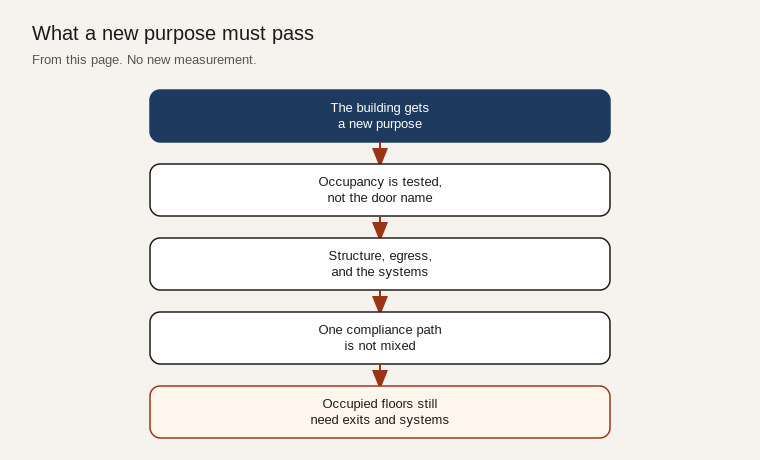
A new purpose is tested as occupancy, structure, egress, and systems, the chosen compliance path is not mixed with another, and occupied floors still need exits and systems in service.
A new purpose is tested by code, structure, and systems
Maryland does not use the model sentence alone. COMAR 09.12.58 incorporates the 2021 International Existing Building Code and replaces the model definition with Public Safety Article §12-1001(c): a change in purpose or level of activity that involves a change in application of the local building code. Painting and reconfiguration are excluded from “renovation,” so neither one, by itself, decides whether the new activity changes which requirements apply. An existing building was erected and occupied, or received a certificate of occupancy, at least one year before the rehabilitation application.
Virginia uses a greater-degree test. In the 2021 Virginia Existing Building Code, a change of occupancy is a change in classification, or a change in purpose or level of activity, only where the current Virginia Construction Code requires a greater degree of structural strength, fire protection, means of egress, ventilation, or sanitation than exists. Accessibility is absent from that list. It remains a separate duty under the provisions Arlington County lists with the 2021 code, and under the ADA where it applies. An existing building has a legal certificate for the intended occupancy, or construction that predates the first statewide code.
The District is on an earlier book. The 2017 DC Construction Codes, effective May 29, 2020, use the 2015 International Codes as amended in Title 12 DCMR. The Existing Building Code Supplement is the 2015 International Existing Building Code as amended by 12-J, and the model text is not reprinted. As of November 2026, a 2021 or 2024 definition is not the District’s. Read 12-J with the 2015 text before importing a Maryland or Virginia section number.
The same occupancy letter can still change the work. The user note to Chapter 10, as presented for Maryland, says one assembly classification covers a bowling alley and a dance hall. “Creative office” on a lease is not a classification.
The three jurisdictions are not on one edition
As of November 2026 the editions below are separate instruments. The table is not a permit determination.
| Place | Instrument | Status as of November 2026 | Do not assume |
|---|---|---|---|
| Maryland | 2021 International Existing Building Code, adopted as the Maryland Building Rehabilitation Code | Effective May 29, 2023, under COMAR 09.12.58. Local officials enforce it and may amend it. | Identical Chapter 1 procedures in every county. |
| Virginia | 2021 Virginia Existing Building Code | DHCD gives an effective date of January 18, 2024. Arlington lists that edition. Its one-year choice of the prior edition ended January 17, 2025. | That the separate 2024 development cycle is today’s code. Ask the local official. |
| District of Columbia | 2015 International Existing Building Code, amended by 12-J DCMR | In force with the 2017 codes since May 29, 2020. DOB estimates successor publication in late 2027. | That the successor, or a Maryland section number, is current. |
The Department of Labor reported that a June 26, 2026 proposal to adopt the 2024 International Building, Residential, and Energy Conservation Codes was withdrawn on October 16, 2026. That notice leaves the 2021 existing-building incorporation in place. The Maryland Building Performance Standards still set the state’s building, residential, and energy editions, and local energy and accessibility amendments may only be stricter.
What the change can require
The questions below come from the adopted text. This page sets no egress distance, live load, or energy-code number.
Structure follows the new demand
In the Maryland presentation of the 2021 work-area chapter, elements that carry tributary live load from a change of occupancy must meet the building code’s live-load section for the new occupancy. Other areas may keep a previously approved live load. A higher risk category brings snow, wind, and seismic checks. Narrow exceptions exist in that text and are not restated here. A qualified structural engineer needs the original information if it exists, the proposed use, and the assigned risk category. Virginia places this topic in Chapter 7, not in Maryland’s Chapter 10. The District starts from the 2015 text plus 12-J.
Egress and fire protection follow the new hazard
The Maryland work-area text and Virginia’s Chapter 7 both sort occupancies by relative egress hazard. A move toward a higher hazard generally pushes the means of egress serving the change toward new-construction requirements, with exceptions only the code official can accept. An equal or lower hazard still has to provide capacity for the new occupant load. Virginia also uses separate tables for height, area, and exterior-wall exposure. Those tables, and any numeric egress exception, stay in the adopted book.
Sprinkler scope differs by book. In the Maryland work-area text, when the new occupancy requires sprinklers, the system covers the changed area and areas not separated from it by the assemblies that section lists. Virginia’s Chapter 7 requires the system throughout the area of the change when the Virginia Construction Code requires it for the new occupancy. Alarms can extend past the renovated room. Some special occupancies pull in the building code’s special-use chapter.
Systems are part of the occupancy
The new use often shows that the systems were sized for the old one. In the Maryland work-area text, different kitchen exhaust or increased mechanical ventilation must meet the mechanical code, and light and ventilation follow the building code for the new occupancy. Fixture counts and water supply follow the plumbing code when demand changes.
Unsafe electrical conditions are corrected without replacing every existing conductor. Assembly, health-care, and other special occupancies can require the affected wiring to meet the adopted electrical code. The Maryland text also requires service and outlet counts to meet that code for the new occupancy. Virginia’s Chapter 7 has its own electrical section. Maryland can also require carbon monoxide detection for new Group E classrooms, with stated exceptions, and smoke alarms for residential and some residential-care occupancies.
Accessibility includes the path, not only the new room
Federal accessibility and the building code are separate approvals. For state and local government facilities, the 2010 ADA Standards require an alteration affecting a primary-function area to make the path of travel accessible, to the maximum extent feasible, including the restrooms, telephones, and drinking fountains serving it, unless the cost and scope are disproportionate. That Title II rule treats path-of-travel cost above 20 percent of the alteration cost to the primary function area as disproportionate. The spending order starts with an accessible entrance, then the route, then a restroom. Offices are primary-function areas. Mechanical rooms, corridors, and ordinary restrooms generally are not. Costs on that path over three years are counted together. Elements already meeting the 1991 Standards or the Uniform Federal Accessibility Standards before March 15, 2012, are not rebuilt solely because a later project touches a primary function. Private public accommodations use the Title III text in the same publication.
Maryland replaces the model accessibility section with COMAR 09.12.53. Arlington pairs the 2021 Virginia code with ICC A117.1. “Technically infeasible” is a documented conclusion about structural-frame or site constraints. Cost alone does not establish it.
One compliance path, then stay with it
The Maryland presentation of Chapter 3 lets the applicant choose one method: prescriptive, work area, or performance. The methods are not combined. Where another code conflicts, the existing-building code takes precedence, and the work must still meet the change-of-occupancy provisions of the energy, mechanical, plumbing, and electrical codes.
Virginia does not use that three-method menu. Chapter 7 applies the Virginia Construction Code only as that chapter prescribes, and it does not require every current provision in the whole building. A compliance alternative exists for some changes and excludes institutional, high-hazard, and Residential Group R-5. The District’s amended 2015 code has its own structure, and the code official confirms which path applies.
Occupied work is a systems and egress problem
A school wing or a storage floor may change while the rest of the building stays open. A partial change does not upgrade every floor, and it does not stop at the new suite. Shared stairs, alarms, power, and ventilation can pull occupied space into the work. If that work disables a system the occupied area still needs, the interim measure has to be one the fire and building officials accept. The early drawing should show what changes, what stays, which exits each phase uses, and which systems cannot go offline.
The following example is illustrative. It is not a Soleil Energy project, and it is not a determination for any address. A landlord converts part of a storage floor to offices and one training room. The rest of that floor and the floors above stay occupied. The open questions are the training room’s classification, the floor’s approved capacity, egress on a stair that still serves storage, ventilation and electrical demand, the path of travel, and legal exits while fire protection is disturbed. Montgomery County, Arlington, and the District can each require a different permit set.
Historic status and energy rules are separate books
Age is not historic status. The existing-building definitions generally require listing, eligibility, a state or local designation, or contributing status in a designated district. A historic chapter may modify some requirements when the code official accepts the modification. It does not erase fire, egress, or structural duties.
Where federal preservation rules also apply, the National Park Service Standards for Rehabilitation are the criteria for the historic preservation tax incentives program, and local commissions often use the same criteria. Standard 1 calls for the historic purpose or a new use that requires minimal change to defining characteristics of the building and its site. The Standards do not replace the building code. Any incentive is a separate question for the State Historic Preservation Office and a qualified tax professional. A preservation architect does not replace the structural engineer.
Energy editions differ as well. Arlington’s table lists the 2021 Virginia Energy Conservation Code for commercial buildings. The District’s construction-codes page still identifies the 2017 energy code, based on ANSI/ASHRAE/IES 90.1-2013 with District amendments, and warns that the integrated pamphlets omit amendments adopted after May 29, 2020. Maryland energy provisions sit in the Building Performance Standards already cited. A rooftop energy project does not close an open change of occupancy.
What to bring before the permit conversation
When a Maryland permit is required, COMAR 09.12.58 calls for a preliminary meeting before the application if a complex multi-code project is an addition, a change of occupancy, or a reconstruction, and also when the work includes sprinklers. Building, mechanical, plumbing, electrical, fire, boiler, energy, elevator, and local historic-preservation officials attend as applicable. Decisions are binding unless a circumstance was unknown and could not reasonably have been found then. A meeting for repair, renovation, or modification is discretionary. Virginia and the District did not copy this Maryland meeting rule.
| Bring | What it decides |
|---|---|
| Certificate of occupancy and the approved use | The legal starting point, which may differ from current informal use |
| Proposed activity, hours, and occupant-load basis | Whether purpose or activity level changes the applicable code |
| Structural drawings, or a statement that they are missing | Whether a live-load and risk-category comparison can start |
| Egress and fire-protection plans for shared stairs and alarms | Whether the change stops at the suite |
| Mechanical, plumbing, and electrical riser information | Whether the new use increases demand on existing systems |
| Historic designation, if any, and a phase diagram | Commission review, and which exits and systems stay available |
Ask which definition applies and which sections govern structure and egress. If the original drawings are missing, say so in that meeting.
Questions owners ask before they commit
Does every reuse trigger a change of occupancy?
No. Continued legal occupancy and ordinary repair can proceed without one. Inside the same group, a change of use can still change the requirements that apply. A training room added to an office lease is that kind of question, and in the District the text to read is the 2015 code with 12-J.
Why can one sketch be reviewed differently a few miles away?
Chapter numbers and editions differ, so a Maryland 2021 work-area citation does not locate the rule in Virginia Chapter 7 or in 12-J. Arlington’s table speaks to Arlington. Near a boundary, confirm which office has jurisdiction.
What changes in the approval itself?
It can add its own certificate of occupancy and work a finish budget never listed: structure, exits, protection beyond the suite, ventilation, fixtures, electrical distribution, or the path of travel. In Maryland’s work-area text, that change waits on the code official. An allowance for unknown structure is not proof the building can accept every use.
Can people stay in the building?
Often, when the portion that stays open keeps a legal occupancy, usable exits, and life-safety systems in service or under an approved interim measure. Shared stairs can pull the work past the suite. Phasing notes are not a temporary certificate of occupancy.
Does an older or historic building get a lighter safety review?
Age does not create historic status, and historic status does not waive fire, egress, or structure. A historic chapter can modify items the code official accepts. The Secretary’s Standards, when they apply, still constrain historic material, and the engineer can still find that the proposed use does not fit.
Who decides that the structure is adequate?
The structural engineer compares the building with the adopted requirements for the proposed use and risk category. The code official accepts or rejects that submission. Missing drawings can mean investigation or a load test under the applicable code. Feeling the floor is not that evaluation.
Start with occupancy, structure, and the systems that must stay on
Name the approved use and the proposed use under the definition that jurisdiction adopted, then test structure, egress, fire protection, ventilation, plumbing, electrical service, and the path of travel on one compliance method. If people remain, the phases have to keep legal exits and the systems those people still need.
Soleil Energy takes on renovations, design-build work, and phased school and government projects that stay in use. Its service-area page names Maryland, Northern Virginia, and Washington, DC, including Prince George’s, Montgomery, Howard, and Arlington, and states that the company serves the District without a District office. That conversation can sort current occupancy, intended activity, and what must stay open. It does not replace the structural engineer or the code official.
Project requirements depend on the site, equipment and applicable rules. Confirm design and installation decisions with the appropriate qualified professional.