A building automation system is the networked arrangement of sensors, controllers, and a supervisory interface that lets operators supervise connected building equipment, most often heating, ventilation, and air-conditioning. It can also exchange status with lighting or other systems when those systems are actually tied in. It does not replace life-safety control, the utility revenue meter, or a protective relay. A qualified professional must assess the actual building before that boundary is applied to a project.
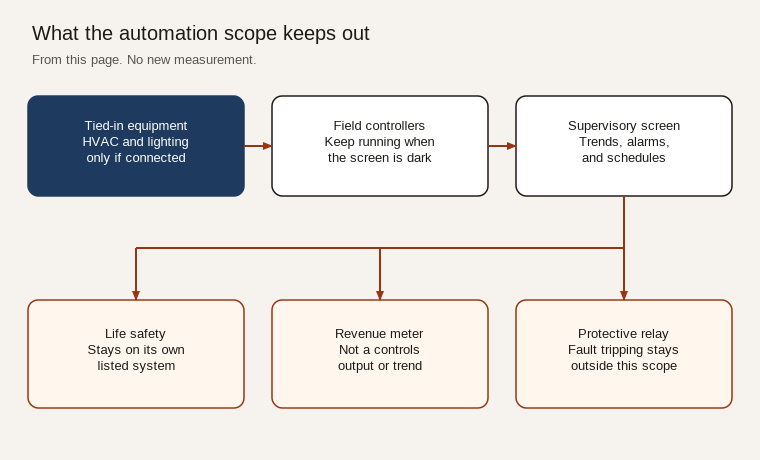
Name the equipment actually tied in, keep field controllers able to run when the supervisory screen is dark, and leave life safety, the utility revenue meter, and a protective relay outside that scope.
What operators can supervise
In a school or office, the system keeps ordinary equipment visible and coordinated. Connected information often includes temperature, humidity, valve or damper position, fan and pump status, and lighting status when the design includes it. Alarms, trends, and service overrides exist only where the points list includes them.
The Department of Energy’s building-controls overview, last updated 8 August 2024, describes building controls as integrated management of heating and cooling, hot water, conveyance, lighting, and other electrical and fuel-fired equipment. Older buildings often still mix pneumatic devices, packaged thermostats, and digital controllers. Calling all of that “the system” hides which devices are actually connected.
The Department of Energy states that high-performance control strategies can deliver, on average, 30% annual HVAC energy savings for a range of commercial building types, with similar reductions in peak HVAC demand. That figure is not a forecast for one building. This page does not publish those strategies or any operating values.
Controllers run the equipment; the screen supervises
Sensors report conditions. Controllers command the valves, dampers, drives, and ordinary starters the project assigns to them. The supervisory computer is where people view graphics, read trends, acknowledge alarms, and change schedules. If that computer is dark, or the path to it fails, the controllers should still run the equipment they were built to run.
A federal guide specification writes that split down, and it is not a private-building code. UFGS 23 09 00, Instrumentation and Control for HVAC (August 2024, Change 1 in August 2025; references aligned with the master list dated October 2026), tells military-project editors to provide direct digital control for the HVAC and other building-level systems the project indicates. The supervisory front end is specified elsewhere, and control logic must reside in the building controllers so it does not depend on a remote front end. Some same-manufacturer plant networks may stay proprietary if a gateway still presents the required points.
A private school or a leased office does not inherit that specification. Ask which functions continue when the supervisory computer or the building network is down, and who keeps the license, the programming tool, and the configuration file. This page does not provide control logic or operating values.
BAS, BMS, and building controls are labels
Building automation system, building management system, energy management control system, and direct digital control are often used as if they were one product. NIST Special Publication 800-82, Revision 3 (September 2023), section 2.3.5, calls a building automation system a form of operational technology and lists heating and cooling, fire, electrical systems, lighting, physical access control, physical security, and other utility systems among examples.
That list is not a contract. The points list and the exclusions are. A proposal that says “full building management system,” without naming included equipment and the fire-alarm, meter, and electrical items left out, cannot be compared with another price. Lighting, elevators, and access control may keep separate vendors. Connecting them is extra scope.
Life safety is not a graphics screen
Fire detection, occupant notification, and the emergency commands the adopted fire code requires belong to a fire alarm system or another listed life-safety system. An ordinary heating-and-cooling supervisory computer should not be the thing trusted to originate them.
FacilitiesNet’s 7 May 2024 article, by Wayne D. Moore and Larry D. Rietz, both of whom describe service on NFPA 72 committees, says the code becomes law where the adopted building code references it, so the edition is local. On the 2022 edition, it says section 21.7 is the basic method by which a fire alarm system interfaces with heating, ventilating, and air-conditioning, and that those connections must operate and be monitored under applicable NFPA standards. NFPA 90A is the example it gives for air-conditioning and ventilating systems. It notes that the fire alarm system often provides duct smoke detection and shuts the air handler down if smoke is present, and that smoke control follows NFPA 92 rather than a comfort-control specification.
That is an interface, not a merger. NIST’s broad list can include fire where a status crosses between systems, while section 2.3.7 treats safety functions as separate and, in the industrial cases it describes, often independent of ordinary control. Do not leave a required life-safety action dependent on a supervisory computer or a remote login.
As of November 2026, confirm the adopted building code, the fire-alarm code edition, and the authority having jurisdiction. This page states no shutdown procedure, device location, or operating value. A qualified fire-protection professional must assess the actual building.
The utility meter is not a controls output
Billing measurement sits at the service boundary. The Department of Energy’s Federal Metering Guidance (October 2022) defines the service entrance as the demarcation between the utility’s service equipment and the customer’s property. For electricity, it says that point is typically the utility’s meter, ahead of the customer’s main breaker. The automation system does not own, calibrate, or replace that meter. The controls scope should say that nobody on that contract opens it. Who may work on the meter is a tariff question, and it differs among utilities in Maryland, Northern Virginia, and the District.
The same guidance defines an energy management information system as a family that includes bill tracking, diagnostics, and building automation systems. The automation system can supply operating data. A controller trend is still not the revenue record. Customer submeters, if added, are a separate line and are not the utility billing meter.
ENERGY STAR Portfolio Manager compares a building with similar buildings, with its own past use, or with a reference, using utility bills. Where a 1-100 ENERGY STAR score exists, a score of 50 is median performance after normalization for weather and operation. Fan trends do not fill that record. For billed demand, start with the tariff and the utility interval data. Soleil Energy’s guide to how commercial demand charges are measured is about that bill question for solar and storage, not about specifying controllers.
A protection relay is a different device
Fault protection is another discipline. A tutorial hosted by the IEEE Houston section describes it as detecting a fault, disconnecting the faulted element, and indicating what happened. Relays monitor, detect, report, and trigger. Breakers interrupt and isolate. The slides identify IEEE device 52 as the circuit breaker. A later portion of the file carries a 2016 copyright notice for the manufacturer that prepared the teaching material. Read it as a section tutorial, not as an IEEE standard and not as settings.
A building automation output might start a fan or enable a normal lighting circuit. It is not the device that recognizes a short circuit and trips a breaker. Do not make the automation network the path that initiates fault tripping, and do not fold relays into a controls proposal. A separate protection scope, if a qualified electrical engineer writes one, is still not building automation. This page states no pickup, delay, or trip arrangement. A qualified electrical professional must assess the actual equipment.
A shared protocol does not assign the work
BACnet, as the ASHRAE committee that maintains it describes the protocol, is the data-communications standard for building automation and control networks. The committee identifies it as ANSI/ASHRAE Standard 135, first published in 1995, and as ISO 16484-5. It defines messages so equipment from different makers can exchange data, commands, and status. The description includes heating and cooling, lighting, access control, elevators, security, and fire detection.
A protocol that can carry fire-detection data is not a listed fire alarm system. Name the devices, the points that cross each interface, and who programs each side. “BACnet included,” with no points list, does not define the job. Technology staff may own the switches, and the controls contractor may own the controllers. Keeping that network off ordinary business computers is coordination, not a side effect of the protocol.
The Computer Security Resource Center’s page for Revision 3, checked 22 November 2026, dates that final guide to September 2023 and notes a draft of Revision 4, with comments due 30 November 2026. Revision 3 is the completed text read here. It says to assess the actual operational technology rather than copy a universal configuration. Citing it does not mean Soleil Energy holds a cybersecurity authorization or meets a named security framework. This page lists no hardening steps.
Commissioning controls is not an enclosure test
Automation work on a renovation shares ceilings, electrical rooms, and the hours the building stays open. It is easy to confuse with envelope testing. UFGS 01 91 19, Building Enclosure Commissioning (May 2023; references aligned with the October 2026 master list), covers the air barrier, fenestration, opaque roofs and walls, and enclosure pressure tests. It does not test controllers.
UFGS 01 91 00.15, Building Commissioning (May 2023, Change 3 in August 2024; the same reference alignment), calls commissioning a quality-focused process for enhancing project delivery and cites ASHRAE 202 (2018) for the fuller description. Editors may include heating and cooling and associated controls, lighting controls, building control systems, utility monitoring, and metering, and the section points enclosure work elsewhere. Those guides apply to Army, Navy, and Air Force contracts. They are not the energy code in Maryland, Virginia, or the District. A functional test covers only the systems someone actually commissioned.
For any other owner, name who produces the control logic, who witnesses the demonstration, what a pass means, and which occupied areas must keep heating, cooling, and life-safety service during the work. As of November 2026, confirm the adopted code edition with the building official and the design professional. This page states no code threshold.
What a proposal should show
Use these questions to compare offers. They expose scope. They are not a design and they are not operating values.
| Topic | What to require in writing |
|---|---|
| Connected equipment | Which air handlers, terminal units, plants, and lighting panels are included, and which stay on packaged controls? |
| Supervisory interface | Which functions continue if that computer or its network is down? |
| Life safety | Which contractor owns the fire-alarm interface, and is the automation system barred from initiating life-safety functions? |
| Revenue meter | Is the utility meter excluded, and are any customer submeters a separate line? |
| Protection | Are protective relays and breaker trip circuits excluded? |
| Occupied use | Which floors stay in service, and which work hours does the price assume? |
| Closeout | Where are the points list, drawings, alarm routing, license, and configuration files, and who may use them later? |
State the occupied calendar every proposal must follow, including nights, weekends, or a school year. Do not treat a vendor default as that calendar. Also say where alarms are delivered. A screen in a locked room does not help if someone else is expected to respond.
An illustrative floor renovation
This illustrative example is not a Soleil Energy project. A landlord renovates one office floor while the floors above and below stay occupied. The existing supervisory computer already shows whole-building air-handler status. The floor work replaces terminal-unit controllers and adds lighting panels for that suite only. The fire-alarm contractor keeps detection, notification, and any required air-handler interface. The utility meter stays sealed and is excluded. Feeder protection stays with the electrical engineer and is not edited from the automation screen. Technology staff decide where the supervisory computer may sit. Acceptance asks whether the new controllers still run when that computer is offline, and whether any life-safety device depends on it. Those are boundaries, not a test script.
An occupied school wing adds a harder constraint: nearby classrooms may stay in session. Phasing, the systems that must stay available, and the doors crews may use all change the price. Write them down before comparing offers.
Common questions
Does a new system replace every controller?
Not by default. Keep a controller when it is documented, when software and parts can still be supported, and when it can present the points the project needs. Replace it when it cannot support the interface, when the software can no longer be maintained, or when the renovation already opens that equipment. Ask for a keep-or-replace list rather than a blanket swap.
If the protocol can carry fire data, is the automation system the fire alarm?
No. The BACnet committee lists fire detection among applications the protocol can support. A message format is not a listed fire alarm system, and it does not move initiation, notification, or the required emergency interface out of the fire-alarm scope. Confirm the adopted edition with a fire-protection professional and the authority having jurisdiction. As of November 2026, that edition is not the same in every county.
Will a new screen change the utility bill?
Not by itself. A clearer screen can make odd operation easier to notice. The Department of Energy’s statement about average heating-and-cooling reductions is about a class of strategies, not a promise for one building. Bills show purchased energy. Controller trends show equipment behavior. Neither one is the utility meter, and neither one rewrites the tariff.
What must be excluded before two prices match?
Name the utility revenue meter, protective relays and trip circuits, and life-safety initiation as excluded unless a different qualified scope says otherwise. State lighting, elevators, access control, the supervisory computer, occupied areas, and work hours. Until those lines match, two lump sums are not the same job. Software rights and configuration files are part of the purchase.
Who has to judge this building?
A qualified professional must assess the actual building. Controls, fire protection, and electrical protection are different disciplines, and an occupied renovation adds the people who manage access and phasing. This page explains boundaries. It is not a design, a code ruling, or a statement that Soleil Energy has accepted a specific system.
Start from the building that is already occupied
Soleil Energy publishes a service area naming Prince George’s, Montgomery, and Howard counties in Maryland, Arlington County in Virginia, and Washington, DC, with no office in the District. The ideas here are general to US commercial buildings. Construction coverage is that published area. For an occupied school, commercial, or institutional renovation inside it, the useful conversation is which systems must stay available, where crews can work, and which interfaces stay outside the controls contract. Soleil Energy’s construction practice can discuss that phased plan. A qualified professional must assess the actual building.
Project requirements depend on the site, equipment and applicable rules. Confirm design and installation decisions with the appropriate qualified professional.