An air-insulated vs gas-insulated substation comparison is about how high-voltage parts are insulated and enclosed, not about which label is universally preferable. Air-insulated equipment uses the surrounding air and physical separation. Gas-insulated equipment places conductors in grounded metal enclosures that use an insulating gas other than air at atmospheric pressure. The choice changes land, access, and gas stewardship. It does not set ownership, a facility rating, or an approval.
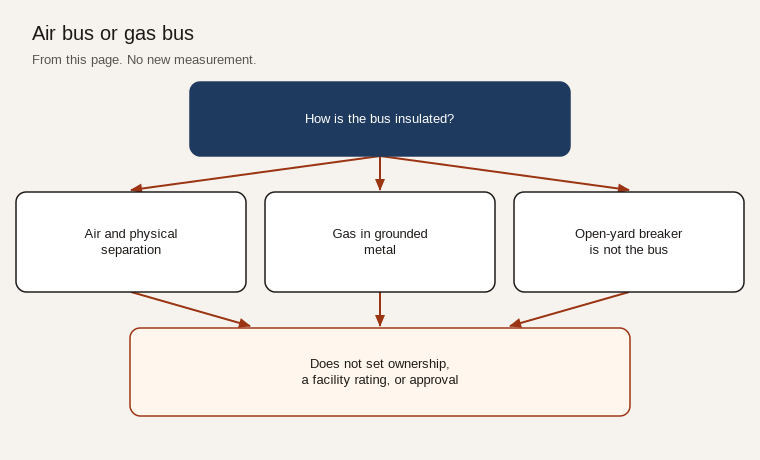
Choose air insulation when the bus relies on open-air separation, and gas insulation when conductors sit in grounded metal with an insulating gas, without treating either label as ownership, a facility rating, or an approval.
| Boundary | Air-insulated equipment | Gas-insulated equipment |
|---|---|---|
| What separates conductors | Surrounding air and physical separation | An insulating gas other than air, inside grounded metal |
| Where the bus sits | In the open air, where weather and people can reach that space | In a grounded metal enclosure |
| What a gas breaker means | An SF6 breaker in an open yard does not make the bus gas-insulated | The assembly houses insulated breakers, busbars, and monitoring equipment |
| What a later bay needs | Land and an outage window for more steel | Compartments and interfaces the maker reserved |
| What the label does not set | Ownership, a facility rating, or an approval | Ownership, a facility rating, or an approval |
The shared job of the substation
A substation switches circuits and changes voltage from one level to another, and it may change alternating current to direct current. The OSHA illustrated glossary describes stations that range from a transformer and switches to a large assembly, with functions such as voltage change, switching, measurement, and ties between utility systems. OSHA separates step-up, step-down, distribution, and underground roles, which a station can combine. The voltages come from the utility and the regional grid, not from the insulation label.
The same glossary lists bus, disconnects, breakers of more than one kind, instrument transformers, arresters, a control house, relays, steel, and power transformers as separate items. Insulation is only how the high-voltage conductors are kept apart from each other and from ground. Compare which of those parts sit in open air and which sit in a grounded metal envelope.
Air, gas, and the breaker are different boundaries
In an air-insulated yard, distance and insulators separate conductors in the open air. Weather, contamination, and people can reach that same space. This page states no clearances. A qualified professional must assess the actual site.
Gas-insulated metal-enclosed switchgear is a different product. The ANSI catalog entry for IEC 62271-203:2022 covers switchgear insulated, at least partly, by a gas or gas mixture other than air at atmospheric pressure, for alternating current above 52 kV, indoors or outdoors, up to and including 60 Hz. The summary says the 2022 edition brought alternative gases in where needed, alongside sulfur hexafluoride. The catalog note is not the purchased standard or a site design.
A lower band has its own document. IEC 62271-200:2021 with its 2024 amendment covers prefabricated metal-enclosed switchgear above 1 kV and up to and including 52 kV, indoors or outdoors, up to and including 60 Hz, and says the assembly can include air-insulated compartments, fluid-filled compartments, or both. A metal-clad row in a building is not automatically a high-voltage gas-insulated substation.
The breaker is a third line. As of November 2026, EPA’s SF6 page says utilities have used the gas since the 1950s in breakers, gas-insulated substations, and other transmission switchgear. The largest use is in high-voltage breakers, where it insulates and quenches the arc. Gas-insulated substations, on that page, hold a significant amount and house insulated breakers, busbars, and monitoring equipment. An SF6 breaker in an open yard does not make the bus gas-insulated.
EPA’s SF6-free breaker directory, dated January 13, 2025 on the page checked in November 2026, defines two tanks that often stand in air-insulated yards. A live-tank breaker interrupts in an energized bushing. A dead-tank breaker interrupts in an enclosure at ground potential. EPA does not endorse the list and says it may be incomplete. The buyer has to confirm the product with the manufacturer.
What changes on the site
An air-insulated yard spreads out because the air gap does the insulating work. The June 2024 Idaho National Laboratory report for the Department of Energy, Industry Scan of Non-SF6 Gas-Insulated Technologies, says higher voltage needs a longer gap to interrupt current in air, so open apparatus grows large. It characterizes gas-insulated equipment as roughly 1/10 the footprint of air-insulated equivalents, and it links that compactness to dense sites and to harsh climates where the station can sit in a controlled building. That 1/10 figure is the report’s June 2024 characterization. It is not a clearance or a quantity to scale onto a parcel.
The same report, citing a 2024 industry source, says that in the United States between 2 and 5% of all new substations are gas insulated. That share is not a recommendation and not Soleil Energy experience. Room for a later bay keeps an air-insulated yard in play. A parcel that cannot hold an open bus puts a gas-insulated assembly on the list only after the one-line and the outage plan are known.
An air-insulated yard usually meets lines on structures. A gas-insulated assembly meets them at bushings, cable seals, or a short gas run, which still need a replacement plan. OSHA lists the power transformer beside both air breakers and SF6 breakers, so the bus insulation does not describe the transformer’s fluid. Extra air-insulated steel is often drawable if land and an outage window exist. A gas-insulated addition has to match compartments and interfaces the maker reserved. If none were reserved, the smaller station can be harder to extend.
Crews clean exposed insulators because contamination sits on the insulation. Enclosures move many of those surfaces inside and add density or pressure alarms. This page does not describe gas handling or energized work. OSHA requires sufficient access and working space about substation equipment and points to ANSI/IEEE C2-2012, the National Electrical Safety Code edition named in that note. The paragraph does not exempt a gas-insulated building or state an air-versus-gas dimension.
Gas stewardship is its own decision
As of November 2026, EPA states that over a 100-year period sulfur hexafluoride is 23,500 times more effective at trapping infrared radiation than an equivalent amount of carbon dioxide, with an atmospheric lifetime greater than 1,000 years. The same page attributes about 67% of U.S. SF6 emissions in 2022 to electrical transmission and distribution in the national inventory. EPA says the gas can leak during manufacture, installation, maintenance, and retirement, and that many newer breakers hold less of it than older ones.
An air-insulated bus can still sit beside gas breakers, while a gas-insulated station puts inventory in the bus as well. The record that matters is which compartments contain a fluorinated gas.
Reporting follows the operator, not the sign on the fence. The eCFR text of 40 CFR Part 98 Subpart DD, current as of November 19, 2026, covers transmission and distribution equipment and servicing inventory that contain fluorinated greenhouse gases, including sulfur hexafluoride and perfluorocarbons. The list includes gas-insulated substations, breakers, switchgear, gas-insulated lines, containers, gas carts, and electric power transformers. Covered facilities use a mass-balance calculation. Applicability refers to a 25,000 metric ton carbon-dioxide-equivalent threshold and to a separate test for facilities that are not electric power systems. This page does not apply either test. Counsel has to read the current part against the real nameplate inventory.
Doing without SF6 is real in some ratings and incomplete in others. As of November 2026, EPA’s mitigation page, updated February 26, 2026, says alternatives emerged over the last 10 to 15 years, with more progress below the highest voltages. It names vacuum interrupters and alternative fluorinated gases and mixtures with lower global warming potential than SF6. The directory shows SF6-free breakers above 34.5 kV offered in the United States, split between alternative fluorinated gas and vacuum gear that uses dry air, a nitrogen-oxygen mixture. A column notes PFAS-family insulating technology. That note is not an approval.
The June 2024 laboratory report, older than that directory update, says no technology then matched SF6 on function, cost, and environmental effect at once. It describes clean air or dry air with vacuum interruption, and fluoronitrile mixtures. Clean air, it says, is a weaker dielectric than SF6 at the same pressure and a poor arc-quenching medium, which is why a vacuum interrupter is paired with it.
This glossary does not teach filling or recovery.
Ratings and approvals do not follow the acronym
A short bus is not a higher rating. NERC Reliability Standard FAC-008-5 requires Facility Ratings used to plan and operate the Bulk Electric System to rest on sound technical principles. On the pages read here it applies to the Transmission Owner and the Generator Owner. The rating shall not exceed the most limiting Equipment Rating in the Facility, and the methodology must show how ambient conditions were considered. A gas-insulated bus does not lift a more limiting transformer, line, or relay, and an indoor room does not share an outdoor ambient assumption unless the methodology says so. The standard picks neither layout and does not cover every private site.
Interconnection study is separate. FERC’s Order No. 2023 explainer notes that Order No. 2023-A, issued March 21, 2024, revised or clarified parts of the rule, and that the explainer is not the legal text. Providers move toward cluster studies, with site-control showings, through their own filings. A compact building can help gear fit land the customer controls. It does not replace the study or the network upgrades. As of November 2026, the queue still follows that provider’s accepted process. Distribution solar review is narrower: Soleil Energy’s commercial solar interconnection guide covers Maryland-focused commercial solar utility review and does not select high-voltage switchgear.
Construction and operation are different OSHA problems. Section 1910.269, including paragraph (u) in the substation operations text, covers operation and maintenance of generation, transmission, and distribution installations, including equivalent industrial sites. The application language excludes construction work except where it states an exception. Draw-out breakers, fence work, and room guarding are subjects of that text, not steps to copy.
A mixed layout is a named mix, not a formula
A dead-tank breaker can stand under an air-insulated bus, and a short gas section can join a transformer to gear that is otherwise open. The IEC 62271-200 catalog scope allows metal-enclosed gear up to and including 52 kV to mix air-insulated and fluid-filled compartments. The IEC 62271-203 catalog scope is the metal-enclosed gas-insulated product above that line. Hybrid, here, means the purchaser chose that mix. Nothing read for this page makes it one standard product or a fixed land reduction.
The one-line still has to name what is air, gas, cable, or another fluid. Missed joints are where future bays disappear. Subpart DD follows equipment and servicing inventory, so a mostly air-insulated station can still include breakers and cylinders when the threshold rules apply. As of November 2026, a station sold without SF6 may use another fluorinated gas or vacuum interruption in dry air. Those are different products.
An illustrative pair of parcels
An illustrative owner has two parcels for one delivery point, and this is not a Soleil Energy project. Parcel A is a narrow urban lot. Parcel B is a larger rural tract with room for a later bay and with more dust and weather. Only for the sketch, the utility wants the same configuration either place.
On parcel A the gas-insulated assembly is the candidate because the live parts would be inside grounded metal. The owner then carries a gas inventory and the maker’s compartments. On parcel B the air-insulated yard is the candidate because the land holds a future bay, with exposed insulators in the weather. A gas-filled breaker on parcel B keeps the gas question alive. Neither sketch sets clearances, grounding, or energized work. Flood level and fault current can reverse the choice. A qualified professional must assess the actual site, and the June 2024 footprint note is not a survey of parcel A.
What the specification should name
On the one-line, separate the utility line, the interconnection facilities, the station, and the plant or load. Mark overhead line, cable, air-insulated bus, and metal-enclosed gas, and mark the transformer alone. Name the breaker medium, the normal and emergency ratings, the indoor and outdoor ambient assumptions, and the most limiting element. State how a future bay attaches, who supplies gas and special tools, and who would report if Subpart DD could apply. Put the standard edition in the contract. A footprint ratio is not a general arrangement. Name who provides working space and which tasks are construction rather than operation. Do not copy switching sequences or gas recovery into a glossary.
If the station serves a generating plant, Soleil Energy’s utility-scale solar work can include that substation and interconnection, as principal or specialist depending on the project. The service does not default to either insulation. The owner still brings the site, the queue position, and the provider’s constraints.
Common questions
Does an SF6 breaker make the yard a gas-insulated substation?
No. EPA treats high-voltage breakers as the largest use of the gas and treats gas-insulated substations as assemblies that also enclose the bus. OSHA lists SF6 breakers beside air breakers and bus supports. Ask whether the bus itself is in open air or in a grounded enclosure that uses an insulating gas.
Does a smaller building skip the interconnection study?
No. The Order No. 2023 explainer is about how transmission providers study generating-facility requests. A building helps only if the customer controls the land and the studied facilities still fit. Upgrades can sit outside that building. The explainer is not the tariff.
Can an air-insulated yard still contain insulating gas?
Yes. Bus in air can stand next to a gas breaker or a cylinder, and Subpart DD follows that equipment and the servicing inventory. Less gas in the bus does not retire the breakers. As of November 2026, some ratings use vacuum interruption in dry air or another mixture, and EPA tells the buyer to verify the offer.
Which document bounds the gear?
Match the product to the scope that was read. The IEC 62271-203:2022 catalog summary is gas-insulated metal-enclosed switchgear above 52 kV. The IEC 62271-200 catalog summary is metal-enclosed gear above 1 kV up to and including 52 kV and may mix air and fluid compartments. FAC-008-5 tells applicable owners how to document ratings. It does not choose the switchgear, and a catalog blurb is not the contract.
What remains for a qualified professional?
Clearances, working space, grounding, weather, fault duty, the transformer interface, the outage limit, and any gas task. OSHA requires access and working space for operation and maintenance and points to a named National Electrical Safety Code edition. This article is not that code. If fluorinated gas may be reportable, environmental staff need the current Subpart DD text.
Bring the boundary into a scope discussion
The comparison is useful once the one-line shows ownership, which parts are in air, which are in a gas enclosure, and what the utility already requires. Voltage class, land, contamination, the outage window, and any known gas inventory make the talk specific. Soleil Energy’s power work includes substation design and construction, switchgear and protection, studies, and related transmission infrastructure in its published service area. That conversation can test fit. It does not decide that a station meets a standard, a tariff, or an environmental rule. A qualified professional must assess the actual site before equipment is specified or built.
Project requirements depend on the site, equipment and applicable rules. Confirm design and installation decisions with the appropriate qualified professional.