Substation automation uses intelligent electronic devices and station communications so protection, measurement, and control can be performed at the substation, with selected information also sent to a remote operator. Those devices measure electrical quantities and equipment status, decide what the measurements require, and operate breakers or other apparatus. A distant screen can supervise and request control. It does not replace the local decision the station is designed to make. A qualified professional must confirm how the actual station is built.
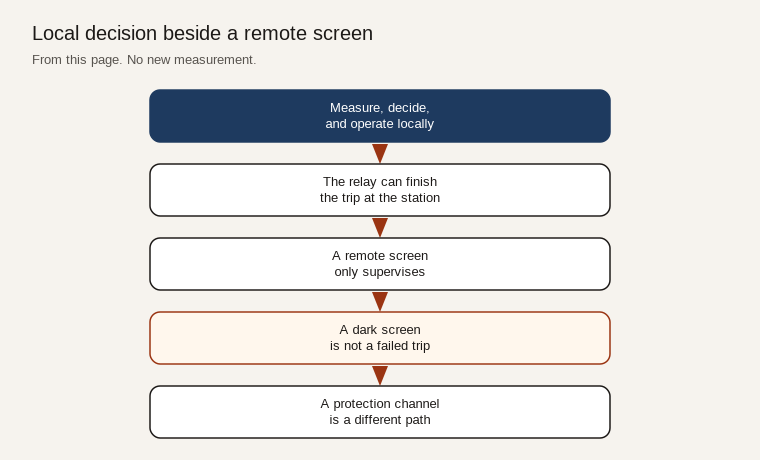
Devices at the station measure, decide, and operate, a remote screen only supervises and can go dark, and a protection channel is a different path from that display.
Measure, decide, and operate at the station
A substation remains a power facility. OSHA’s illustrated glossary calls it a high-voltage electric system facility used to switch equipment and circuits and to change voltage. A station may change or regulate voltage, switch circuits, measure electrical quantities, and control reactive power. It need not do all of those. Automation changes how some of them are sensed, decided, and carried out.
Measure. Current, voltage, and equipment status must reach a device that can use them, on instrument-transformer circuits and contacts or as sampled data. Each measurement has a source, a destination, and a failure mode. A blank on a screen is not a failed sensing circuit.
Decide. A relay or other local controller compares what it receives with its configured logic, then trips, blocks, alarms, allows a close, or does nothing. That comparison happens in the device, not in a person watching a distant display, unless the scheme deliberately includes a person. Most fault decisions do not.
Operate. The decision has to act on apparatus. A trip uses control circuitry, a trip coil, and the station direct-current supply. A supervisory request still has to be accepted or refused by station equipment. A line item that names none of the three steps is a wish list.
The remote screen is a different job
Supervisory control and data acquisition, or SCADA, gathers information and carries control requests. A human-machine interface is the display a person uses. Either can sit in the control house or in a center covering many stations. Role, not distance, is what makes the function supervisory. The screen shows what was communicated, under the point-list names, and a person can request an action the design allows. Visibility does not perform the relay’s comparison. If the path fails, the display stops being evidence of the present state. Functions built to finish in the station can continue. Functions built to need that path cannot. The drawings have to say which is which.
OSHA’s substation eTool notes that substations are often unattended field locations, unless people report there regularly. The equipment, not a person in the yard, then measures, decides, and operates.
As of November 2026, the IEEE C37.1-2007 catalog entry is titled “IEEE Standard for SCADA and Automation Systems.” It says the standard defines requirements for those systems in substations, and that substation integration is the design process that is the foundation for substation automation. The page lists it as Inactive-Reserved, inactivated on November 7, 2019, with no active replacement shown. This page has not read the clauses, and an inactive entry is not a current design code. Integration is deciding which device measures which circuit, which device may trip, which signals leave, and which commands may return. Automation is what those pieces do after that scheme exists.
Where the devices sit
The IEC System Committee on Smart Energy describes the arrangement on its substation automation roadmap. The page carries a 2026 copyright and was read on November 22, 2026. It says intelligent electronic devices perform protection, local and remote monitoring and control, asset-condition tasks, and metering. It lists core functions separately: protection, local control and supervision, remote control and supervision, equipment supervision, metering, measuring, and online diagnosis. Those names are not synonyms.
The page groups equipment into zones joined by wires or by communications. The process zone is primary equipment: breakers, switches, the transformer regulator, and current and voltage sensors. The field zone holds relays, meters, fault detectors, and bay controllers. The station zone aggregates information through a remote terminal unit, a station controller, a possible local display, and outward communications. A control-house screen is not the distant office display, and it is not the relay. OSHA’s equipment list on the same glossary includes current transformers, potential transformers, relays, a control house, and supervisory control. Not every station has every item.
Protection is a chain, not a picture
NERC’s Glossary of Terms defines terms used in its reliability standards. Protection System, subject to enforcement and effective April 1, 2013, includes protective relays that respond to electrical quantities; communications necessary for those protective functions to operate correctly; voltage and current sensing devices that feed the relays; the station direct-current supply for those functions, including batteries and chargers; and control circuitry through the trip coil.
Sensing devices deliver the quantities. The direct-current supply lets protection operate when the source it protects is in trouble. Control circuitry carries the decision to the trip coil. A channel is in that definition only when the protective function needs it, as with a comparison between two line terminals. That channel is not the path that paints a symbol on a remote screen. Losing one is not losing the other. This page will not invent the backup. A qualified protection engineer defines it for the actual terminals.
The glossary’s Bulk Electric System entry, also subject to enforcement, opens with transmission elements operated at 100 kV or higher, unless modified by the lists that follow, and it excludes local distribution. Those lists were not applied here. A feeder label does not classify a private station.
The same glossary’s Remedial Action Scheme, subject to enforcement and effective April 1, 2017, detects predetermined system conditions and may trip generation or load or reconfigure a system. Individually, it excludes fault protection that isolates the faulted element, and controllers of reactive devices or tap changers that sit at the station and monitor only local quantities. A local feeder trip is not that wider scheme. Using remote quantities can take a controller outside the local exclusion. That is a design fact, not a brochure label.
A protocol name is not a specification
The IEC roadmap says proprietary communications tied owners to one supplier even after devices combined protection, control, and monitoring. It describes an IEC 61850 station bus as devices communicating with one another and with a station controller, and a process bus as sampled instrument-transformer signals sent to protection and measuring devices. As of that November 2026 reading, IEC 61850-8-1 covers in-station flows other than sample values, IEC 61850-9-2 covers sample values, and the series mostly replaces IEC 60870-5-103 for connecting relays. Paths leaving the station can use IEC 60870-5-101 or IEC 60870-5-104. The page also lists IEEE 1815, known as DNP3, and time profile IEC/IEEE 61850-9-3. That map does not order a station to drop copper trips or pick one protocol.
As of November 2026, the IEEE 1815-2012 catalog entry is Inactive-Reserved, inactivated on March 30, 2023. It shows draft P1815 and notes that the DNP3 level is chosen per device. The superseded 1815-2010 abstract described an intermediate level for substation devices. This page has not read the protocol text. Naming only “IEC 61850” or only “DNP3” does not say which functions stay hardwired, which messages may trip, how two suppliers’ devices will be tested, or which clock keeps one breaker operation in order.
Cybersecurity is a separate decision this page does not make. As of November 2026, NIST’s Guide to Operational Technology (OT) Security, Special Publication 800-82 Revision 3, dated September 2023, addresses performance, reliability, and safety of programmable systems that interact with the physical environment. A note dated September 21, 2026 points to a draft Revision 4, with comments due by November 30, 2026. Neither edition is a station configuration or a contractor credential. A CISA alert of August 13, 2025 describes an inventory as a current list of systems, hardware, and software, classed by importance and function. Naming devices and paths is not choosing firewalls, accounts, or segmentation.
Scope, outages, and handover
The one-line identifies the apparatus. The function list says what each device measures, decides, and operates. The point list says what a remote system may display or command. Control authority says who may operate locally, who may operate remotely, and which conditions refuse a request. A refusal can be the scheme working.
A relay cutover or a test that must move a breaker often needs the circuit out of its normal state. The window the facility or the utility will release decides which tests finish. Records should name each function, the configuration version left in service, the point list, the interlocks, the arrangement tested, and unfinished items. Where protection is in scope, sensing inputs, the direct-current supply, and the trip path belong in that test boundary.
Soleil Energy’s commercial solar interconnection guide describes the utility process for connecting a customer solar system. That process can involve protection. It does not define the internal scheme of an existing substation. A plant substation that steps generator output up to the grid is a third boundary, tied to the generating project.
The yard is still a high-voltage workplace
As read on November 22, 2026, 29 CFR 1910.269 covers operation and maintenance of generation, control, transformation, transmission, and distribution equipment, including utility installations and equivalent industrial installations. It does not apply to construction, except for cases the text identifies. 29 CFR 1926.950 covers construction, including alteration, conversion, and improvement of existing equipment. A relay replacement can fall there. The employer determines which duties apply.
Both sections require training and an exchange of installation information between host and contract employer before work. 29 CFR 1910.269(u) adds access and working space, conditions for inserting or removing draw-out breakers, fence grounding when a fence changes, limits on unqualified entry, and guarding of energized parts. Those are employer duties, not a work method or a relay setting. A qualified person using the employer’s procedures must assess the station. A state plan, or the District of Columbia, may use a different text.
An illustrative station with the display dark
This illustrative station is not a reported project. Two incoming lines, one transformer, and several feeders serve an industrial site. The owner wants an office screen that shows breaker position and can request a feeder open. The question is what remains when that screen is dark.
Each feeder relay measures its own current, voltage, and breaker status, decides a trip from its own logic, and operates through the direct-current supply and trip circuit. The office screen is not in that chain. The open request is supervisory. Local logic may still refuse it when the disconnects do not allow the operation. That refusal is a decision, not a failed link. If the office path is down, the request cannot be sent, while the feeder relay can still trip for the faults its logic covers.
One function in the illustration does need communications: a comparison between the incoming terminals. When that channel fails, the illustration does not invent a backup trip. A real station may put a trip on a network message or keep it on copper. Only the drawings, configuration, and tests show which was built. The example is not a setting, a protocol choice, or a security design.
Misreadings that waste the outage
A new display is not the scheme. Matching device brands is not interoperability. “Digital substation” only points at sampled signals, and many stations mix copper and data. The Inactive-Reserved catalog entries read in November 2026 are not adopted editions. Public guidance is not a configuration and does not show that a company holds a framework. A remote open is supervision, not protection.
What to bring to a scope conversation
| Question to settle | What the answer changes |
|---|---|
| What is measured, and from which sensors? | Devices, wiring or samples, and test inputs |
| Which decisions may depend on an outside link? | What still operates when that link is down |
| Which commands must local logic refuse? | Control authority and what an operator may believe |
| Which protection needs its own channel? | A failure different from a dark screen |
| What outage window exists? | Which tests can finish |
| What files and unfinished items are handed over? | Whether the owner can operate the station later |
Bring the one-line, the ownership boundary, outage limits, the existing relays and remote systems, and who may operate. Do not send passwords or a diagram that would let a stranger operate the station.
For stations in the markets Soleil Energy describes, bring voltage, ownership, the outage window, and the records the owner and the utility expect. Soleil Energy’s power practice includes substation, switchgear, protection, and commissioning work scoped against those facts. A plant substation is a different scope, described on the utility-scale solar page. Field coverage is the markets on the service-area page, including Maryland, Northern Virginia, and the District of Columbia. A qualified professional still has to assess the station.
Questions that change the next decision
What does automation add that a screen quote leaves out?
It adds each device’s measure, decide, and operate duties, the points a remote system may show or command, interlocks that can refuse a command, the outage needed to test the chain, and the version left in service. An owner or utility approval can appear even when a display purchase would not have required one.
When is a communications channel part of protection?
When the protective function cannot decide correctly without it, NERC’s glossary includes that channel in the Protection System. A comparison between line terminals is the usual case. The path that updates an office display is different, even if both are digital. A display check does not test the protection channel.
Does naming IEC 61850 settle the design?
No. As of the November 2026 reading, the roadmap is a family of models and mappings, including station-bus and process-bus uses. The specification still has to say which functions use it, which stay hardwired, and which test shows two suppliers’ devices doing the intended job. A DNP3 name leaves the same gap.
What should testing prove, and what should it refuse to prove?
For the cases the engineer defined, inputs, the decision, and the operation should match the scheme, and remote points should match the point list. The record should name the version tested and what the outage did not allow. It does not prove settings or a cybersecurity framework.
What remains for a qualified professional?
The actual one-line, which decisions are local, which depend on a channel, who may command, and which work rules and reliability obligations apply. This page does not select relay settings, choose a protocol as the design, or set a cybersecurity configuration.
Project requirements depend on the site, equipment and applicable rules. Confirm design and installation decisions with the appropriate qualified professional.