An arc flash study is an engineering assessment of the thermal energy a person could be exposed to if an electric arc occurred at specified equipment under stated electrical conditions. Facilities use it to inform boundaries, labels, and protective measures. It does not authorize energized work, replace lockout and a test for the absence of voltage, or decide the protection for a real task. A qualified person has to assess the actual equipment.
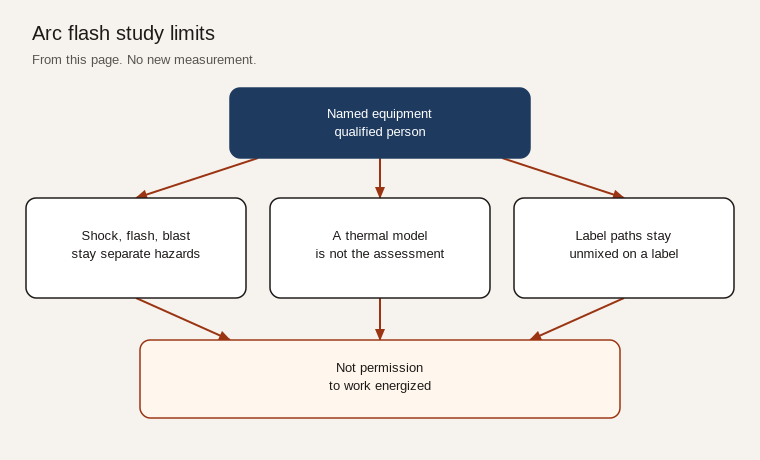
Shock, arc flash, and arc blast stay separate hazards, a thermal model is not the whole assessment, and neither path permits energized work, so a qualified person assesses the actual site.
Shock, arc flash, and arc blast are different hazards
Electric shock is current through the body. An arc flash is current jumping through air, with heat, light, and molten metal. NIOSH lists that injury apart from contact burns and shock. An arc blast, the pressure wave, is a third effect. A thermal model measures none of the pressure, and a shock limit measures neither hazard.
OSHA’s arc-flash page says arc temperatures can exceed 35,000 °F and that most of these burn injuries come from ignited clothing. It also says arcs occur at voltages such as 120/208 volts, and that incident energy depends mostly on amperage, duration, and distance rather than voltage alone. That is not a clothing selection and not permission to work energized.
A calculation is not the whole assessment
“Arc flash study” usually means the engineering model: sources, protective devices, and estimated thermal exposure under named cases. A risk assessment is wider. It asks whether the task creates a hazard, how likely and severe injury could be, and which controls come first. The model informs severity when it fits. It does not justify energized work.
Calculated incident energy, heat per unit area, is one path. Tables in the workplace standard the employer adopts are another. They should not be mixed on one label. This page gives neither path: no method, no clothing table, no working distance, and no heat result. A qualified person judges the equipment and the task.
NFPA’s 70E page, checked in November 2026, listed the 2027 edition as current, issued April 16, 2026, and effective May 6, 2026. It describes safe-work practice for shock, electrocution, arc flash, and arc blast. That page is not the standard, and the clause text was not in the record read here, so this article states no 70E requirement, clause number, review interval, or label recipe.
Which OSHA duty applies is a scope question
OSHA has not adopted the current 70E edition as an OSHA rule. A November 14, 2006 interpretation, written about NFPA 70E-2004 rather than the 2027 text, says OSHA did not enforce that unadopted edition. Consensus standards can inform a hazard analysis and can show that a hazard is recognized. The letter says the General Duty Clause does not enforce a consensus standard and usually should not be used where an OSHA standard already applies.
Many workplaces fall under 29 CFR 1910 Subpart S. Section 1910.333 requires work practices on or near equipment that is or may be energized. Exposed live parts shall be deenergized first unless the employer shows that deenergizing adds hazards or is infeasible. The notes include life support, emergency alarms, hazardous-location ventilation, and testing that only works energized. Parts under 50 volts to ground need not be deenergized if burns or explosion from arcs will not increase. That exception is not a finding that every such circuit is harmless.
Gear that is deenergized but not locked and tagged under that section is treated as energized. Only a qualified person may work on parts left energized under the rule. Stored energy that could injure someone must be released, and capacitors handled for that purpose are treated as energized. An AC model does not settle a capacitor, a drive, or a battery.
Section 1910.335 requires eye or face protection against arcs and flying objects, shields or barriers where dangerous arcing might occur, and alerting by signs, barricades, or an attendant. The 2006 letter says Subpart S then lacked a specific rule for the marking described in NFPA 70E-2004. That letter is not the National Electrical Code. NFPA’s NEC page, checked in November 2026, lists the 2026 edition as current and says the NEC is enforced in all 50 states. It does not identify the edition adopted in Maryland, Virginia, or the District, and it quotes no labeling text. Confirm the adopted edition locally.
Section 1910.132 requires a written certification that the workplace was assessed for hazards needing PPE. Paragraph (g) limits that assessment language to listed PPE sections and excludes electrical protective equipment under section 1910.137. A PPE certificate is not an arc flash study. Where both rules cover the same condition, the 2006 letter says Subpart S prevails.
29 CFR 1910.269, read in the eCFR in November 2026, covers operation and maintenance of generation, control, transformation, transmission, and distribution equipment, including utilities and equivalent industrial installations. It excludes installations and work practices covered by Subpart S. A note puts standby or emergency generation that only supplies a workplace under Subpart S. Where 1910.269 does apply, an employee exposed to an electric arc requires a reasonable estimate of incident heat energy. Appendix E is guidance OSHA treats as meeting that duty; another method is allowed if it reasonably predicts the exposure. The appendix uses fault current, arc length, distance, and clearing time. This page does not reproduce those methods, distances, or tables. Construction is generally outside the section, with exceptions the rule states. A qualified person classifies the installation. The street address does not.
Maryland, Virginia, and the District are not one program
OSHA’s state-plan FAQ, checked in November 2026, places the District of Columbia among jurisdictions under federal authority and lists Maryland and Virginia among state plans that cover private-sector workers as well as state and local government workers. The District is not on that state-plan list.
OSHA’s Maryland page describes MOSH coverage of private workplaces and state and local government, with exceptions that include maritime work, military bases, certain postal contracts, aircraft cabin crew, and some federal property. MOSH adopts federal standards by reference and also has state standards. MOSH’s own page excludes federal employees and work under the mine-safety, longshore, and atomic-energy statutes. The two lists are not identical. Confirm the agency for the site.
OSHA’s Virginia page describes VOSH coverage with exceptions that include maritime work, certain postal contracts, federal enclaves, a named federal power facility, and aircraft cabin crew. VOSH also has an overhead high-voltage line statute. A site inside an exception can remain federal OSHA work. None of these pages adopts NFPA 70E or names a calculation method.
Soleil Energy’s service-area page limits described coverage to Maryland, Northern Virginia, and Washington, DC, names Prince George’s, Montgomery, Howard, and Arlington, and says the company serves the District without an office there. That is a commercial boundary, not a safety-agency ruling.
The IEEE guides have a lane, and a correction sheet
IEEE 1584-2018, checked in November 2026, is the active Guide for Performing Arc-Flash Hazard Calculations, published November 30, 2018, in place of the 2002 guide. The record describes models for hazard distance and incident energy, and a draft title limited to three-phase AC systems from 208 V to 15 kV. The IEEE 1584.1-2022 record describes that draft as excluding single-phase AC, direct current, short-circuit and coordination studies, and PPE recommendations. Those are catalog statements. A qualified person still confirms fit to the equipment.
A correction sheet dated August 30, 2019, accompanies the 2018 guide. A citation of that guide should show the sheet was used. This article does not copy it. IEEE 1584.1-2022, published July 12, 2022, is for specifying scope and deliverables; the page does not list them, so none are invented here. IEEE 1584.2-2025, published September 19, 2025, with ANSI approval shown as February 11, 2026, collects data for three-phase 50/60 Hz systems at 1000 V and below. A finished checklist is not proof the building still matches the model.
The guides do not select PPE. Exposure under stated assumptions still has to meet the applicable rule, the task, and the condition of the gear.
Current, duration, and the case you model
Available current, clearing time, and distance move thermal exposure. Voltage alone does not rank it. A device that waits can leave an arc alive longer, so a coordination change that lets a downstream device open first can change exposure even when it keeps the rest of the system online. Short-circuit work asks whether equipment withstands the current. Coordination asks whether devices operate in order. The arc-flash question uses both and is limited to the cases that were actually run.
Soleil Energy’s power practice includes load-flow, short-circuit, and coordination studies, plus single-line diagrams. Thermal exposure is a further question, and the scope should say whether it is included.
A normal lineup is not a closed tie, a generator online, or daytime photovoltaic contribution. Assumed impedances and unread settings have to be labeled as assumptions. The model also assumes the device operates as drawn. A jammed or mis-set device may not. This page sets no test interval and no setting.
What to assemble before anyone models
The rows below are a preparation list, not a procedure and not a claim that every row applies everywhere.
| Information | Why it changes the question |
|---|---|
| Field-checked one-line | Omitted gear and a mis-drawn tie never enter the model. |
| Dated utility fault data | The utility sets service current. An old letter may describe a changed substation. |
| Source data | Transformers, generators, and what may run together change the current used. |
| Installed device settings | Clearing follows the device in the gear, not the original specification. |
| Real operating cases | Open tie, closed tie, and on-site sources are different studies. |
| Explicit exclusions | Single-phase, direct-current, and out-of-range gear need their own decision. |
| Known gaps | Estimates and equipment that could not be opened should stay visible. |
If a cover cannot be removed safely, say the data were not verified. A value borrowed from a similar building is not a field reading.
What makes the assumptions obsolete
Update when available current or clearing time changes: a new utility letter, a replaced transformer, a new or re-set protective device, a tie that will close, generation or storage paralleled with the utility, daytime photovoltaic contribution, or motors added in a renovation. A field check that disagrees with the report is a trigger even without a design change.
Some programs also reread the file on a cycle their chosen workplace standard requires. No such interval is stated here, because the 2027 edition of NFPA 70E was not read clause by clause. Confirm the edition in use, and do not wait out a cycle after a known change. Copied labels and a reprinted file with new software defaults are not a new study.
An illustrative building with two sources
This illustrative example is not a Soleil Energy project and not a numerical result. An office has two services and a normally open tie, studied only in that open state. Operators now plan to close the tie in an outage, and a rooftop photovoltaic system can run during the day. The old labels miss both. A revision names the cases and the exclusions. It assigns no heat and no clothing.
A second illustrative change leaves the one-line looking the same. A replacement trip unit is set so a downstream device opens first. Duration at that equipment may change even though the transformer did not. Keeping the old report because “nothing structural changed” misses the input that often dominates the thermal question.
What to ask before treating a report as current
Ask which method and edition were used, and whether the 2019 correction sheet was applied to an IEEE 1584-2018 citation. Ask which cases were run, which case governs each label, the date of the utility data, and which numbers were assumed. Ask what was excluded, how settings were confirmed, and which changes retire the file. The report is not permission to work energized. If the contract names IEEE 1584.1, ask for that edition’s scope and a written exclusion list rather than a reconstructed one.
The employer still owns training, any energized-work justification, lockout, and protective equipment. For a site inside the service area above, bring the one-line, the latest fault letter, the installed settings, and the sources that can run together. Soleil Energy can discuss whether thermal-exposure work belongs with the short-circuit and coordination scope through its power practice. That discussion does not approve energized work and does not select clothing or approach distances.
Questions that change the scope
Does a finished study allow energized work?
No. Exposed live parts are deenergized before work unless the employer demonstrates an exception. A model is not that demonstration. Gear that is off but not locked and tagged is still treated as energized, and testing for voltage is work a qualified person plans.
Must every commercial building have an IEEE 1584 file?
Not from the sections read here. Subpart S requires work practices, protection where arcing could injure people, and alerting. It does not name IEEE 1584. The incident-heat estimate in section 1910.269 applies only inside that section. Standby generation used only to supply the workplace is pointed toward Subpart S. Classify the site before assuming either duty. Ordering a calculation because a consensus standard uses one is a program choice, not a federal form.
What changes make the file obsolete?
Utility contribution, transformers, devices or settings, tie position, motor contribution, or generation and storage that can run with the utility. A mismatch between report and gear counts too. Confirm any calendar review in the standard the employer adopted. Do not keep a label after a known change, and do not invent an interval from an unread edition.
Is the shock boundary the arc-flash boundary?
No. One is about contact and near approach. The other is about heat from a possible arc, and either can sit outside the other. This page states no distances. A report that states them has to show its basis, applied by a qualified person to the task.
Does the AC model cover batteries and single-phase panels?
Not by default. The IEEE draft description read in November 2026 leaves single-phase AC and direct current outside that guide, though those circuits can still arc. Record the exclusion. IEEE 1584.2 checklists focus on three-phase systems at 1000 V and below and do not absorb the rest of the site.
Who says a label is still fit to use?
The employer, through a qualified person comparing the label, the report, the settings, and the case about to be created. NIOSH’s page, checked in November 2026, says only qualified persons should do electrical work and that they should deenergize first. A sticker neither qualifies someone nor outlives a system change.
Project requirements depend on the site, equipment and applicable rules. Confirm design and installation decisions with the appropriate qualified professional.