
A power quality study is a scoped investigation of voltage and current at chosen points in an electrical system, used to see whether recorded deviations fit the utility supply, the facility’s loads, or the wiring between them. It captures events such as sags, swells, interruptions, unbalance, flicker, and waveform distortion for a qualified professional to interpret. The meter file does not, by itself, assign a cause, a compliance result, or a repair.
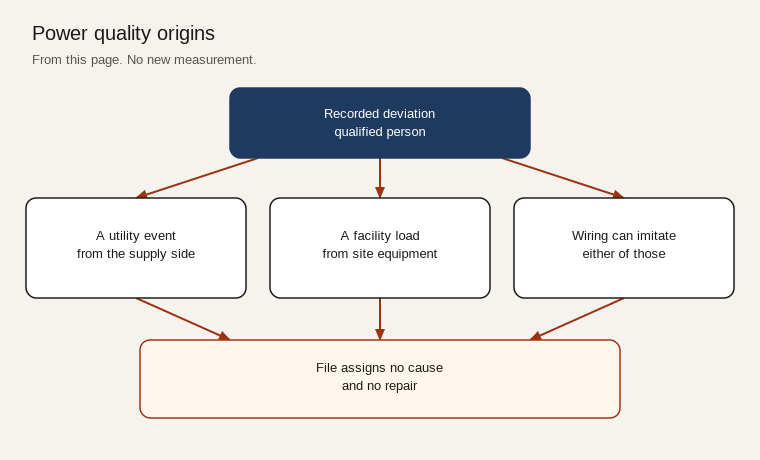
A utility event, a facility load, and the wiring between them stay separate questions, and the meter file assigns neither a cause nor a repair, so a qualified person assesses the actual site.
The split the study is hired to make
A drive trip, a controller reset, flicker, or a hot transformer does not name its source. The same reset can follow a voltage sag from a utility-feeder fault, a dip when a motor starts in the plant, or a loose conductor at one piece of equipment. Calling all of that bad power hides the decision.
As of November 2026, IEEE 1159-2019 describes deviations that may originate in the source of supply, in load equipment, or in the interaction between them, and it covers monitoring devices, application, and interpretation. That catalog is not a site finding. The same page lists revision project P1159, so a report that says only “1159” is not specific enough to audit.
Keep three questions apart. More than one can be true on different days. A utility event arrives from the supply side, such as an area fault or feeder switching, only when the evidence supports that reading. A facility load event comes from customer equipment such as motors, welders, or drives. A wiring question covers terminations, the neutral, grounding and bonding, capacitor interaction, or the instrument connection. A bad path can imitate the other two. The study holds those categories open until missing evidence is named. It is not a procedure for energized work and does not authorize opening gear, changing a setting, or calling the installation acceptable.
Where the recorder sits
Service voltage shows what arrived at the building, not the extra drop on a long feeder. Line current shows what that line drew, not whether utility voltage had already collapsed. A sag at both the service and a downstream panel, without a prior rise in facility current, fits a supply-side event better than a local start. A sag only downstream, in step with that panel’s current, fits load and path impedance. A disturbance at one disconnect while the bus is steady fits that circuit’s wiring or the instrument connection. A direction flag depends on method and placement. Check it against the one-line.
The sensor path can invent an event. IEC 61000-4-30:2025, corrected in July 2026, defines in-situ methods for 50 Hz or 60 Hz systems and says transducer effects are acknowledged but not treated in detail. State where each channel was connected. Its parameter list includes frequency, voltage magnitude, flicker, dips, swells, interruptions, transients, unbalance, harmonics, interharmonics, rapid voltage changes, and related currents. Class A means advanced and Class S means surveys: a method class, not a facility grade and not a rule that a US site must use either class. A study may use the full list or a subset. Neither that catalog nor IEEE 1159-2019 states how many days to record.
Steady voltage is a different problem from a sag
The scope text of ANSI C84.1-2020 establishes nominal ratings and operating tolerances for 60 Hz systems above 100 volts, including preferred ratings up to and including 1200 kV maximum system voltage. In defining that maximum, it excludes transients and temporary overvoltages from abnormal conditions such as faults and load rejection, while saying those events may still affect equipment. The ANSI blog entry, read in November 2026, states that the 2020 edition was reaffirmed in 2025.
The contents identify service and utilization ranges, including Range A and Range B. This page does not restate the tables. A qualified professional compares a steady reading with the invoked edition, the nominal voltage, and the measurement point. A sag, swell, or interruption is a different question. IEEE 1250-2018 says some equipment is not designed for the surges, faults, distortion, and reclosing duty on typical utility distribution systems, and that steady voltage and flicker remain concerns. As of November 2026 IEEE lists the guide as active, with an ANSI withdrawn date of June 21, 2024 on the same entry. Confirm which document a specification names. Flicker can disturb lighting without one deep sag, so a breaker-only scope can miss it.
Harmonics use another boundary
Distortion is steady-state content at other frequencies, especially from drives and rectifiers. It is not a voltage sag, even in the same report.
As of November 2026, IEEE 519-2022 is the active IEEE standard for harmonic control. The catalog says it sets design goals for linear and nonlinear loads, calls the source-load interface the point of common coupling, and addresses steady-state limitations. Transients may exceed those limitations, and radio-frequency interference is outside the document. A project summary on the same page says the steady-state voltage and current distortion limits apply at the user point of common coupling where loads produce harmonics.
This page does not restate those limits, any distortion percentage, or any clause number. A panel or drive summary can still be the wrong point. Identify the point of common coupling on the one-line; ownership varies, and a qualified professional confirms the point the edition and any utility rule use. Current distortion is what the load draws. Voltage distortion is what other equipment must accept. Eaton’s consulting application guide treats operating range, whether loads are affected by harmonics or generate them, and transient voltage as design inputs. That is a manufacturer’s reference, not a US limit and not a monitoring procedure. The 2022 catalog supersedes the 2014 edition, but a contract may still name the earlier one. Use the edition the agreement invokes, not the year on a printout.
What a meter file cannot decide
IEEE 1159.3-2025 defines a vendor-independent format for power quality measurement and simulation data. The catalog says it is meant to represent phenomena identified in IEEE 1159-2009 and other power-related data. The project text allows raw, processed, simulated, proposed, specified, and calculated data, plus sampling rate, resolution, calibration status, instrument identity, and location.
A file is therefore not self-interpreting.
- It does not prove the sensor was on the named circuit. Location is metadata someone must check.
- It does not separate measured samples from calculated or simulated series unless that flag is stored and read.
- It does not decide that a sag caused a trip. Matching clocks are a reason to look further. A controller can stop for a mechanical reason in the same minute.
- It does not assign responsibility between utility and facility. Tariffs and interconnection agreements differ by account.
- It does not show conformity with IEEE 519, ANSI C84.1, a utility rule, or the electrical code.
- It does not select or size a filter, transformer, ride-through device, starter, or repair.
The 2025 abstract still cites phenomena from the 2009 monitoring practice, while the monitoring page lists IEEE 1159-2019 and project P1159. As of November 2026 those are different edition trails. A quiet week can miss the prior failure. Absence of an event covers only the interval, points, and settings used.
Wiring can imitate a supply event
Voltage that swings at one machine while the panel bus is steady is not fixed by calling the utility or by condemning a nearby drive. Nonlinear loads can load the neutral unexpectedly. Capacitors can magnify distortion through source impedance. A loose termination can drop voltage only when its load runs, which looks like a utility sag on one channel. That is not a test method. The scope should say whether the neutral, capacitor banks, and critical terminations are in the question. Without a channel map, instrument-transformer ratios, and a shared clock, a site problem and a measurement problem look alike. A qualified professional must assess the actual site. This page does not describe opening equipment or reworking a connection.
On-site sources are not an approval
Inverters are nonlinear and can trip or change behavior when they export. Ignoring whether solar, storage, or a generator was online can misread voltage and current. IEEE 1547-2018, as of November 2026, covers interconnection of distributed energy resources and includes power quality, abnormal-condition response, islanding, and tests, for a 60 Hz source. Amendment 1547a-2020 is on the same page. A trip file is not a conformity demonstration, and this study is not an interconnection approval.
The ANSI C84.1 foreword says the 2020 revision added an annex on generation and storage that may cause voltage rise, and that allowable voltages at the point of common coupling were not changed. Export rise and a fault sag are different complaints. Soleil Energy’s commercial solar interconnection guide explains the Maryland utility review, with a Virginia comparison. It does not read facility waveforms. Keep that schedule separate from the trip investigation.
Not a code inspection, and not a work practice
NFPA 70, the National Electrical Code, is NFPA’s benchmark for safe electrical design, installation, and inspection. As of November 2026 the development page lists the 2026 edition as current. NFPA states that the Code is enforced in all 50 states. Which edition a building uses is still a question for the authority having jurisdiction. A monitoring report does not answer it.
Connecting recorders is electrical work. OSHA 1910.269, read in November 2026, covers operation and maintenance of generation, control, transformation, transmission, and distribution, including certain installations open only to qualified employees. It does not apply to installations or work practices covered by Subpart S, and a note sends emergency or standby generation toward that subpart. Training topics include exposed live parts and nominal voltage. Those rules are not a definition of voltage sag. Which rule covers a connection depends on the work. A qualified professional must assess the actual site. Nothing here is a procedure for energized connections.
Settle the scope before recording
Put the points and the non-decisions in writing before recording.
| Scope item | Why it is there | What it still does not do |
|---|---|---|
| Complaint, with times | Ties records to resets, flicker, or heat | Prove the event caused the symptom |
| One-line and nominal voltages | Shows sources, ties, capacitors, and a candidate coupling point | Prove the drawing is current |
| Voltage and current | Current distinguishes a load event from a supply event | Name a failed part inside a machine |
| Neutral and wiring, in or out | Stops a path problem from being called a utility event | Authorize opening equipment |
| Ratios, class, and clock | Makes files comparable and flags calculated data | Fix a bad field connection |
| Decisions kept outside the file | Stops a distortion table from becoming a repair design | Set harmonic limits or relay settings |
The deliverable should name sensor locations, the interval, matching events, origins still plausible, and questions left open.
An illustrative week of stops
This example is illustrative. It is not a Soleil Energy project.
A packaging controller resets on several afternoons. The file set is a utility note, a service recorder, a line-panel recorder, and an operations log.
On one afternoon both voltages fall and recover with the utility note, and line current does not jump first. That fits a supply event better than a motor start. It does not decide fault, ride-through, or a missed tariff. Ride-through belongs to the equipment and its control power, which these recorders may not have measured.
On another afternoon service voltage stays steady while panel voltage dips as a compressor starts and its current rises. That fits facility load and the feeding path. It does not choose a feeder, a repair, or a starting method.
On a third afternoon the bus is steady, the compressor is idle, voltage at the controller is erratic, and neutral current does not match the expected phase loads. A wiring or measurement-path question stays open. The file names no termination and proves no code violation. One distortion figure for the week would erase the split.
Questions that change the scope
Can a study separate a utility event from on-site equipment?
Only with voltage and current at more than one point, on clocks that match the complaint. One service channel misses a downstream-only problem. One load-current channel misses an upstream sag that ended first. Sensitivity and commercial responsibility stay open. IEEE 1159-2019 allows source, load, or interaction. It does not award the cause.
Does the meter file decide who must fix the problem?
No. The format carries measurements and calculated or simulated values. Responsibility sits in the tariff or interconnection agreement and in what was connected. A direction flag is an output to review, not a finding of fault.
Is a distortion summary an IEEE 519 result?
Not by itself. The 2022 catalog places steady-state limits at the user point of common coupling and separates them from transients. A downstream summary can still matter for equipment. Conformity needs the correct point, the invoked edition, and a qualified professional. This page does not provide the limits.
Does this replace arc-flash, short-circuit, or coordination work?
No. They answer fault current, equipment duty, and device timing. A sag waveform does not calculate incident energy or select a relay setting. Keep the names separate so one purchase does not drop the open question.
How long should monitoring run?
Match the window to the shift, startup, large-load cycles, and any utility work already identified. A quiet interval can be a baseline and still miss the failure. The IEEE 1159-2019 and IEC 61000-4-30 pages reviewed in November 2026 set no universal duration. State what a missed event does to the conclusions.
What should be in hand for a scope review?
Bring the current one-line, nominal voltages, misoperation times and places, utility notices, and existing files with sensor locations. Add a published ride-through or input-range document if the manufacturer issued one. State which origins must be separated and which decisions the file must not make. A qualified professional assesses the site before energized work or a final setting.
Bring the one-line to a scope discussion
Soleil Energy’s published service area names Prince George’s, Montgomery, and Howard counties in Maryland, Arlington County in Northern Virginia, and Washington, DC, without a DC office. Coverage outside that list is not established by this page.
Inside that practice, the next step is a scope conversation with the current one-line, not a remote waveform reading. Soleil Energy’s power work includes substation, switchgear, distribution, and study tasks. Its public project sequence names load flow, short-circuit, and protection coordination, plus interconnection feasibility, and asks for voltage class and the work window. A power quality study sits beside that work and is not the same task. Name the symptom, the points that can be monitored, and the decisions that stay outside the file. A qualified professional must assess the actual site before a record is treated as a cause or a repair.
Project requirements depend on the site, equipment and applicable rules. Confirm design and installation decisions with the appropriate qualified professional.
