
Behind-the-meter solar is photovoltaic generation connected on the customer’s side of the utility revenue meter, so its output can serve that customer’s load before any surplus crosses the meter. The phrase names a physical and metering boundary. It is not a retail tariff, an export price, or a wholesale market product. Whether surplus is credited, purchased, limited, or refused depends on the utility account and the agreement then in force.
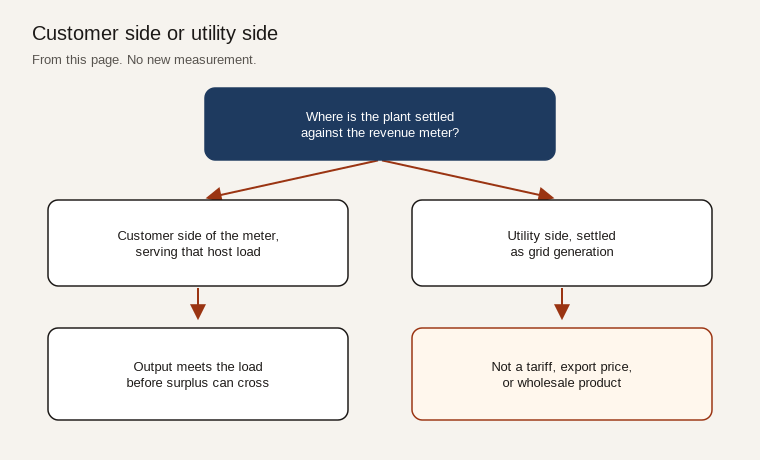
Customer-side connection can serve the host load before any surplus crosses the revenue meter, while a utility-side plant is settled as generation, and neither placement is itself a tariff or a wholesale product.
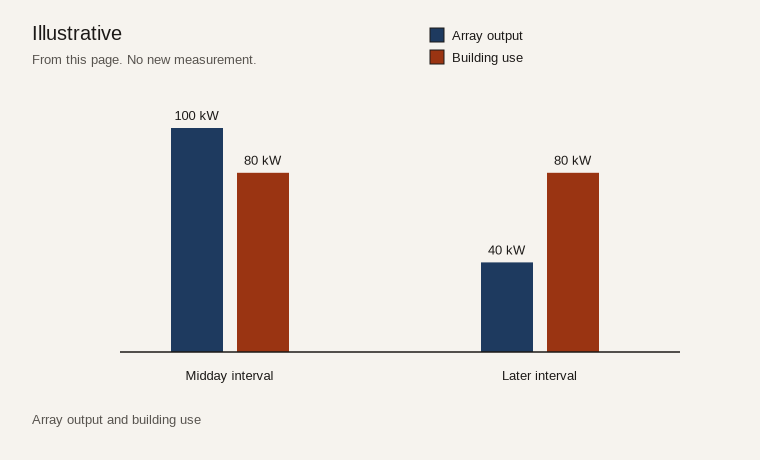
The bars repeat the labeled illustrative midday and later intervals, and those figures are illustrative rather than a project result.
The meter is a boundary, not a product
The revenue meter is where the utility settles the account. A rooftop, carport, or ground array wired into the customer’s service is behind that meter. A plant connected on the utility side, and settled as generation rather than as a reduction in retail purchases, is not. The one-line diagram shows which arrangement it is.
EIA uses the phrase for onsite generation. Its buildings and industrial characterization, released March 28, 2024, says distributed generation “refers to onsite, behind-the-meter energy generation,” including solar photovoltaics. That is a modeling category, not a bill credit. See the EIA distributed-generation characterization. Form EIA-861M is a different cutoff: small-scale photovoltaic capacity under 1 megawatt, split between net-metered and other distributed systems. The EIA-861M small-scale series is not the legal definition. A commercial array can be behind a retail meter and at or above 1 megawatt.
NERC uses that side of the meter only for a reliability exclusion. In the April 30, 2026 Bulk Electric System reference, Exclusion E2 covers certain units “on the customer’s side of the retail meter” that serve retail load, and only if net capacity to the Bulk Electric System does not exceed 75 MVA and specified standby service is in place. The reference says the exclusion targeted qualifying cogeneration and similar plants, and that the test looks at flow from connections at or above 100 kV. The NERC Bulk Electric System reference is not a building permit and does not set a retail credit.
Production meets the load before it can cross the meter
Inverter output and building load meet on the customer side of the meter. Production below the load is import. Production above the load can flow out unless a control or the agreement stops export. Import is purchased on the account’s tariff. Export, when it is allowed, is paid only under the rule that actually applies: net metering, a successor rule, a purchase, a contract, or no payment. A non-export control can hold surplus on site. Output follows irradiance, so a midday load may overlap production while an early-morning billed peak does not. Energy and demand are different bill lines. Soleil’s guide to what panels and batteries change about demand charges separates them.
A grid-parallel inverter is not backup power. IEEE 1547-2018 covers interconnection, including abnormal conditions and islanding. It does not state a utility’s settings or which loads survive an outage. That design is separate, and a qualified professional has to assess the service.
Front of the meter, and credits from somewhere else
Front-of-the-meter solar is generation delivered to the grid as generation, rather than as a reduction of a host customer’s retail purchases. The plant can sit next to a building and still be front of the meter if it has its own interconnection and does not serve that building first. Soleil Energy describes plant construction, and the substation and utility interconnection that connect a plant to the grid, on its utility-scale solar page.
Maryland’s Chapter 353, in the 2026 Laws of Maryland, tells the Public Service Commission to take input on residential behind-the-meter, commercial behind-the-meter, and front-of-the-meter net-metered projects. The enrolled Chapter 353 text does not set one export price for the three groups.
A wholesale term is not the retail bill
PJM’s phrase “Behind The Meter Generation” is a wholesale tariff term. At a January 23, 2026 workshop, PJM quoted a Part I definition: a generating unit that delivers energy to load without using the Transmission System, unless a distribution owner consents and PJM accepts that consent. The quoted text excluded capacity designated as a Generation Capacity Resource, and output sold at another location or into the PJM energy market. The slides described retail behind-the-meter generation as netting generation and load at one electrical location. See the January 23, 2026 PJM workshop.
The slides also said FERC had directed a proposal for how much load a network customer may net, plus a transition, and that the threshold was still under discussion. As of November 2026, do not take a rate, a cap, or an eligibility rule from that deck. A building array is studied by the distribution utility unless it is actually seeking PJM netting or a co-located configuration.
Federal language is wider. As displayed on the eCFR on November 19, 2026, 18 CFR 35.28(b)(10) defines a distributed energy resource, for that section, as any resource “located on the distribution system, any subsystem thereof or behind a customer meter.” That is a wholesale participation concept. It does not enroll the building or replace a state retail program.
Maryland, Virginia, and the District do not share one rule
Soleil Energy’s commercial work is aimed at Maryland, Northern Virginia, and Washington, DC. As of November 2026 the points below come from the sources named. None replaces the account’s tariff, and none printed a commercial cents-per-kilowatt-hour export price for an onsite customer-generator.
Maryland. Chapter 353 defines an eligible customer-generator as a customer that owns and operates, leases and operates, or contracts with a third party that owns and operates a qualifying facility, including solar, on the premises or contiguous property, in parallel, and intended primarily to offset the customer’s own requirements. Net energy metering is the billing-period difference between utility supply and energy fed back, measured in both directions. The standard contract or tariff runs until the earlier of 3,000 megawatts statewide or July 1, 2027. A customer-generator already on it then stays eligible until decommissioning, a specified change that increases injection or alternating-current output, a new interconnection agreement, or a statutory repowering. The Commission is to approve a successor framework by February 1, 2027 for a program starting July 1, 2027. Successor incentives are to be lower, and the Commission designs the compensation. Both programs together run to 6,000 megawatts. The chapter does not set that later export price.
COMAR 20.50.10.01, read on November 22, 2026, still continues net metering until statewide capacity reaches 1,500 megawatts, bars it above 2 megawatts, and limits initial qualification to 200 percent of baseline annual usage. It also points to COMAR 20.50.09, which this page does not restate. Those are net-metering tests, not a definition of behind-the-meter solar. Ask the utility, in writing, which window and size test it is applying. The regulation and Chapter 353 do not match.
Virginia. Section 56-594, read on November 22, 2026, is in force in the text that lasts until January 1, 2027. The renewable facility must be on the customer’s wiring, on the customer’s side of the interconnection, in parallel, and intended primarily to offset the customer’s own requirements. Capacity is not more than 25 kilowatts residential or three megawatts nonresidential. After July 1, 2020 it also may not exceed 100 percent of expected annual use in a Phase I territory or 150 percent in a Phase II territory. The section names neither phase. Net energy metering is a 12-month difference. Excess is paid only under a power-purchase agreement at the Commission-approved tariff rate, or higher if the parties agree. The rate is not stated here. The customer-generator owns the certificates and has one option to sell them to the supplier with that agreement. Third-party ownership is not itself a retail sale under this section. Match a purchase contract to the Virginia statute that governs it. Notice starts a 30-day residential or 60-day nonresidential decision on interconnection requirements. That decision is not permission to operate. Only part of the January 1, 2027 text was retrieved. That part keeps the customer-side test and these ceilings and excludes a small portable device defined elsewhere.
District of Columbia. Section 34-1501, read on November 22, 2026, defines a customer-generator as an owner-operator of not more than 1,000 kilowatts on the customer’s premises, using listed technologies that include renewable resources, interconnected and intended primarily to offset the customer’s own requirements. Community net metering in that section is a bill credit for a community renewable energy facility, not onsite production at the subscriber’s meter. Section 34-1518 lets the Commission set the program, requires two-direction metering, and leaves net-export compensation to Commission rules. No cents-per-kilowatt-hour price is printed. Use the Commission rule and the District rider, not a Maryland schedule. Community-facility renewable energy credits belong to the subscriber organization or third-party owner unless a separate transaction says otherwise. Participation alone does not make those parties public utilities.
Ownership, financing, and tax sit beside the meter
Host ownership, a lease, and a third-party power-purchase agreement can all connect on the customer’s side of the meter. The contract sets who pays, who takes the output, who may claim a tax attribute, and who holds certificates. A third-party owner, where the statute allows one, does not by itself open every contract form.
Tax treatment sits outside the meter. The 2025 Instructions for Form 3468, read on November 22, 2026, describe the section 48E credit in Part V for a qualified facility placed in service after 2024, used to generate electricity, with an anticipated greenhouse-gas emissions rate not greater than zero. It cannot be claimed where a section 48 credit, among other listed credits, is allowed for that year or any prior year. The “What’s New” note on Public Law 119-21 ends the credit for wind or solar facilities placed in service after 2027 if construction begins after July 4, 2026, and it restricts material assistance from prohibited foreign entities. Part V allows no credit if construction begins after 2025 and includes that assistance. For tax years beginning after July 4, 2025, a specified foreign entity or a foreign-influenced entity is also denied it. The instructions set the percentage. This page does not. Use the Form 3468 instructions and a qualified tax professional.
Elective pay and transfer are separate. The IRS page on elective pay and transferability, read on November 22, 2026, limits elective pay to certain tax-exempt and governmental entities and lets other eligible taxpayers transfer all or part of a credit to an unrelated buyer for cash. A registration number has to be on the return. Payment can be reduced if domestic-content rules are missed and output is not less than 1 megawatt, with exceptions that include Notice 2024-84. A taxable business should not assume it can elect payment.
C-PACE is county financing, not a meter rule. The Maryland Clean Energy Center’s C-PACE description lists solar photovoltaic power, repayment as a property-tax surcharge, and a requirement that the county adopt an ordinance and sign a locality agreement. Not every county has done so. Soleil’s commercial installation cost guide cites public price figures for Maryland. They are not a Soleil Energy price.
What the project scope still has to name
The label does not fix the cash-flow inputs: retail rate and riders, demand measurement, export rule and netting interval, coincidence of production with load, interconnection cost, ownership and any credit, open incentives, operating cost, roof or structural work, and tariff-change risk.
| Decision | What to pin down |
|---|---|
| Account and tariff | Utility, jurisdiction, rate schedule, demand treatment, and riders |
| Export treatment | Net metering, a successor rule, a purchase of excess, or non-export |
| Interconnection | Study path, and permission required before operation |
| Site control | Roof age, structure, and landlord consent |
| Load shape | Interval data, rather than one monthly total |
| Ownership and tax | Owner, credit claimant, and certificate holder |
| Outage scope | Circuits that must stay up |
The commercial site checklist covers the building records. The commercial interconnection guide separates a utility application from a building permit.
An illustrative split between use and export
The arithmetic below is illustrative. It is not a Soleil Energy project, a bill, or a credit rate.
Assume no storage and no export limit. In one midday interval the array delivers 100 kW at the point where it meets the building load, and the building uses 80 kW, so 20 kW is available to leave through the meter. Later the array delivers 40 kW while the building uses 80 kW, so the meter imports 40 kW. If billed demand is the highest interval in the period, and that interval occurs when the array is not covering the load, the midday surplus does not set the demand determinant. An export limit or a battery changes both intervals. The tariff, not this arithmetic, sets any compensation.
Soleil’s guide to modeling a commercial building’s numbers is about using the account’s interval data, tariff, export rule, and ownership structure. A claim that selected loads stay on needs its own scope and a qualified professional.
Common questions
Does behind-the-meter solar mean the project is on net metering?
No. The phrase locates the connection. Net metering is a separate billing test in Maryland, Virginia, and the District. The array can be non-exporting or paid under a successor or purchase rule. Identify the account’s path before pricing the surplus.
Will the array run during an outage?
Not from meter location alone. IEEE 1547-2018 addresses abnormal conditions and islanding for grid-parallel equipment. Backup is a separate design for named loads.
Does a carport or a ground array count?
Yes, when it connects on the customer’s side of the revenue meter and serves that load. A separate grid interconnection on the same parcel does not. A community subscription may appear only as a credit. Read the one-line.
Does the PJM term cover a typical rooftop?
Usually no. The January 23, 2026 slides described wholesale netting, and the threshold FERC had directed was still open. A state distribution interconnection follows that utility and commission. Use the current PJM tariff only for an actual wholesale or co-located posture.
Who owns the renewable energy certificates?
Virginia’s version effective until January 1, 2027 gives them to the eligible customer-generator, with a one-time sale option in the excess agreement. District community-facility credits go to the subscriber organization or third-party owner unless another transaction says otherwise. Chapter 353, as read here, does not settle Maryland ownership. Match the contract to the issuing program.
What is different for a tax-exempt owner?
Ask whether elective pay is available, whether the placed-in-service year uses section 48 or section 48E, and whether registration can be finished before the return. Also ask whether domestic-content or prohibited-foreign-entity rules could reduce or disallow the credit.
Bring the account, not a generic rate
Bring the utility bill, interval data if the utility will provide them, the roof or land limits, and a statement of whether export, backup, or both are wanted. Soleil Energy works with commercial customers in Maryland, Northern Virginia, and Washington, DC. It can review a site-specific business case for onsite generation against that account’s tariff and interconnection path. That review is not a credit finding or a utility approval. Start from the renewable energy practice.
Project requirements depend on the site, equipment and applicable rules. Confirm design and installation decisions with the appropriate qualified professional.
