
Building commissioning is a quality-focused process that checks whether a facility and the systems in its scope meet the Owner’s Project Requirements. It follows the work from early requirements through design, construction, and early operation, and it records what was verified. It is not the same task as starting a piece of equipment once. The reference point is the owner’s written requirements, not a contractor’s statement that a unit ran.
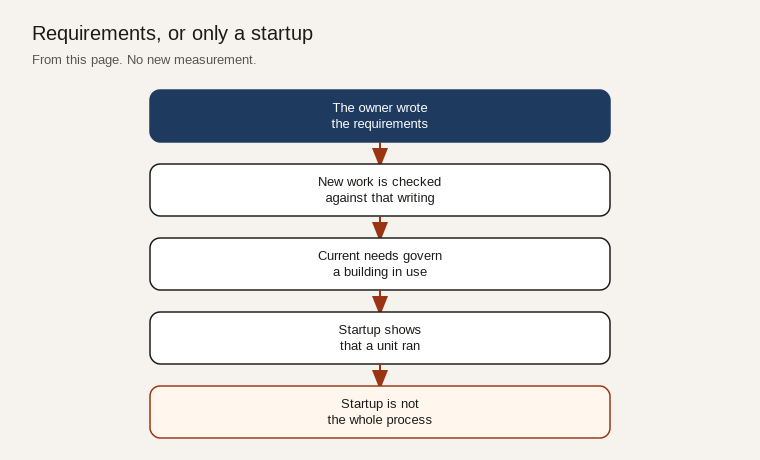
New work is checked against the owner’s written requirements, an occupied building that was never commissioned uses current needs, and a startup does not answer either question.
What the process is asked to verify
Commissioning asks whether the scoped elements were planned, designed, installed, tested, operated, and documented so they meet the objectives the owner wrote down. The public preview of ASHRAE Guideline 0-2019 states that purpose: the guideline describes a process capable of verifying that the facility and its systems meet the Owner’s Project Requirements. The preview covers process and records. It does not set equipment values for a school, an office, or a leased floor.
The Whole Building Design Guide commissioning committee describes the same job. Commissioning facilitates planning, design, construction, installation, testing verification, documentation, and operation so systems conform to those requirements. It is not design, and it is not construction. The designer still designs, the contractor still installs, and the owner accepts what remains. The process does not replace the building official.
The written requirements are the acceptance reference
For new work, the Owner’s Project Requirements, the OPR, are the written target. A line that names which rooms must stay in session is part of what “met” means. If after-hours use is never stated, there is nothing later to check it against. Guideline 0 orders the phases as predesign, design, construction, and occupancy and operations, from predesign through occupancy, for whatever systems the owner includes. The foreword says each phase is there to verify design, construction, and operator training. Requirements written only to echo finished drawings miss mismatches while they are still a paper problem.
The basis of design is the record of concepts, calculations, decisions, and product selections used to meet the OPR and applicable rules. Guideline 0 assigns that record to the design team. Commissioning compares it with the OPR. It does not become a redesign. When the owner changes a requirement, both documents should change with the owner’s acceptance. UFGS 01 91 19, May 2023, with references aligned to the Unified Master Reference List as of October 2026, uses that split for enclosure work on projects that adopt the military guide specification. It is not a private-building code in Maryland, Virginia, or the District of Columbia.
New-building work and retro-commissioning start differently
New-building commissioning, including many major renovations still in design, starts before there is an occupied result to measure. The Whole Building Design Guide places the provider in predesign so the OPR, the basis of design, the plan, and the start of the systems manual can still change the job. Design review compares the documents with the OPR and is not a recalculation of the engineering. Construction then uses submittals, checklists, an issues log, and witnessed functional performance tests. After training, the owner operates the building. A seasonal mode that could not be run is deferred, not passed.
Retro-commissioning starts with a building already in use. In 42 U.S.C. § 8253(f), read on the Legal Information Institute in November 2026, retrocommissioning means commissioning a facility or system that was not commissioned at construction. Recommissioning means commissioning beyond development and warranty, aimed at design intent or current operating needs while occupancy requirements are met. Those federal definitions do not, by themselves, require a private owner to buy either service. The Department of Energy’s federal commissioning page, updated May 14, 2026, uses the same split: new work against design intent, retro-commissioning where it never happened, recommissioning where it did, and ongoing commissioning from monitored data.
Where no OPR still describes the building, Navy and Marine Corps existing-building criteria call the target the current facility requirements: how the facility should run now. Those criteria do not apply to a construction project, and a civilian school or lease is outside their mandatory scope. Designing against an OPR is still a different job from investigating a building that already runs.
| Decision | New-building commissioning | Retro-commissioning | A one-day startup |
|---|---|---|---|
| Typical moment | Predesign through early operation of new work or a major renovation | An occupied building not commissioned at construction | The day a unit is first started |
| Reference | Owner’s Project Requirements, changed only with the owner’s acceptance | Current facility requirements for present use | The startup record and the manufacturer’s instructions |
| A record can show | Scoped systems were checked against those requirements in the phases the plan names | Selected systems were investigated, and accepted changes were checked against current requirements | The equipment operated on that visit |
| It does not show | That unnamed systems were included, or that the building official approved the work | That a new-building design process occurred | That integrated systems meet the owner’s requirements |
Use recommissioning when an earlier record exists and the question is drift, a change of use, or a return to documented intent after the warranty phase. Calling every old-building visit retro-commissioning hides whether that comparison is possible.
A one-day startup does not answer the owner’s question
Startup is a construction task. A contractor or a manufacturer’s representative starts equipment and records that it operated. Commissioning may witness selected startups. Witnessing is not the process.
Chapter 9 of the Los Alamos National Laboratory Sustainable Design Guide, hosted by the Department of Energy, states the limit. Commissioning is more than construction observation, start-up, testing, adjusting, and balancing, final punch-out, or later re-tuning. Those steps can sit inside the process. Alone, they cannot meet its goals. The chapter is an older laboratory guide, not a current code, and this page does not adopt its historical cost discussion.
Functional performance testing asks whether installed systems behave as the requirements and design documents require, under the conditions the plan names. The Whole Building Design Guide has contractors run those tests with the provider witnessing. UFGS 01 91 19, in its own definitions, calls that test a systematic check that controls and other elements can operate as required. This page gives no procedure or setpoint. Testing, adjusting, and balancing is separate: it measures flows against assigned design values. That report can be an input. It does not train operators, and it is not the commissioning report.
A startup visit is too late to test the design against the OPR, and it usually stops at one unit rather than interfaces among equipment, the enclosure, and controls. For federal facilities, section 8253(f) runs the defined process from the first day of design through not earlier than 1 year after construction, including preparation of operators. A private contract may choose another duration. A last-afternoon visit still does not close training, the issues log, or a deferred seasonal check.
Write the target before tests are discussed
The owner need not draft a specification. The target does have to be specific enough that two proposals price one job. The prompts below fit an OPR or, for an existing building, the current facility requirements. They are not pass-fail values.
| Topic | What the owner should be able to point to |
|---|---|
| Use | Who occupies the building, which spaces must stay available, and which hours matter |
| Scope | Which systems are included, and which are excluded |
| Interfaces | Where new work joins existing equipment, controls, or the enclosure |
| Changes | Who may revise the requirements, and how that revision is recorded |
| Training | Which staff must operate the scoped systems after handover |
| Open items | How unresolved issues, deferred checks, and exclusions will be listed |
Systems commissioning is the same process stopped at named systems. A lighting-control replacement is not a whole-building effort. The Whole Building Design Guide allows either boundary. State it before fieldwork, or the prices will not describe the same work.
The enclosure is a frequent gap. On projects that use UFGS 01 91 19, enclosure commissioning checks that enclosure materials, components, assemblies, and systems meet the OPR. Leaving the roof or walls out can make a mechanical result answer the wrong question. That specification’s pressure-test instructions are not repeated here.
Accessibility is a design standard, not a commissioning step. The 2010 ADA Standards for Accessible Design set scoping and technical requirements for new construction and alterations of covered state and local government facilities, public accommodations, and commercial facilities. A commissioning report is not a compliance finding. Name the standard in the requirements only when it applies. A qualified professional and the authority having jurisdiction decide.
An occupied addition makes the split concrete
This example is illustrative. It is not a Soleil Energy project, and it is not a procedure.
A district keeps classes in the existing wing while an addition is built. The OPR names the rooms that must stay in session, the systems that serve only the addition, and the ducts and controls the addition will join. New-building commissioning asks whether the design traces to those sentences, whether the interfaces behave as required, whether operators were trained, and what the issues log leaves open. A one-day startup of the new air handler shows that the unit started. It does not show that the existing wing stayed usable.
The older wing has no commissioning record, and some rooms overheat. That is retro-commissioning against current facility requirements, not a question the addition’s startup sheet can close. An investigation of the old wing also does not approve the addition. If a test would stop ventilation in occupied rooms, the plan has to say who resolves that conflict. Commissioning does not invent a safe outage. A landlord faces the same split when a tenant changes hours on a floor served by a base-building unit and nobody has written which document governs it.
Handover is a set of matched records
A later manager should see what was required, what was checked, and what stayed open. The Whole Building Design Guide treats the report, the issues log, training, and the systems manual as part of the process. Keep the current OPR or current facility requirements, the basis of design or a note that none exists, the plan, the scope list, and operations information that matches the installation. Name who was trained and any deferred seasonal mode. If the enclosure was out of scope, say so. Startup sheets can be attachments. A log that says only “see contractor” does not say what was accepted or postponed.
What commissioning does not decide
It does not establish that the building, energy, or fire code is satisfied. The authority having jurisdiction and the responsible design professionals make those calls. As of November 2026, this page states no size threshold, deadline, or eligibility rule for Maryland, Virginia, or the District of Columbia. Whether commissioning is required, and for which systems, depends on the adopted edition and the local authority. Confirm that edition for the site.
ASHRAE’s commissioning catalog, checked in November 2026, still lists Guideline 0-2019. Its foreword distinguishes that guideline, which outlines best-practice order for varying owner requirements, from ASHRAE/IES Standard 202, described there as the minimum acceptable process. The catalog lists Standard 202-2024 for new buildings and new systems, Standard 230-2022 for existing buildings, and Guideline 0.2-2015 for existing systems and assemblies. The guideline is on continuous maintenance, so name the edition and any addenda the contract uses. This page uses the preview and the catalog, not the full paid text.
ENERGY STAR Portfolio Manager compares energy use with similar buildings, past use, or a reference level. That comparison does not show that a system meets the OPR or the current facility requirements, and commissioning does not promise lower bills. A qualified professional must assess the actual building. Nothing here is a finding about a particular school, lease, or renovation.
Bring the requirements into the construction scope
Soleil Energy’s construction practice includes commercial and institutional work, renovations, and phased school and government projects while a building stays in use. That is a construction scope, not a statement that Soleil Energy is the commissioning provider. An owner who needs the written target to survive phasing, roof work, or a tenant alteration can bring the draft requirements, the known problems, the drawings on hand, and the rooms that cannot be shut down. The service-area page names Maryland, Northern Virginia, and Washington, DC, including Prince George’s, Montgomery, Howard, and Arlington counties, and states that there is no DC office. Do not assume coverage past that list. The useful conversation starts from the requirements and the occupancy limits.
Questions to settle before the scope is priced
How does commissioning verify systems against documented owner requirements?
For new work, compare submittals, installation, witnessed functional performance, training, and the issues log with the OPR and the basis of design. Where the building was never commissioned, use current facility requirements instead. Each issue should point at a requirement a reader can find. A report that names no reference document has not finished that comparison.
When is the work retro-commissioning rather than new-building commissioning?
Keep new-building commissioning for design that is still open, including many major renovations. Use retro-commissioning when the building already runs and was never commissioned. Use recommissioning when an earlier record exists and the question is drift, or a new operating need, after the warranty phase. Say in the contract which systems sit in which scope.
Why does a successful startup not close commissioning?
Startup shows that equipment could be started on that visit. It does not show that the design met the OPR, that dependent systems behave together, or that remaining operators were trained. The laboratory guide cited above treats startup as one step, not the process. Keep the sheet, and ask which other planned phases were done.
Does testing, adjusting, and balancing replace commissioning?
No. Balancing checks flows against assigned design values. Commissioning uses the owner’s requirements and also covers design, documentation, and training. Ask who compares the two records and how a clash is logged. Neither record is the building official’s approval.
Who owns the requirements when a tenant changes the building?
The party with authority over the shared systems owns the operating target. Put new hours and equipment into the current facility requirements when they become that target, with the building owner’s acceptance where systems are shared. Commissioning can check the document. The lease decides who pays.
Do Maryland, Northern Virginia, and the District use one commissioning rule?
No. Each adopts building and energy codes on its own schedule. Section 8253(f) defines terms for covered federal facilities, and military specifications apply only when a project uses them. As of November 2026, confirm the adopted edition and any local amendment before treating a national guideline as a permit rule. A qualified professional should make that check for the building.
Project requirements depend on the site, equipment and applicable rules. Confirm design and installation decisions with the appropriate qualified professional.
