
A construction change order is a written change to the work under a construction contract that also states whether the contract price, the contract time, or both move with it. On a private project using unmodified architect-issued general conditions, the owner, contractor, and architect sign it after they agree. A change directive can direct the work before that agreement. A field fix that was never priced is neither writing.
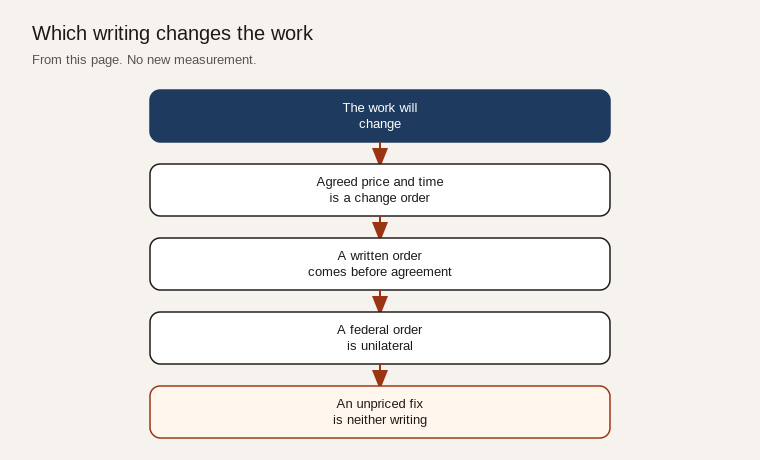
A signed change order records agreed price and time, a written directive authorizes work before that agreement, a federal order is unilateral, and an unpriced field fix is neither writing.
| Writing | Who agrees | What it settles |
|---|---|---|
| Private change order | Owner, contractor, and architect | The work, plus any change in sum, time, or both |
| Change directive | Owner and architect; the contractor need not sign | Authority to proceed before sum and time are settled |
| Minor change | The architect only | A change consistent with the documents and no sum or time adjustment |
| Unpriced field fix | No one the contract names | Nothing agreed, so it is neither of those writings |
| Federal change order | The contracting officer alone | A unilateral in-scope change, with the price often settled later |
Agreement is the private-project test
On a project that uses the American Institute of Architects’ conventional general conditions, the change order records agreement. It does not request one. AIA Contract Documents’ explanation, read in November 2026, describes it as a written agreement among the owner, the contractor, and the architect that changes the work, the contract sum, the contract time, or any combination. On those forms it is G701, and it binds when all three sign. It then becomes one of the contract documents.
Each of the three lines can be zero. The writing names the change in the work, any adjustment in the contract sum, and any adjustment in the contract time. A credit, a time-only revision, and a clarification with no money and no time can all be change orders. Treating the term as extra cost hides those cases. A proposal request asks for a price and does not authorize the work. A change order request is only the contractor’s proposal. Parties edit the general conditions, so a signed agreement that names other people to prepare or sign controls.
A directive is not a field fix
A construction change directive fills the gap when the work cannot wait and the price is not agreed. AIA Contract Documents’ comparison, read in November 2026, describes a written order, prepared by the architect, directing the contractor to proceed before cost or time is settled. G714 is the named form. The owner and the architect sign. The contractor need not sign for the directive to take effect, and the comparison says the contractor is generally required to proceed while the adjustment is determined. When the parties later agree, they typically sign a G701. If the contractor signs the directive and accepts its terms or its pricing method, that agreement itself becomes a change order. If not, the explanation says Article 7 of A201 sets the path for interim and final adjustments. The pricing method is the one already in the contract.
A minor change is narrower. The architect may order a change consistent with the documents that does not adjust sum or time. G710, Architect’s Supplemental Instructions, is the named form, and the owner and contractor do not sign. It is not a substitute when cost or time will move. If the contractor believes it will, the contract’s notice is due before the work proceeds.
A field fix that was never priced is neither writing. Someone on site says to add a curb or swap a product. The crew does it the same day, with no quantities and no time effect. A later invoice uses the change-order label. It was not signed by the people the contract names, and it states no agreed sum or time, so it is not a change order. It is not a directive, because a directive is a written order from the owner and the architect. The comparison calls that informal pattern a constructive change. Installed work does not become an agreed modification. Private notice periods sit in the signed contract, so this page states no universal number of days.
A federal change order is unilateral
Federal construction uses the same words for a different instrument. As of November 2026, Acquisition.gov shows Federal Acquisition Regulation FAC Number 2026-01, effective March 13, 2026.
FAR 43.103 calls a bilateral modification a supplemental agreement, signed by the contractor and the contracting officer. One use is the negotiated equitable adjustment that follows a change order. A unilateral modification is signed only by the contracting officer, and issuing a change order is listed as that kind of act. FAR 43.201 says the changes clause generally lets the contracting officer make unilateral changes, in designated areas and within the general scope, by a written change order on Standard Form 30 unless another method is provided. The General Services Administration forms library lists SF 30, revision date November 2016, under FAR 53.243.
FAR 43.102 allows only a contracting officer, acting within authority, to execute a modification. Other government personnel shall not execute modifications, imply authority to do so, or direct work that should be a modification. An inspector’s field direction is not a federal change order. Price the modification before execution when that can be done without harming the Government’s interest. If a significant cost increase could result and there is no time to negotiate a price, negotiate at least a ceiling price unless that is impractical. When the change order is not forward priced, FAR 43.204 requires two documents: the change order and a supplemental agreement for the equitable adjustment. If the price is agreed first, only the supplemental agreement is required. Definitization is to occur in the shortest practicable time. FAR 36.211(b) requires certain small-business construction solicitation notices to publish the agency’s added definitization procedures, or to say none exist, and timing data for the prior 3 fiscal years.
FAR 52.243-4, Changes (June 2007), is the clause FAR 43.205(d) prescribes for fixed-price construction expected to exceed the simplified acquisition threshold. Below that threshold, FAR 43.205(e) prescribes a different clause. Paragraph (a) lets the contracting officer, without notice to the sureties, change the specifications, the method of performance, or Government-furnished property or services, or direct acceleration, within the general scope. Paragraph (b) treats another written or oral order from the contracting officer as a change order only if the contractor gives written notice of the date, circumstances, and source and states that it regards the order as a change order. Paragraph (c) says that, except as the clause provides, no order, statement, or conduct of the contracting officer is a change. Paragraph (d) requires a written equitable adjustment, and for a paragraph (b) change it excludes costs incurred more than 20 days before that notice, except for defective specifications. Paragraph (e) requires a written proposal within 30 days, unless extended. Paragraph (f) bars a proposal after final payment.
“Without notice to the sureties” does not freeze the bond. FAR subpart 28.1 covers bonds in the same text. Section 28.102-2 provides that a price increase, above that subsection’s threshold, adds bond protection equal to the increase unless the contracting officer makes the lesser-amount determination the subsection allows. Section 28.106-5 requires the surety’s consent in stated cases, including some price changes and new work beyond the original scope.
Maryland and Virginia public contracts
Private work follows the signed contract. The statutes below are public-procurement rules, and they do not attach to a private job because the building is in the same state. As of November 2026, Maryland tracks the federal pattern. State Finance and Procurement §13-201 defines a change order as a written order signed by the procurement officer directing changes the contract lets that officer order without the contractor’s consent. A contract modification is a written change to specifications, delivery, time, price, quantity, or other terms, made by mutual action of the parties.
Section 13-218 requires a clause for the State’s unilateral written power to order in-scope changes and a temporary stop. A construction contract also needs a clause if the site differs from the specifications, and a claims path under §15-219. A price-affecting change needs prior written approval and a prior fiscal certification of available money and of the effect on the project budget or total construction cost. If the certification shows cost beyond budgeted and available money, the change is prohibited unless more money is provided or the scope is reduced to fit the budget.
Section 15-112 says when covered State construction work may start. It excludes public school construction and public school capital improvements, and it yields where it conflicts with federal law. Except as the section provides, change-order work may not be required to begin until the procurement officer issues a written change order naming an agreed price, a force account, a construction change directive, or a time-and-materials basis. The directive is a path inside that writing, not a reason to start with nothing on paper. A disagreement about whether work is already in scope does not erase the officer’s power to order work the contract is determined to require, or the contractor’s claim. It is not a license for unpriced extras. Unit-price work may continue past the estimate without a change order, with a final adjustment if the actual quantity requires one. Within 5 days, the prime must give the subcontractor a copy and the subcontract amount. For State Highway Administration or Maryland Aviation Administration construction, a written acceptance letter has that force until the written change order issues. Section 15-112 does not govern county contracts.
Code of Virginia §2.2-4309, read on the Virginia Law site in November 2026, lets a public contract allow modification during performance. A fixed-price public contract may not increase past the threshold in that section without advance approval of the Governor or designee, for state agencies, or of the governing body, for political subdivisions. A noncompliant political-subdivision modification is voidable at the governing body’s discretion and cannot support a contractual claim under §2.2-4363. The threshold is in the statute and does not apply to private work. District of Columbia public rules were not restated from the D.C. Code here; use the District contract for who may authorize a change.
What the writing still has to decide
Name the work added, deleted, or revised, and the drawings and specification sections it replaces, with dates. State any price adjustment and the method the contract already uses, and keep original-scope work out of the backup. State any time adjustment and the completion date that results. The AIA explanation asks whether the change is on the critical path and whether concurrent delay is in the request. Off-path work does not automatically move the date. An authorized detail can still conflict with the roof, the structure, or another trade. A qualified designer has to check the building; this page does not. FAR 43.204 also urges that a federal settlement release state any exception, because a broader release is a different deal.
Subcontract paper is separate. The AIA explanation points to G701S for an agreed change with a subcontractor. ConsensusDocs 796 is a unilateral subcontract directive for immediate work while a formal change order is still negotiated. It is not an agreed subcontract price and not the owner’s change order.
Design-build does not delete the instrument. The Design-Build Institute of America defines the method as one contract for design and construction and states that it brings fewer changes and fewer claims. That is DBIA’s account, not a rule that changes are unavailable. FAR 36.102 likewise defines federal design-build as one contract with one contractor. Details inside criteria the owner already set are often performance. Changing those criteria needs the instrument the agreement names.
An illustrative roof, told three ways
The following sequence is illustrative. It is not a Soleil Energy project and not a design for any roof.
A contract replaces the membrane on an occupied office and shows no new curb. A facility manager tells the foreman to add a curb and two walkway paths. The crew installs them that afternoon, with no price, no time effect, and no record of whether the penetration suits the membrane or the structure. The later invoice is labeled a change order. It is not. It is a field fix that was never priced.
If the private parties agree first, the change order states scope, sum, and time before the extra work. If the open roof cannot wait, the owner and architect sign a directive and price it later. A covered Maryland State contract still follows §15-112, and a federal contract still follows the contracting officer’s order. The facility manager’s request is none of those writings, and it does not show that the curb is an acceptable roof detail.
Before the next signature
Sort the pending change from the file: who may direct the work; which sheets change; whether the work is already required; which pricing method applies; what completion date results; and, on a public contract, which approval and fiscal step is still open, and whether a federal job still needs a supplemental agreement or a bond update.
Soleil Energy’s commercial, institutional, renovation, design-build, and roofing work is described on the construction page. A useful discussion starts from the delivery method, what is already signed, what changed, and whether price and time are in writing. The service-area page names Prince George’s, Montgomery, and Howard counties in Maryland, Arlington County in Virginia, and Washington, DC, where the company serves the District and does not keep an office. This page does not replace the contract, a design check, or counsel on a dispute.
Questions that change the next document
Does every change order add money?
No. The AIA explanation of G701 allows the contract sum to rise, fall, or stay put. Deleted work does not automatically return time.
When may work start before the price is agreed?
Only under the instrument the contract provides: an AIA change directive, a federal contracting officer’s order under FAR 52.243-4, or, on a covered Maryland State contract, the procurement officer’s written change order under §15-112. A field instruction is none of those.
Why is a federal change order unlike the private one?
FAR 43.103 makes the federal change order unilateral. The contracting officer signs, and the supplemental agreement often prices it later. An unmodified AIA change order is the agreement itself, signed by the owner, the contractor, and the architect.
Does design-build remove change orders?
No. One contract for design and construction, as DBIA and FAR 36.102 describe it, often makes development inside the owner’s criteria part of performance. A change to those criteria still needs the instrument the agreement names. Fewer changes is not zero changes.
What if the work is already installed?
Record who directed it and whether that person had authority, then use the path the contract still allows. Quantities help the price. They do not supply missing authority. Notice and waiver belong with counsel reading that contract.
How is this different from an allowance or a unit price?
An allowance or unit price is already in the contract. Reconciling it can still need a writing, and the AIA account of common causes includes that step, but it is not the same event as adding work the documents never showed. Maryland’s unit-price exception in §15-112 does not carry over to a private contract.
Project requirements depend on the site, equipment and applicable rules. Confirm design and installation decisions with the appropriate qualified professional.
