
Construction closeout is the set of contract decisions that turn finished construction into a facility the owner can occupy, operate, and pay for. It is not a single signature or a binder delivered on the last day. Separate decisions cover substantial completion, the punch list, record documents, training, and final payment. Each one has its own evidence, and finishing one does not decide the others. The signed contract, not a generic checklist, controls what must be shown.
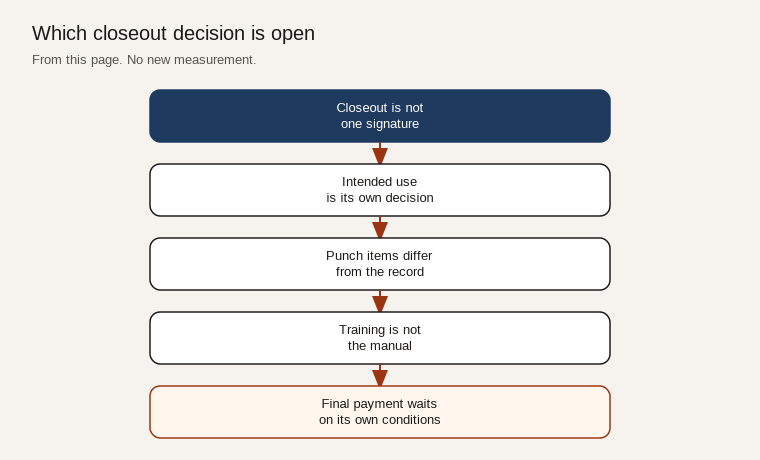
Intended use, remaining items, record documents, training, and final payment are separate decisions, and finishing one of them does not decide the others.
Five decisions, not one binder
A certificate, a deficiency list, drawings, a manual, a sign-in sheet, and a final invoice answer different questions. Name each decision in the agreement and in the general-requirements specification before bids.
| Decision | The question it answers | What it does not decide |
|---|---|---|
| Substantial completion | Can the owner use the work, or a named portion, for its intended use? | That every deficiency is gone, or that occupancy has been approved |
| Punch list | Which items remain, who finishes them, and by when? | That an omitted item is waived |
| Record documents | Do final records show what was installed, including concealed changes? | That the design set or a field markup is that record |
| Training | Were the named people instructed on the required systems? | That a manual upload is the instruction |
| Final payment | Have the conditions for the last payment been met? | That moving in, or releasing part of a hold, closes the contract |
Private and federal contracts name these stages differently. Beneficial occupancy is not a date on an American Institute of Architects certificate. The clauses and the District of Columbia occupancy page below were read as of November 2026 and apply only when that text governs. Maryland, Virginia, and the District do not share one retainage or lien statute, and this page states none.
Substantial completion is an intended-use decision
On the AIA framework, substantial completion means the work, or a designated portion, is sufficiently complete under the contract documents for the owner to occupy or use it for its intended purpose. AIA Contract Documents describes that test and places final completion later, when the punch list, the required records, and the final-payment conditions are finished.
The G704-2017 sample certificate records the date for the portion identified. The parties attach incomplete or corrective work, the time allowed to finish it, and the split of security, maintenance, heat, utilities, damage, and insurance. Warranties required by the contract documents start on that date unless the certificate says otherwise. The sample sets no warranty length. There is no universal AIA certificate of final completion. A partial certificate must name the portion, and only if the contract allows one.
Occupancy is the authority having jurisdiction’s approval, not the certifier’s. In the District of Columbia, the Department of Buildings describes a certificate of occupancy as verification that the use complies with the zoning regulations, the DC construction codes, and the Green Building Act. Conditional, core-and-shell, and permanent certificates are separate, and none of them is G704-2017. As of November 2026, that District page is not the rule in Maryland or in Arlington or Fairfax.
GSAM 552.211-70, Substantial Completion (Mar 2019), displayed with GSAM Change 200 effective October 19, 2026, requires use of the entire work without impairment from unfinished or deficient work and without interference from the contractor. Where the contract requires it, fire and life-safety systems must be tested and accepted by the authority having jurisdiction first. The clause is a General Services Administration supplement, not a private default.
FAR 52.236-11, Use and Possession Prior to Completion (Apr 1984), lets the Government use finished or partial work after the contracting officer lists what remains. Use is not acceptance.
The punch list records remaining work
The punch list registers incomplete or nonconforming items. The G704-2017 sample says failure to include an item does not change the duty to complete the contract documents. A list with no room, no trade, and no duration does not finish the form.
Give each line a number, a room or grid, the defect, the trade, a due date, and the person who confirms the fix. Close the line only after that person has seen it. Keep this list apart from the possession list in FAR 52.236-11, which is notice before use and not a certificate. If a test must wait for a season, or a room is occupied, write the reason and the return date on the line.
Record documents are not the design set
Record documents say what was built after finishes cover it.
The August 2026 Unified Facilities Guide Specifications section 01 78 00, Closeout Submittals, prepared by the Army Corps of Engineers for the Naval Facilities Engineering Systems Command and the Air Force Civil Engineer Center, states that its references agree with the October 2026 Unified Master Reference List. As-built drawings are marked-up drawings kept on site, showing deviations such as modifications, answers to requests for information, contracting-officer direction, contractor design, and differing site conditions. Record drawings are the compilation of those conditions. Notes limit that record-drawing language to design-build, and to design-bid-build only when the contractor prepares the set. The section binds a Maryland, Virginia, or District job only if the contract incorporated it.
The trailer set is the working as-built record until the contract’s review accepts the compilation. Execution text calls for the as-built submittal 30 days before the beneficial occupancy date. That interval is tailored guide text, not a private statute. The content list includes buried utilities, piping, and final-inspection revisions. “Record drawings,” with no list, does not identify a concealed pipe.
Source files supplied for drafting are not construction documents. The signed and sealed set governs a conflict, and the contractor uses the source files at its own risk. FAR 52.236-21, Specifications and Drawings for Construction (Feb 1997), as displayed for FAC Number 2026-01 effective March 13, 2026, says shop-drawing approval does not excuse an error or a failure to comply, except a variation the clause says must be described and approved. Alternates I and II (Apr 1984) apply only when added, and then they require finally approved shop drawings through acceptance. The basic clause does not.
Training is not the manual
The manual is the reference. Training is the session. UFGS 01 78 23, Operation and Maintenance Data, May 2023 with Change 4 dated August 2026, agrees with the October 2026 master list. The manual holds manufacturer data for training designated personnel. Part 3 requires comprehensive training before acceptance for beneficial occupancy, on the systems the technical sections name, for maintenance personnel and applicable occupants. A Navy editing note adds a facilities management specialist.
Subject to brackets the editor resolves, the training plan reaches the contracting officer at least 60 calendar days ahead, after the quality-control manager or the commissioning authority approves it. The plan names the systems, the audience, the instructors, and the schedule. Trainees receive an outline 14 calendar days ahead. Sessions are recorded, including questions. Open questions are answered in writing and added to the recording. Attendees sign a daily roster. A validation letter states the systems, the instructor, and when and where, with the rosters attached: two copies to the contracting officer and one in the manual. The roster without the letter does not close the item.
This is a Department of Defense guide specification. A private contract may require less, but it should name the audience, the systems, and the closing document. Manual issues are a progress submittal, a prefinal submittal a bracketed number of days before beneficial occupancy, and a final submittal on that date.
Soleil Energy’s commercial solar operations and maintenance guide covers monitoring, inspection, repair, and reporting after a commercial plant is in service. That later work uses equipment identities, warranty conditions, and as-installed records from closeout.
Final payment waits on stated conditions
The last payment follows the contract’s conditions. Moving in does not meet them by itself. FAR 52.232-5, Payments under Fixed-Price Construction Contracts (May 2014), as displayed for FAC Number 2026-01 effective March 13, 2026, requires completion and acceptance of all work, a proper voucher, and a release of claims other than claims the contractor excepts in stated amounts. A progress-payment certification is not final acceptance of a subcontractor.
If progress is unsatisfactory, FAR 52.232-5 allows the contracting officer to retain a maximum of 10% of the payment until satisfactory progress is achieved. At substantial completion, the same clause lets the contracting officer keep only the amount adequate to protect the Government and requires release of the rest of the withheld funds. As of November 2026, that ceiling applies when progress is unsatisfactory. It is not an automatic hold on every invoice and not a Maryland, Virginia, or District cap.
GSAM 552.211-70 withholds final payment and any retainage release until contract completion, after the punch list is corrected and final-payment conditions are met. The two clauses can both be in the contract and do not say the same thing.
On an AIA-framework job, substantial completion may change the sum still held. Final payment generally waits for the listed documents, which can include paid-bill affidavits, lien releases, and surety consent when a performance or payment bond is in the contract.
A warranty is a dated instrument
A warranty needs a start date, a length, an issuer, and the upkeep that keeps it in force. The G704-2017 sample starts contract-required warranties on the substantial-completion date unless the certificate states another date. It states no length.
FAR 52.246-21, Warranty of Construction (Mar 1994), is optional. The contracting officer may insert it for a fixed-price construction contract when agency procedures approve a warranty clause. The contractor then warrants conformance and freedom from defect in equipment, material, design furnished, or workmanship, at any tier, except a Government-furnished defect the contractor did not cause. The warranty continues for 1 year from final acceptance, or for 1 year from earlier possession of a part. Repair or replacement carries 1 year from that repair or replacement. The contractor remedies the defect, including resulting damage to Government property, at the contractor’s expense. Rights for latent defects, gross mistakes, and fraud remain. As of November 2026, these periods belong to this clause only.
The contractor must obtain ordinary commercial warranties, put them in writing for the Government if directed, and enforce them if directed. After paragraph (b) expires, the Government may sue at its own expense on a subcontractor, manufacturer, or supplier warranty. UFGS 01 78 00 has the editor submit a plan at least 30 days before the pre-warranty conference, listing the 1-year construction warranty, longer warranties with their own end dates, and the maintenance that keeps each warranty in force.
Product, workmanship, and roof coverage on a solar project can come from different issuers. Soleil Energy’s explanation of solar panel warranties separates those layers. File each warranty with its issuer, the contract’s start date, and the required upkeep.
Design-build changes who decides
The Design-Build Institute of America defines design-build as one contract for design and construction, where other methods keep those contracts apart. The certifier may be the design-builder’s architect, an owner advisor, or a contracting officer. The five decisions remain, and the agreement names who makes each one.
An illustrative floor, decided five times
This walk-through is illustrative. It is not a Soleil Energy project and not contract text.
An owner renovates one occupied office floor. The contract allows substantial completion of that floor alone. Lights, exits, and the floor’s air system are ready. The certificate names the floor, the date, and who handles security, utilities, and damage there.
The punch list names a door that will not latch, a stained tile, and a missing directory, each with a trade and a date. A mislabeled circuit found later is added, and leaving it off the first list would not waive the work under the G704-2017 sample. The moved conduit is still a markup, not the record drawing. The manual is uploaded, but the session and validation letter are open, so training is open. The final invoice waits on closed punch items, an accepted record set, the training record, and the named releases.
Questions owners ask before they sign
Does a certificate of occupancy prove substantial completion?
No. One decision belongs to the building official under adopted code and zoning. The other belongs to the contract’s certifier. In the District, conditional, core-and-shell, and permanent certificates are different approvals, and none is G704-2017. Core and shell leaves tenant interiors unfinished.
If the punch list omits a defect, has the owner accepted it?
Not under the G704-2017 sample, and not under FAR 52.236-11. The omitted item remains the contractor’s duty, and possession is not acceptance. A waiver has to be written by the person authorized to waive work.
When does a markup become the record drawing?
When the named person accepts the compiled set. UFGS 01 78 00 treats the field markup as the as-built drawing and the compilation as the record drawing. Shop drawings join that record only if Alternate I or II of FAR 52.236-21 is in the contract.
Can the manual substitute for training?
Only if the specification says so. UFGS 01 78 23 also requires the session, the roster, the validation letter, and written answers to open questions before beneficial occupancy.
Does substantial completion release the final payment?
It may change retainage. Under FAR 52.232-5, funds beyond the amount kept to protect the Government can be released then, while final payment still needs full acceptance, a voucher, and a claims release. Under GSAM 552.211-70, both final payment and retainage release wait for contract completion. Other jobs follow the signed section and the state lien statute, which differs in Maryland, Virginia, and the District.
Does design-build remove the punch list and the record set?
No. One contract changes who certifies the work. It still has to name the open items, the concealed record, the trainees, and the releases for the last payment.
Bring the five decisions to a delivery discussion
Soleil Energy’s construction work includes commercial, residential, government, and institutional projects, renovations, and design-build in Maryland, Northern Virginia, and Washington, DC. A useful conversation names the delivery method, the budget, how the building will be used, and who certifies each closeout decision. Discuss that scope with Soleil Energy’s construction team. Bring the draft closeout list or the open questions. The conversation does not decide code compliance, a certificate signature, or whether a payment is due.
Project requirements depend on the site, equipment and applicable rules. Confirm design and installation decisions with the appropriate qualified professional.