
A dry-type vs liquid-filled transformer comparison asks how the windings are insulated and cooled, not which unit is universally appropriate. A dry-type unit uses air and solid insulation. A liquid-filled unit immerses the windings in a dielectric fluid that also carries heat. The choice changes containment, maintenance, code review, and replacement fit. It does not, by itself, select a power class or an installation location. A qualified professional must assess the actual site.
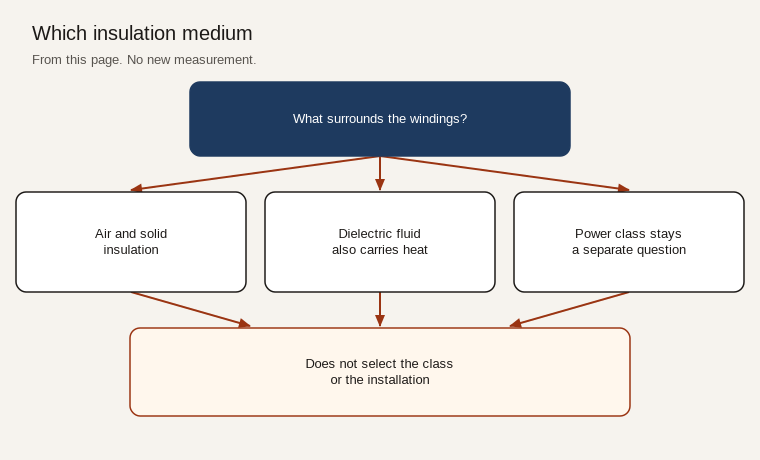
Choose the comparison by the medium around the windings, air and solid insulation or a dielectric fluid that also carries heat, and keep power class, location, and spill rules as separate questions.
What the two constructions actually do
Both constructions change voltage. The difference is the medium around the core and coils. In a dry-type unit, solid insulation and air, or a gas or dry compound in a sealed design, insulate the windings and carry heat away. In a liquid-filled unit, a dielectric fluid insulates and moves heat to the tank and cooling surfaces.
Those are families, not one product. The IEEE catalog entry for IEEE C57.12.01-2020 describes general requirements for ventilated, non-ventilated, and sealed dry-type distribution and power transformers and autotransformers, single-phase and polyphase, with 601 V or higher in the highest voltage winding. Those three enclosures do not share one cleaning routine or one heat path.
As of November 2026, the active liquid-immersed general-requirements document on the IEEE catalog is IEEE C57.12.00-2026. Its posted scope covers liquid-immersed distribution, power, and regulating transformers and autotransformers at the same 601 V floor. It excludes instrument transformers, voltage regulators, arc-furnace and rectifier transformers, specialty transformers, grounding transformers, mobile transformers, and mine transformers. Liquid in a tank does not put every special-purpose unit under that standard. The catalog lists the edition as active, with board approval on November 4, 2026, still titled as an approved draft and superseding the 2021 edition. This page uses that posted scope only and states no temperature-rise cutoff.
A unit whose highest winding is below that 601 V floor is outside both statements. Many indoor transformers serving utilization voltage are in that group. They still have a cooling method and an installation question. Pointing at C57.12.01 or C57.12.00 does not answer them.
Power class is a separate question
Dry-type versus liquid-filled is a cooling and insulation comparison. Power class versus distribution class is a different comparison.
IEEE C57.12.10-2017 is a product standard for liquid-immersed power transformers and autotransformers. The catalog states a base-rating scope of 833 kVA and above single-phase and 750 kVA and above three-phase. That sentence identifies which liquid-immersed power transformers the product standard covers. It is not a cutoff for choosing dry-type or liquid-filled construction, it does not cover dry-type units, and a smaller liquid-filled unit is not automatically a distribution transformer in every other document.
The general-requirement standards already apply to both distribution and power transformers inside their voltage floor and exclusions. A dry-type unit can still be a power transformer under its own product documents. Choosing air or a fluid does not answer the power-versus-distribution question, and the reverse is also true.
A nearby standard is easy to mix in. IEEE 1547-2018 covers interconnection of distributed energy resources with the utility system, including performance, abnormal conditions, power quality, and islanding. It is not a transformer construction standard. An interconnection can require a transformer. It does not decide dry-type versus liquid-filled.
Loading guides do not travel with the cooling method
Nameplate capacity is a rating under stated conditions. Loading above that rating has its own guide, and the guides are not interchangeable.
IEEE C57.91-2025, published March 5, 2026, addresses loading mineral-oil-immersed transformers and step-voltage regulators above nameplate: insulation effects, gases in the oil, loss of transformer life, auxiliaries, ambient, altitude, cooling method, and temperature criteria. The title is mineral oil. A natural-ester, synthetic-ester, or silicone fluid is not covered merely because it is a liquid.
IEEE C57.96-2013 gives loading recommendations for dry-type units in ventilated, non-ventilated, and sealed enclosures. As of the catalog page read in November 2026, its status is inactive-reserved, inactivated March 21, 2024, with a revision project listed. An inactive guide, and temperature-rise figures that appear only in an older catalog summary, are not a current design limit. Rise, insulation system, and ambient are nameplate items for the unit being purchased.
A fan or pump stage is not spare capacity. It exists only while the auxiliaries run and the heat path works. A hotter room or a higher altitude also changes the margin, so copying the capacity text forward does not carry it.
Fire rules are adopted text, not a fluid slogan
As of November 2026, the NFPA 70 development page lists the 2026 edition of the National Electrical Code as current. It also describes a reorganization that began in the 2023 edition, continued in 2026, and is aimed at completion in the 2029 edition. Section numbers have been moving. A remembered article number, or a table in an older brochure, is not the project rule until it is checked against the edition the authority having jurisdiction enforces.
COMAR 09.09.03.04 states that the Maryland Board began enforcing that 2026 edition on August 31, 2026, and on August 31 every three years after that. The sentence is a board enforcement rule. It does not fix every local amendment in Maryland, and it says nothing about Virginia or the District of Columbia. Confirm the adopted text with the authority having jurisdiction. This page does not prescribe a fire rating, a fluid, or an installation location.
Less-flammable is a classification codes and listings use to sort some dielectric fluids, often by fire point and by restrictions in the listing. It is not a blanket claim that the fluid is safer, and it does not approve a vault, a roof, an electrical room, or an outdoor pad. Mineral oil, a seed-oil fluid, a synthetic fluid, and a silicone fluid can share a tank shape and still differ for fire review, spill review, and loading. Identify the fluid and read the adopted code. Dry-type construction removes the liquid. It does not remove heat, clearances, or nearby combustible material. Where a ventilated unit sends its air is still an installation fact.
Oil rules follow the fluid and the whole facility
As of November 2026, EPA’s description of oils covered by the Spill Prevention, Control, and Countermeasure rule is wide. Oil includes petroleum, fuel oil, sludge, animal and marine fats, vegetable oils from seeds, nuts, fruits, or kernels, and other oils and greases, including synthetic oils and mineral oils. The same definition is in 40 CFR 112.2, shown on eCFR as current through November 19, 2026. A seed-oil dielectric is not outside that definition merely because it is not mineral oil. Whether a named product meets it is a composition question. Silicone fluid is not named in the text read here, so this page does not place it in or out.
That section defines oil-filled operational equipment as equipment whose oil only supports the device. Transformers are a named example. They are not bulk storage containers, but they still contain oil, and storage capacity means shell capacity.
40 CFR 112.1 applies to certain non-transportation-related facilities that, because of location, could reasonably be expected to discharge oil in harmful quantities to navigable waters or adjoining shorelines. A facility is outside the part, aside from Regional Administrator authority also written there, only when both of these are true: completely buried oil storage of 42,000 U.S. gallons or less, and aggregate aboveground oil storage of 1,320 U.S. gallons or less. Only containers of 55 U.S. gallons or greater count. The location test gives no credit for dikes or other manmade features. Those figures are the regulation’s thresholds as read in November 2026, not a target volume for a transformer.
Count the facility. A generator reservoir, hydraulic oil, drums, and a transformer add together. A dry-type unit adds no oil container, and replacing one liquid-filled unit does not end a federal plan if other oil remains. Choosing a liquid does not, by itself, create a plan. Compliance with this part also does not replace other federal, state, or local requirements.
Federal efficiency covers a defined distribution class
The Department of Energy sets conservation standards for distribution transformers under the Energy Policy and Conservation Act. The April 22, 2024 final rule, 89 FR 29834, took effect July 8, 2024, and requires compliance with the amended standards on and after April 23, 2029. It treats liquid-immersed, low-voltage dry-type, and medium-voltage dry-type distribution transformers separately. As of November 2026, which table applies still depends on manufacture date and equipment class. This page does not copy efficiency tables.
The boundary is in 10 CFR 431.192, as read in November 2026. A distribution transformer under that subpart has an input of 34.5 kV or less, is rated 60 Hz, and has a capacity of 10 kVA to 5000 kVA for liquid-immersed units and 15 kVA to 5000 kVA for dry-type units. A low-voltage dry-type unit there has an input of 600 volts or less. A medium-voltage dry-type unit has a primary between 601 V and 34.5 kV. Both dry-type definitions use a gaseous or dry-compound medium. Paragraph (5) then excludes specified categories, so a specialty or regulating unit is not covered until that list is read.
Those sentences bound a federal efficiency category. They are not temperature-rise limits and not advice to change construction at a stated capacity. A liquid-immersed power transformer under IEEE C57.12.10 can fall outside the definition, and a small dry-type unit can fall inside it while sitting below the 601 V floor of IEEE C57.12.01. The same section treats basic impulse insulation level as a feature that changes energy use, so that level is not kept merely by copying one-line voltages onto a different insulation system.
Replacement is a constraint problem
An illustrative case: an indoor liquid-filled unit is proposed for replacement by a dry-type unit at the same voltages and capacity. That match does not show a fit. The room may lack the airflow a ventilated dry-type unit needs. Bushings may become lugs. Impedance may change fault current on existing equipment. Taps, winding arrangement, and impulse level may not match, and the door, pad, or outage may suit only one enclosure.
Removing the fluid drops that tank from the oil inventory and does not close the facility-wide spill question or the fire-code question for the new enclosure. Staying with a liquid, including a change away from mineral oil, can change the loading guide, the tests, the listing, and the spill count even when the tank looks familiar. This illustration is not a Soleil Energy project and not a recommendation to choose either construction.
The submittal should name the cooling designation, any fan or pump stage, insulation system, offered temperature rise, impedance, basic impulse level, fluid identity if any, weight, footprint, terminations, and the standard editions claimed. “Meets IEEE” or “meets code,” with no document number, is not yet a specification. Nonsinusoidal current, altitude, and ambient belong on that sheet for both constructions.
Records worth gathering before a price
| Record or question | What it changes |
|---|---|
| Adopted code edition and the authority having jurisdiction | Which text and local amendments actually apply |
| Fluid name, if a liquid is present | Which loading guide, tests, listing, and spill definition are candidates |
| Other oil on the site, with shell capacities | Whether one transformer changes a facility plan |
| Cooling stage, temperature rise, and insulation system | Whether two ratings are the same thermal duty |
| Impedance, impulse level, taps, and winding arrangement | Whether downstream equipment and the connection still hold |
| Terminations, weight, access, and heat path | Whether the room and the outage can accept the enclosure |
| Manufacture date and federal distribution-transformer status | Which efficiency rule, if any, applies |
| What must stay in service | Whether the work sequence fits the building |
The table is a briefing list, not a specification or a finding for an address.
Questions that change the scope
Does less-flammable liquid mean the installation is the safer one?
No. Less-flammable is a sorting label in codes and listings. As of November 2026, it is not a finding that the fluid is safer in every building, and it does not skip containment, protection, or a location review. Identify the fluid and read the adopted code. This page does not choose the fluid.
Does an indoor room require a dry-type transformer?
No. Placement is decided under the adopted code, the building, the fluid if any, and the authority having jurisdiction. Dry-type units are not automatically allowed indoors, and liquid-filled units are not automatically barred. Ventilated, non-ventilated, and sealed dry-type units also differ. Maryland’s board date for the 2026 edition of NFPA 70 does not answer Virginia, the District of Columbia, or a local amendment.
Can a matching capacity be swapped from liquid-filled to dry-type?
Not on capacity alone. Impedance, impulse level, terminations, heat path, weight, and fluid obligations can all change. A low-voltage unit and a unit at 601 V or higher may not share the same IEEE general standard. Federal classes also split low-voltage dry-type, medium-voltage dry-type, and liquid-immersed distribution transformers. Crossing those lines is a new specification.
Does a vegetable-oil fluid fall outside the federal oil rule?
Not because the label says vegetable. As of November 2026, EPA and 40 CFR 112.2 include vegetable oils from seeds, nuts, fruits, or kernels, plus synthetic oils and mineral oils, so a seed-oil dielectric can sit inside the definition. Silicone is not named in the text read here. The location test and the capacity exemptions above still apply to the whole facility, including other oil.
Is this the same choice as power class versus distribution class?
No. The general-requirement standards cover both distribution and power transformers inside their scopes. IEEE C57.12.10 is a separate product standard for a defined set of liquid-immersed power transformers. The Department of Energy definition is another boundary, with its own edges and exclusions. None of those boundaries chooses the cooling method.
What should be in hand before asking for a replacement price?
Bring the one-line, a nameplate photo or transcription, the fluid identity if any, room or pad limits, the outage window, and any nonsinusoidal load. Add the adopted code edition once the authority having jurisdiction is known. Without that set, a price is a catalog conversation, not a check of fault current, heat, containment, or fit.
Talk through ratings and replacement constraints
Soleil Energy’s power services include transformer installation, maintenance, and replacement, including oil sampling and related testing where that work is in scope. A useful next step is a scope conversation about voltage, nameplate data, fluid identity if any, access, and the outage window. That conversation does not select a fluid, assign a fire rating, or approve a room. A qualified professional must assess the actual site, including the adopted code and, where oil is present, the spill rules for the facility rather than for a single nameplate.
Project requirements depend on the site, equipment and applicable rules. Confirm design and installation decisions with the appropriate qualified professional.