
Transformer dissolved gas analysis is a laboratory or monitor measurement of gases dissolved in the insulating liquid of a liquid-filled transformer. Thermal or electrical stress can break down that liquid and the solid insulation in it, leaving gaseous products in the liquid. The sample is asked to show which gases are present and how they are changing. It does not, by itself, decide whether the unit should stay in service. A qualified professional has to assess the actual equipment.
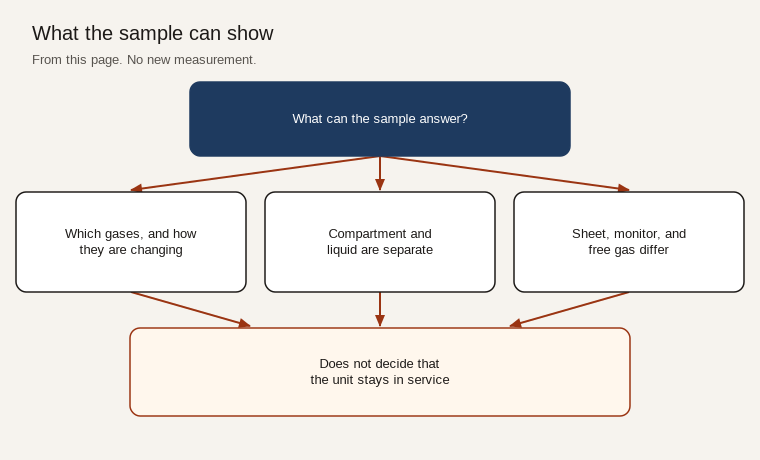
Read a dissolved-gas result as evidence from one compartment and one method about which gases are present and how they change, not as a decision that the transformer should stay in service.
What the sample is asked to show
A liquid-filled transformer uses insulating liquid as a dielectric and as a way to move heat. Cellulose paper or pressboard is often immersed in that liquid. ASTM D3612 states that oil and oil-immersed insulation may decompose under thermal and electrical stress and generate gaseous products that dissolve in the oil. The nature and amount of the gases recovered may indicate the type and degree of the abnormality that produced them. The same statement says the rate of generation, and the change in specific gases over time, are also used to evaluate the apparatus.
The sample is evidence about one volume of liquid, from one compartment, at one time, by one named method. It supports a comparison with earlier results from that compartment. It is not a picture of the tank interior, a proof of nameplate rating, or a calendar life for the paper. IEEE C57.104-2019 describes its intent as information concerning serviceability. As of November 2026 the IEEE catalog lists that edition as active and also lists a revision project. This page does not restate the guide’s norms.
ASTM D3612-02(2026) is listed active, last updated January 26, 2026. It covers extraction and gas-chromatography measurement for electrical insulating oil at or below a stated viscosity. The scope names hydrogen, oxygen, nitrogen, carbon monoxide, carbon dioxide, methane, ethane, ethylene, acetylene, propane, and propylene, and it says other methods have been used. A note sends interpretation to IEEE C57.104 rather than treating the test method as the interpretation guide. The standard does not claim to cover every safety concern in its use.
A July 2022 Idaho National Laboratory brief, available through OSTI, describes methane, hydrogen, ethylene, ethane, the carbon oxides, oxygen, nitrogen, and acetylene as key dissolved gases whose rates can indicate condition. That brief is research on plant data, not an operating rule. This page gives no key-gas chart, no ratio recipe, and no concentration at which a unit should leave service. Those steps belong in the current guide for the actual liquid and compartment, applied by someone qualified to assess the unit.
What the result cannot decide
IEC 60599:2022 describes how dissolved-gas or free-gas concentrations can be interpreted to diagnose mineral-oil-filled equipment in service and to suggest future action. The catalog limits that suggestion: the indications are guidance, and action is taken only with proper engineering judgment. As of November 2026 the IEC webstore shows edition 4.0, published May 25, 2022, with a stability date of 2026. That date is a committee planning mark. It does not prove the edition was withdrawn, and it does not prove a particular owner has adopted it. Confirm the edition named in the specification.
The 2019 IEEE catalog entry says the guide treats quality verification and limitations, not only fault identification. This page has not reproduced those clauses. A damaged container, the wrong compartment, a monitor never compared with a laboratory, or a sheet that omits the method can make a confident report useless.
The result cannot locate the source inside the tank. IEEE C57.152-2025, the guide for diagnostic field testing of liquid-filled power transformers, regulators, and reactors, says several kinds of tests should be interpreted together, and that the manufacturer’s acceptance criteria may take precedence. As of November 2026 that edition is active, published June 2, 2026. Dissolved gas does not close the question alone.
One traditional diagram used to name a fault type has a structural limit. The Idaho National Laboratory brief says that diagram should not be used unless a fault is already known to be present, because it always returns a diagnosis. A method that always names a category will name one on a quiet unit. That is a reason not to hand someone a ratio worksheet. It is not a reason to ignore a real change in the record.
A published case shows the same boundary without a rule to copy. In a February 6, 2019 NRC inspection report for Byron Station, dissolved-gas trends after an earlier event were judged, with the manufacturer, to be a longer-term reliability concern rather than an imminent failure. Monitors were added, and a separate furan sample looked at the cellulose. The unit later failed. The report tied that failure to maintenance that exposed already damaged lead insulation, while the inspectors wrote that the earlier evaluation fit the data then available. A watched trend did not identify the damaged lead, and it did not decide whether opening the tank later was acceptable. The narrative is not a threshold.
The liquid and the compartment change the question
IEEE C57.104-2019, on the catalog page read for this article, is for mineral-oil-immersed transformers. It is the wrong document to assume for a natural ester or a synthetic ester. IEEE C57.155 is the separate family for ester-immersed transformers. As of November 2026 the catalog shows the 2014 edition and an active draft project that would supersede it. Nothing on that page says ester actions match mineral-oil practice. Confirm the edition the laboratory is using.
A tap changer is another compartment. IEEE C57.139-2026 is listed as the active standard for gases in liquid-type on-load tap changers. The catalog title still includes the words “approved draft,” with board approval dated September 25, 2026, and it supersedes the 2015 guide. The page says dissolved-gas measurements in the tap-changer oil are required in order to use the guide, and that the guide is category-specific rather than manufacturer-specific. A main-tank sheet is not a tap-changer sheet. Breathing arrangement and mechanism type are part of that guide; a glossary cannot assign them to an unseen unit.
IEC 60599:2022 is written for mineral oil and cellulosic paper or pressboard. Its notes on other equipment, including bushings, are indications only. It may be applied to other liquid-solid systems only with caution. A bushing note is not a limit for a reader to enforce.
Dry-type transformers do not offer this sample. A March 2006 Bureau of Reclamation volume, FIST 6-2, lists dissolved-gas analysis for oil-filled transformers and not for dry-type units. That volume is Reclamation practice, not a specification for every commercial site. If there is no insulating liquid, a dissolved-gas trend is the wrong request.
A laboratory sheet, a monitor, and free gas are different records
ASTM D3612 is a laboratory method, not a field instruction for drawing oil. IEC 60567:2023 covers free gas from gas-collecting relays and analysis of free and dissolved gases. Oil sampling is no longer in that document; the catalog points to IEC 60475:2022, which applies to mineral and non-mineral liquids in transformers and similar equipment, within a stated viscosity limit. Dissolved gases are extracted before chromatography. Free gas from a collecting relay is analyzed without that extraction. Those sentences describe the standards. They are not steps for opening a valve.
A monitor is a different record. IEEE C57.143-2024 covers parameters, risk and benefit, sensors, and monitoring systems for liquid-immersed transformers. The catalog states that this guide does not cover interpretation of monitoring results. As of November 2026 it is the active edition, published August 27, 2025. An alarm is not the mineral-oil interpretation guide, and it is not a chromatography report.
In the Idaho National Laboratory study, online analyzers recorded gases more often than the yearly analysis used for 2-furaldehyde, which the gas sensor did not record. FIST 6-2 says continuous monitors need expertise, may not be justified for smaller transformers, and do not remove periodic tests of moisture, dielectric strength, interfacial tension, acid number, and furans. That remark is the 2006 manual’s judgment, not a price for any other owner.
Oil condition and paper aging are separate questions
IEC 60422:2024 is supervision guidance for mineral insulating oils and other hydrocarbon liquids, including reconditioning, reclaiming, and oil contaminated with PCBs. A scope note says condition monitoring of the equipment by dissolved gases, furanic compounds, or other means is outside that document. As of November 2026 the webstore shows edition 5.0, published July 18, 2024. A dielectric, acidity, or interfacial-tension result answers a question about the liquid. It does not answer the dissolved-gas question, and the gas sheet does not answer the liquid-maintenance question.
Paper aging has other markers. IEC TR 63025:2021 describes methanol and ethanol as cellulose-degradation products dissolved in the liquid, usable as aging tracers. That is not the ASTM D3612 hydrocarbon list. The laboratory brief adds that 2-furaldehyde in the study came from a more intensive oil analysis, not from the gas sensor, and that direct tests of paper strength are difficult. None of this is a remaining-life calculation for a reader to run.
A chromatography report aimed at hydrogen and hydrocarbons is not a determination of whether the liquid is regulated for polychlorinated biphenyls. If transport or disposal raises that question, it has to be asked under the current environmental rules and the fluid’s history. This page does not state those rules.
What to settle before anyone interprets a file
Dissolved-gas work changes scope when it is an information package, not a line that says “oil test.”
| Item in the file | What it changes |
|---|---|
| Compartment | Main-tank, tap-changer, and bushing liquids are not one sample. |
| Liquid | Mineral oil, natural ester, synthetic ester, and silicone do not share one guide. |
| Method and date | A chromatography report and a monitor trace are different evidence. |
| Earlier results for that compartment | One concentration is not a trend. |
| Recent processing, leaks, or an opened tank | The next sample can describe the work, not only an internal fault. |
| Tests the gas sheet omits | Electrical tests, moisture, and cellulose markers can still be open. |
| Who interprets, and which edition | Norms are not self-applying. An old specification may name a retired edition. |
These rows are not acceptance criteria. A baseline after filling is a different record from a sample years later. If a unit may be moved or reused, the file for each compartment is part of the purchase. A missing file is a gap, not proof that the unit is quiet.
A proposal should say whether “dissolved gas analysis” means drawing a sample, a laboratory method, a monitor, or interpretation by a qualified person using a named edition. Soleil Energy’s power page lists oil sampling, thermographic inspection, and testing among transformer services, with installation, maintenance, and replacement. That list is not a claim that every engagement includes interpretation, and it is not an acceptance of any unit.
An illustrative file, not a verdict
Consider an illustrative case, not a Soleil Energy project. After an outage, a facility receives two laboratory PDFs. One is labeled main tank and one is labeled on-load tap changer. Both name gases from the chromatography set. Neither says the unit may return to service. The main-tank liquid is mineral oil. The tap changer has its own liquid and its own operating history. Someone staples the sheets together and asks for a single pass.
Match each sheet to its compartment, liquid, and method, and set it beside earlier results for that compartment. Do not read the tap-changer sheet with the main-tank mineral-oil guide, and do not treat the main tank as a cellulose test if those markers were not requested. Note recent processing or an opened cover beside the numbers. The file can show whether the record is complete enough for a qualified assessment. It does not support a ratio exercise from this article. As the Byron report illustrates, agreeing laboratory and monitor results can still leave a maintenance exposure undescribed.
Questions that change the next step
Does a dissolved-gas sheet say to take a transformer out of service?
No. The sheet reports gases. The mineral-oil guide informs a serviceability judgment, and IEC 60599 says action follows only with proper engineering judgment. This page states no removal concentration. Someone qualified to assess the actual unit has to make that call.
Can the main-tank result stand in for the tap changer or a bushing?
No. The tap-changer guide is a different IEEE document, and it expects measurements from the tap-changer oil. IEC 60599 treats bushing notes as indications, not as one limit set for every compartment. Separate oil volumes need separate samples. A quiet main tank does not describe a gassing tap changer.
Will an online monitor replace the laboratory and the other oil tests?
No. The monitoring guide does not interpret monitor results. The Reclamation volume still calls for moisture, dielectric, interfacial tension, acid, and furan tests, and for expertise in reading the monitor. The laboratory brief’s gas sensors did not record the furan used for paper in that study. A shorter interval is not an interpretation.
Is this the same test as oil quality, furans, or a PCB check?
No. IEC 60422 places dissolved-gas analysis and furanic compounds outside oil-supervision guidance. Methanol and ethanol methods in IEC TR 63025 are cellulose tracers, not the dissolved-gas list. A run aimed at hydrogen and hydrocarbons is not a polychlorinated-biphenyl determination. Order the test that matches the decision.
What should change in scope if the unit may be reused or replaced?
Ask for the historical file by compartment, the liquid, the method, and the gaps, and name who will interpret any new sample against which edition. A single sheet taken just after oil processing is not that file. The sample may be describing the processing.
Why does this page not list ordinary gas levels?
Those levels depend on the edition, the liquid, and the compartment. The licensed interpretation texts were not used here, so this page does not reprint them. An old public table can disagree with the guide that is active now. A qualified person should apply the edition that fits the actual unit.
Bring the record, not a conclusion
Assemble the file and have a qualified person assess the actual transformer. Soleil Energy’s power page describes transformer installation, oil sampling, inspection, testing, maintenance, and replacement. Soleil Energy’s service area names Maryland, including Prince George’s, Montgomery, and Howard counties; Arlington County in Northern Virginia; and Washington, DC, and states that there is no DC office. A county on that list does not interpret a gas sheet.
Bring the laboratory sheets, any monitor exports, and a note of recent oil work, plus the outage window if maintenance or replacement is under discussion. Leave the service decision to the assessment of that unit.
Project requirements depend on the site, equipment and applicable rules. Confirm design and installation decisions with the appropriate qualified professional.
