
Electrical thermographic inspection is a non-contact examination of the infrared radiation coming off energized electrical equipment, made so a thermal pattern can be recorded while current is flowing. The image is evidence from that moment under the load and viewing conditions that existed then. It is not a repair procedure, not a temperature limit, and not proof the equipment is fit to stay in service. A qualified person has to judge the pattern against the actual equipment.
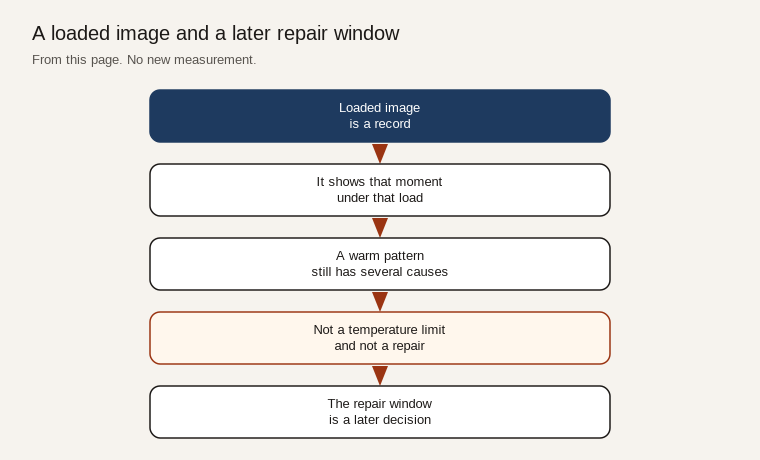
A loaded image is a record of one moment under the load then present, and the repair window is a later decision rather than a temperature limit or a repair step.
What the image records
A thermal camera builds a picture of apparent temperature from infrared radiation. It does not measure current, resistance, or torque. ASTM E1934, the active Standard Guide for Examining Electrical and Mechanical Equipment with Infrared Thermography, reapproved in 2024, says in its public significance section that an infrared examination identifies and documents exceptions. The same text says the data describe the equipment only at the time of the examination, that the examination is not remedial, and that it does not by itself show the equipment is operating properly. Other tests and maintenance are still required.
A bright area is a reason to ask a sharper question, not an instruction to tighten a lug, change a breaker, or declare a bus fit for another year. ASTM’s public text says opinions about cause, integrity, or corrective action require knowledge beyond infrared thermography.
The public scope covers documentation of qualitative and quantitative examinations. Comparing one lug with the other two is qualitative. Reporting a temperature is quantitative, and the surface dominates that reading. ASTM E1933, reapproved in 2022, states that emissivity can cause surface temperature measurement errors. This page assigns no emissivity setting. A painted bus and a polished lug can look different for reasons that are not the current. Record the setting that was used.
One warm pattern, several causes
ASTM E1934 says warm exceptions are usually created by higher resistance from loose or deteriorated connections, short circuits, overloads, load imbalances, or faulty, mismatched, or improperly installed components. Cool exceptions are usually caused by failed components. A hunt for hot spots alone can miss a device that should have been carrying current and is not.
A Fluke article on electrical thermal imaging, with a modification date of November 3, 2026, describes unwanted heating when resistance or current is abnormally high, and heating that rises with the square of the current when resistance does not change. It also says equal load should mean equal temperatures, then qualifies that point: unbalance, overload, a poor connection, and harmonic imbalance can look alike. Measuring the load is what separates them.
Fluke describes a fuse hot at one end as contact trouble there, and a fuse hot at both ends as a pattern that fits overload, imbalance, or a fuse that is small for the current. That is a manufacturer interpretation, not a repair step and not an action temperature. Wind can cool a spot. A camera cannot see through a closed metal door or a solid bus enclosure. Warmth on a cover, or sun on a tank, is a clue about the surface in view, not a view of the lug behind the steel.
The survey and the repair do not share one outage
A resistive joint does not show itself when no current is flowing, so the inspection has to happen under load. That window is different from a de-energized torque check, an insulation-resistance test, or breaker work that needs an electrically safe condition. Putting both kinds of work on one day, without saying which tasks need live load, produces either a useless image or energized work nobody planned.
OSHA 1910.333 requires safety-related work practices near or on equipment or circuits that are or may be energized. Live parts to which an employee may be exposed shall be deenergized before the employee works on or near them, unless the employer can demonstrate that deenergizing adds hazards or is infeasible because of equipment design or operational limitations. A note lists testing that can only be performed energized as one example of possible infeasibility. Placing a loaded survey in that example is not permission. The employer still has to show the infeasibility, and other practices have to protect people if live parts stay exposed.
Only qualified persons may work on energized circuit parts, and they have to know the techniques, protective equipment, and insulated tools the task needs. Opening a cover is energized work. Reading a saved image is not. A warm lug does not authorize tightening it while the gear is energized. De-energized contact falls under the lockout, tag, and verification practices in the same section, including a qualified person’s test that the parts are dead.
Which section applies depends on the installation. 29 CFR 1910.269, as displayed on the eCFR on November 19, 2026, covers operation and maintenance of generation, control, transformation, transmission, and distribution lines and equipment accessible only to qualified employees, including utilities and equivalent industrial installations. It does not apply to construction, with stated exceptions, or to Subpart S. Standby or emergency generation is identified as Subpart S, so a building panel is not a 1910.269 job merely because it is electrical. Before a contract crew enters a covered yard, the host employer must inform the contract employer of specified safety-related characteristics and known conditions. The contract employer must instruct its people and report unique hazards its own work presents.
OSHA 1926.950 covers construction of transmission and distribution lines and equipment, including alteration, conversion, and improvement. It is not the work-practice rule for unqualified employees. Qualified employees must be trained to distinguish exposed live parts, determine nominal voltage, keep the subpart’s approach distances, and use the required protective equipment. A survey during a line rebuild follows those construction rules. None of these sections is a scanning recipe.
What NFPA 70B changed, and what it left open
As of November 2026, NFPA’s March 8, 2023 article says 70B moved from a recommended practice to the Standard for Electrical Equipment Maintenance. The Standards Council issued the 2023 edition on December 27, 2022, and it became effective on January 16, 2023, when ANSI approved it as an American National Standard. The article contrasts the 1973 recommended practice, written around what should be done, with a standard it calls more enforceable, and it says jurisdictions may take time to decide how to enforce it. The purpose it describes is safeguarding persons, property, and processes from failure, breakdown, or malfunction, and a means to establish a condition of maintenance, which the article also ties to NFPA 70E. That is NFPA explaining its own documents, not a finding that Maryland, Northern Virginia, or the District has adopted an edition. Confirm the citation with the authority having jurisdiction, the insurer, and the contract. The catalog page, retrieved November 22, 2026, shows covers for the 2023 and 2026 editions. Use the edition the citation names.
This page did not read a purchased copy of the issued book. What follows is committee text and has to stay labeled that way.
A September 30, 2022 correlating-revision report from the cycle that produced the 2023 edition includes text submitted September 22, 2022. It says infrared thermographic inspection of connections and terminations that have nominal current flow shall follow Section 7.4. The same report lists infrared thermography for all equipment at 12 months, 12 months, and 6 months across three condition columns. Manufacturer recommendations come first. Where they are unavailable and failure would present an unacceptable risk, the draft says intervals shall not exceed that table, and only if another chapter references the table. Section numbers were still being aligned.
A first-draft ballot dated July 5, 2024 repeats that infrared row, at the same three intervals, beside new transfer-switch rows. The thermography revision still contains editing marks. It discusses removing covers for a line of sight, an annex note that infrared windows can provide that view without removing covers, and documenting the temperature difference between the area of concern and a reference. The committee statement says work at operating load, or at 40% of nominal loading, was moved to the annex as a recommended practice. Permanently installed temperature devices could be permitted to satisfy the sections they actually cover. This page does not adopt that 40% of load, or any temperature difference, as a limit.
ANSI/NETA MTS-2023, approved as an American National Standard on March 6, 2023, and stated to supersede the 2019 edition, is a set of field tests for whether equipment is suitable for continued service. It is broader than one thermal image. Temperature-difference tables are often attributed to NETA. That table was not opened for this page and is not restated as an action level. A contract that cites NETA should name the edition and the load that was present.
What the scope and the handover have to fix
The visit has to be energized and loaded, someone qualified has to be allowed to open or approach the gear, and the file has to be usable later. The image does not itself add a repair, a new protection setting, or a statement that the equipment has been maintained.
| Decision | What to settle before the visit |
|---|---|
| Boundary | Which lineups, transformers, joints, and terminations are in, and which are left out on purpose? |
| Load | When will the equipment carry a representative load, and who will measure it? |
| View | Covers off, listed windows, or permanent sensors, and which edition allows that choice? |
| People | Who is qualified if parts will be exposed, and which OSHA section fits this installation? |
| Reference | A similar part under similar load, the surrounding air, or an earlier image of the same point? |
| Follow-up | What outage or test is triggered, and who may decide the image is not enough? |
A usable finding names the point, the time, the measured load, the viewing method, airflow or sun if they matter, the thermal image, a visible photo, and the reference. Name the edition if the contract required one. A warmer lug under the recorded load is a finding. A torque value is not in the image.
Windows are a listing question. A January 14, 1997 OSHA interpretation told a window maker that equipment must be acceptable under 1910.303(a), and that gear modified after a nationally recognized testing laboratory listed it must stay inside that certification. The letter notes that later rule changes can affect enforcement guidance. Cutting a window into listed equipment still needs a check against the listing and the manufacturer’s instructions. The 2024 ballot annex note is not that check and is not the issued edition. Permanent sensors cover only the points where they are installed.
On a solar plant the same limit holds. Soleil Energy’s commercial solar maintenance guide lists an infrared scan of combiners and a share of modules as one task and treats the image as symptoms crews still have to diagnose. A warm combiner lug is not, by itself, a reason to replace an inverter. A first loaded survey is a baseline only when the file says the load was present. It does not prove torque, a relay study, or an oil sample, and it does not stand in for a maintenance-test specification.
An illustrative finding
Consider an illustrative plant board, not a Soleil project and not a reported case. During a production afternoon, one phase lug looks warmer than the other two on the same device, and warmer than the lugs on a similar feeder carrying a comparable load. The file holds the thermal image, a visible photo, the equipment name, the time, and the current a qualified electrician read on each phase. The room air is still. The lugs are dull, not freshly polished.
That file is a difference under those conditions. It is not a temperature limit and not a repair procedure. It cannot separate a loose strand, corrosion, unbalanced current, or a reflection. If the difference stays unexplained, the repair belongs in a planned outage on that cubicle. A later survey does not clear the rest of the board. Heating rises with the square of current when resistance holds steady, so a light-load day can hide a joint that would stand out in normal service. Record the load. Do not call a near-idle lineup a completed survey.
Questions facilities and utility teams ask
Does the image say what to repair?
No. ASTM E1934’s public text separates the examination from remedial work. The image can point an outage at a device. The repair method comes from the equipment, the manufacturer’s instructions, and a qualified judgment once the gear is safe for that work.
Can the survey share the repair outage?
Not if the outage removes the load. Diagnosis needs current. Repair needs a de-energized window. Tightening a warm lug during the survey is energized repair work, not an ordinary look.
Is NFPA 70B automatically binding in Maryland, Northern Virginia, and DC?
Not from the sources read for this page. OSHA’s work-practice sections are regulations. NFPA 70B applies when an authority, insurer, or contract adopts an edition. As of November 2026, confirm which edition that citation names. A summary is not the adopted text.
What belongs in the handover?
Identity, load, view, reference, both images, and what was not inspected. The crew should not have to guess which breaker was warm, or whether the comparison was the next phase or the room air.
How is a substation survey different from a building panel survey?
The heating is similar. The rule is not. A building panel may fall under Subpart S and 1910.333. Generation, transmission, and distribution work limited to qualified employees may fall under 1910.269. Line construction may fall under 1926.950. Do not copy approach distances from the last site.
What changes in the work package?
Add a loaded window, qualified access if covers come off, a view that respects the listing, and a record the later outage can use. The image is not approval of an unchecked connection, and it does not replace oil sampling, relay testing, or a protection study. This page states no price.
Bring the window and the records
For substations, switchgear, and transformers, the useful conversation is the loaded window and the handover. Soleil Energy’s power work includes substation and switchgear engineering and construction, transformer services that list thermographic inspection and testing, commissioning, and later maintenance. A scope discussion can start from the equipment boundary, who may approach exposed parts, when the gear will be loaded, and which records must exist before an outage is used for repairs. That conversation is about the actual site. It is not a finding that a particular image has already shown a defect, and it is not a substitute for the qualified person who has to assess the equipment.
Project requirements depend on the site, equipment and applicable rules. Confirm design and installation decisions with the appropriate qualified professional.