
An energy management system is the controls and data layer that decides how a facility’s loads, on-site solar, battery storage, and the utility connection interact. It uses measurements and operating priorities to request charge, discharge, load changes, or a limit on export. It is not the utility’s bulk-grid control system, and it is not a single thermostat. A qualified professional still has to match the design to the actual site.
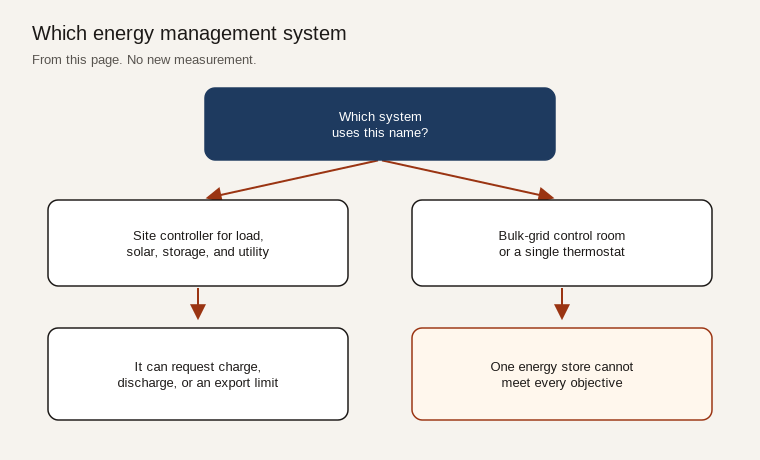
A site controller that can request charge, discharge, or an export limit is not the bulk-grid control room and is not a thermostat, and one store of energy cannot meet every objective at once.
The same name describes different jobs
Facility managers hear “energy management system” in at least four conversations. The equipment, the owner, and the failure are not the same.
A bulk-power energy management system is a control-room tool. The North American Electric Reliability Corporation’s September 2024 reference describes it as computer applications system operators use to monitor, control, and optimize generation or transmission, including supervisory control and data acquisition, automatic generation control, state estimation, and contingency analysis. The job is situational awareness on the bulk electric system. The document is guidance, not a binding requirement. That control room is not choosing whether a warehouse charges a battery before a billed demand interval.
An organizational energy management system is a management practice, not a controller. ISO 50001:2018, confirmed in 2024, is titled “Energy management systems: Requirements with guidance for use.” The organization’s public description presents a technology-neutral Plan-Do-Check-Act framework. The catalog page is not the paid standard, so it shows purpose, not unseen clauses. Following it does not issue a power command.
A building energy management information system is software for facility data. The Federal Energy Management Program, on a page updated December 8, 2025, defines these tools as software that monitors, analyzes, and controls building energy use, from bills and interval meters to, in some products, changes to equipment. Scope can include building automation and distributed resources. The page says identified measures do not happen unless people act. Reporting is not authority to move power.
The system this page explains is the site layer used with solar and storage. Sandia National Laboratories’ chapter on energy storage management systems describes a local energy management system that takes operating data from the storage device and the power conversion system, calculates charge or discharge power, and sends that result as a power command. Data move upward. Commands move downward. A central system may dispatch many sites, or the local system may be the only layer.
Where the site controller sits
A battery management system measures voltage, current, and temperature and estimates state of charge and state of health. Sandia treats that layer as the one that keeps the storage device inside safe conditions and reports state upward. Disconnecting a module when a limit is violated belongs there. The energy management system does not replace that protection.
The power conversion system moves energy between the battery’s direct-current side and the building or utility alternating-current system. Sandia describes lower-level control, which operates the converter, and higher-level control, which selects charging, discharging, or standby from the power command and the storage state. Voltage support and power-factor behavior may live in that conversion equipment rather than in the supervisory layer. Which functions are enabled is a utility and equipment question.
Above both, the site energy management system chooses the objective and the requested power from the meter, solar production, storage state, and any external instruction it was built to accept. It does not create energy the battery lacks, and a request is not proof of delivery. Sandia notes that the conversion system still checks battery limits while it delivers commanded power.
A thermostat holds a zone near a selected temperature. A drive follows its own process signal. Those loops can be inputs or controllable loads. They do not know the billed interval, remaining battery energy, or an export limit unless they were connected for that purpose. If the controller acts on a sensor that is not the billed meter, its screen can look successful while the bill uses a different quantity. Interval data, production, and storage state need one time source and a known measurement point. A gap in the record, or a meter replaced during the year, is a data problem before it is a tuning problem.
One store of energy cannot meet every objective
Sandia’s chapter separates fast power applications, such as frequency support, from slower energy applications, such as shifting use or reducing customer demand. Behind the meter, it describes charging and discharging so use moves in time, with bill effects discussed through demand charges, time-of-use energy charges, and net metering. Market operation is different: stay inside market rules and the device’s physical limits. Energy used for one purpose is not still available for another.
Energy held back for an outage, for battery life, or for a later interval reduces what can be dispatched now. The Department of Energy’s December 2023 battery evaluation method treats a minimum state of charge left in the controller as energy the evaluation will not count as demonstrated capacity. It does not say what minimum to use. It also says availability cannot be judged from meter data alone, because an idle hour can be intentional. The dispatch command and the response are both required.
Backup is an electrical configuration, not a software name. The Department of Energy’s solar and resilience overview, updated May 18, 2026, says ordinary solar is designed to switch off when grid power is lost, and that producing power then takes a properly configured inverter and storage. IEEE 2030.7-2017 addresses, in its published scope, microgrid energy-management functions above component control, including grid-connected and autonomous operation. A grid-tied battery that never separates from the utility is not a microgrid because a vendor used this name. That catalog statement is a boundary, not a certification.
Discharge changes a demand charge only when the tariff’s interval, season, and any look-back use the quantity the controller reduced. Soleil Energy’s guide to how solar and batteries relate to demand charges explains why the billed figure and the tallest spike on a chart can differ. Point the controller at the tariff’s figure.
Loads, solar, storage, and the utility are one decision
An illustrative office still has high cooling load late in the afternoon while solar production falls. The controller can request battery discharge so utility import does not rise by the entire drop. The request works only while conversion equipment can deliver the power and the battery management system still allows energy to leave. Recharge is a second transaction: importing during an hour that sets billed demand can move the peak instead of shrinking it. An illustrative warehouse with two peaks the same day depends on energy left after the first and on whether charging is allowed before the second. This sequence is not a Soleil project, a size, or a target to copy.
Export is separate from the building’s preference. IEEE 1547-2018, in the catalog statement read for this page, covers interconnection and interoperability of distributed energy resources, including performance, response to abnormal conditions, power quality, and islanding. That is interconnection behavior, not an economic schedule. As of November 2026 the catalog lists the 2018 edition as active, with a 2020 amendment. Which edition and settings apply depends on the utility and the authority having jurisdiction. Baltimore Gas and Electric, Pepco, Dominion Energy, and Southern Maryland Electric Cooperative do not share one rulebook. Confirm the account. Do not treat the catalog as permission to choose settings. Also state whether the battery may charge from the utility, only from on-site generation, or only under a defined condition. That choice changes interconnection treatment and when import occurs.
A building system or a dashboard is still not this layer
A building automation system coordinates loads such as air handling and lighting. The Federal Energy Management Program treats it as one data source, not as the decision among solar, storage, and the utility meter. Some deployments can write to equipment. Many only trend points and announce faults. Ask which points are read, which can be written, and who may approve a write.
A monitoring screen is a view. Soleil Energy’s monitoring and operations service covers production, faults, and maintenance, including systems another firm installed. Watching a value is not requesting power. Keep the command, the power at the agreed meter, and any mismatch alarm as separate records. If the software only recommends, name who must act. If it acts alone, say which conditions stop it. A qualified professional makes those choices for the site.
Wholesale operations use another energy management system
When PJM Interconnection writes “EMS,” it means its operational energy management system and the data exchanged with generation owners. Manual 14D, Generator Operational Requirements, Revision 72, effective November 18, 2026, applies to generating facilities on the PJM transmission system, or to PJM market participants, unless the manual narrows that scope. Section 4 is data exchange between PJM supervisory control and the PJM energy management system. For storage-resource model participants and hybrid resources, the real-time list includes state of charge. That path is not the definition of a controller on a retail account that never enters the market.
Manual 14H, New Service Requests Cycle Process, Revision 07, effective August 19, 2026, covers new service requests, studies, and agreements. A site controller does not perform that process. Many behind-the-meter projects interconnect only with the distribution utility and the local permit office. Some do both. Confirm which path applies.
Substation supervisory control operates equipment in a power facility. Soleil Energy’s power work includes that integration for substation and distribution projects. It is not the logic that chooses how a building uses its own solar and storage.
Devices often do not share one protocol. Sandia identifies Modbus TCP as commonly used, DNP3 as important in utility supervisory control, and IEC 61850-7-420 plus the Modular Energy Storage Architecture as interface references. Name each required interface, who supplies the driver, and what commissioning must show.
What this layer changes in the project
Putting a real energy management system in scope changes compatibility and handover evidence. It does not, by itself, decide a permit or a tax result.
| Question | Why it belongs in the scope |
|---|---|
| Operating priorities | Backup reserve, demand management, on-site solar use, and an outside program can conflict. Write the order. |
| Measurement boundary | Controller and bill must share the meter, the interval, and the time source. |
| Command authority | Which devices accept a power request, which only report, and who may edit logic later. |
| Hard limits | Battery protection, conversion ratings, and any export or import constraint from the interconnection. |
| Loss of the supervisory computer | What each resource does if that computer or its network is unavailable. |
| Evidence | Commands compared with measured power, not only a chart of battery activity. |
| Handover | Who may change priorities, who holds access, and how a change is recorded. |
Cybersecurity belongs here because the controller can change physical power. The National Institute of Standards and Technology’s Guide to Operational Technology (OT) Security, Special Publication 800-82 Revision 3, September 2023, is guidance, not a certification. It defines operational technology as programmable systems that interact with the physical environment, including industrial control and building automation, and it warns that blocked information can cause loss of view or loss of control and that unauthorized command changes are a serious incident class. A site controller that requests inverter or battery power is in that class. The publication record, checked November 22, 2026, shows Revision 3 as final and a draft of a later revision with comments due November 30, 2026. A draft is not current guidance. This page does not claim Soleil Energy holds any framework and does not prescribe settings. A qualified professional decides what a contract requires.
Sandia distinguishes remote calculation of commands from functions that stay local. State which pattern applies and what still runs if the higher layer drops, then test it.
Soleil Energy’s guide to commercial battery storage in Maryland explains why backup and demand reduction are different jobs. The controller is where that choice becomes a rule. If a proposal cannot say which job wins, the equipment list is ahead of the plan.
Questions to settle before the order
- Which priority wins when reserve, a demand interval, and solar production disagree, and what happens if a point is missing?
- Which devices accept a command, and which battery or inverter limits can reject it?
- If outage operation is a later goal, what grid separation is still missing? Ordinary grid-tied solar does not provide it, as Soleil Energy’s guide to solar during an outage explains.
- Is a wholesale path in scope? If it is, name the agreement and the data exchange. If it is not, say so.
- Who can change logic remotely, and what monthly record will show that commands matched the meter?
Frequently asked questions
Is the battery management system the same thing?
No. Sandia’s architecture gives the battery management system protection and state reporting. The energy management system calculates the power request. Protection may refuse the request. The upper layer does not override that refusal.
Will it run the building during an outage?
Only when the equipment is designed and approved to separate from the grid and operate as a local source. The Department of Energy’s resilience overview says ordinary solar switches off when the grid is lost. An afternoon discharge schedule does not add that capability.
Does the monitoring screen count as the system?
Not by itself. The Federal Energy Management Program treats supervisory control as one capability, not as a feature of every information product. Soleil Energy’s monitoring service watches and maintains production. It is not dispatch authority.
Does this enroll the site in PJM’s markets?
No. Manual 14D applies to generating facilities on the PJM transmission system or to market participants, unless the manual says otherwise. Manual 14H is the new-service process for projects on that path. A controller used only to shape a retail bill is different. Confirm the path with the serving utility before treating market telemetry as required or available.
What if the controller or its network fails?
The specification should say what each resource does, and the project should test that condition. Central dispatch and local control, as Sandia distinguishes them, fail differently. This page does not assign a fallback.
How is an ISO 50001 effort different?
The public description of ISO 50001:2018 presents a technology-neutral management framework for energy performance. A site controller is equipment and software that request power from named devices. A facility can have either, both, or neither. One does not satisfy the other.
Start with interval data and the priorities
Bring the interval record, the tariff lines it can affect, the loads that must keep running, and the order among backup, bill management, and on-site solar use. Those facts decide whether a supervisory layer belongs in the project.
Soleil Energy works with homes and businesses in Maryland, Northern Virginia, and Washington, DC. For a storage discussion, bring that interval data and the operating priorities. Soleil Energy’s battery storage team can use the records, with the existing electrical equipment, to see whether storage and its controls are the right scope.
Project requirements depend on the site, equipment and applicable rules. Confirm design and installation decisions with the appropriate qualified professional.
