
A guaranteed maximum price is a ceiling on what an owner pays for the cost of the work plus the contractor’s fee, for a defined scope. Below the ceiling, payment follows allowable cost plus the fee. Above it, the firm that accepted the ceiling carries the excess unless the contract raises the ceiling. Allowances, written assumptions, and owner changes can still move the number. It is not a lump sum, and it is not cost-plus with no cap.
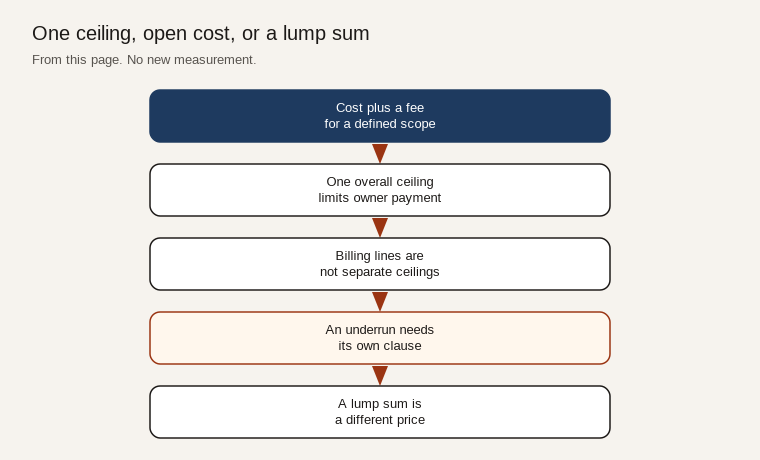
Payment follows allowable cost plus the fee up to one overall ceiling, a billing line is not its own ceiling, and an underrun is not shared unless the contract has a savings clause.
What the ceiling limits
The ceiling limits payment for a defined scope. It does not cap land, financing, separate consultants, or furniture the owner buys outside the contract, and it does not turn the job into a stipulated price.
As of November 2026, the AIA A102-2017 summary is the owner-contractor form for the cost of the work plus a fee when a ceiling is required. The A102 instructions say to insert one figure for the cost of the work and the fee together. The fee is inside that figure, not stacked on top of it.
AIA A133-2019 is the construction-manager form, used with A201-2017 and B133-2019. The manager may advise before construction and then build. The owner may accept, reject, or negotiate the proposal. The manager is bound to furnish labor and materials and to finish at or below the ceiling only when the owner signs Exhibit A. This page uses GMP as a short name for the full term. A proposal spreadsheet is not the signed amendment.
ConsensusDocs 500, as of November 2026, is another publisher’s owner-manager agreement. Its description says the manager can do preconstruction work, can subcontract fully designed portions before the rest of the design is finished, and can set the ceiling before design is complete through the 500.1 amendment. A133 prices preconstruction in its own article. Confirm whether that pay sits inside the later ceiling or is billed apart. The summaries do not choose for you.
Allowable cost is a defined list
The A102 summary says Article 7 clarifies reimbursable cost and Article 8 lists cost that is not. Off-site supervisory time is a fill-in for tasks and time share. Agreed labor rates hold unless a modification changes them. Insurance through a captive insurer the contractor controls needs the owner’s prior approval. Bonuses, profit sharing, and similar personnel incentives are not reimbursable unless the owner approves them first. An unallowable bill does not increase what the owner owes.
The fee method is blank. The instructions say to enter a lump sum, a percentage of the cost of the work, or another method, and how the fee changes when the work changes. This page states no fee percentage, because the form sets none. A lump-sum fee stays put when cost moves. A percentage of cost grows until the ceiling stops the owner’s payment. Write the method down.
Billing lines are not separate ceilings
The A102 summary of section 12.1.5.2 says a schedule of values does not create a ceiling on each line. Only the overall figure is the ceiling. A line may run over if the total does not. One trade over its line is not a breach while the total is inside.
Section 12.1.5.3 requires backup to the architect when cost moves off a contingency line. The August 15, 2025 ConsensusDocs announcement says the updated 500 defines contingency and states that contingency is part of the GMP. Confirm the edition, including whether you hold the update or the prior edition the announcement kept available for 13 months after publication. Drawing contingency does not lift the ceiling. If a design change spends a fund meant for buyout, later prices have no cushion.
Allowances, assumptions, and changes
An allowance is a stated sum for work not yet fully designed or selected. It is not proof the final choice will cost that sum. A102 section 5.2.3 says to name each allowance and its amount with the ceiling. ConsensusDocs describes 500.1 as the exhibit for allowances that may vary, with clarifications, assumptions, alternates, and unit prices. Listing them does not say who pays a shortfall. One draft raises the ceiling. Another makes the contractor deliver the function inside the allowance. Another hides the rule in the exhibit. A lower ceiling can be a thinner specification, so compare the allowances and not only the headline.
A ceiling before finished drawings prices the written assumptions, not every later sheet. A102 section 5.2.4 says to state them. The A102 summary of section 5.2.6, and A133 section 3.2.8, say the owner must authorize document revisions that incorporate those assumptions. A hard buyout inside the assumptions does not create a new ceiling. A design that leaves them is a document change: not free, and not an increase until it is processed. “No added steel at the existing roof” can be checked. “Normal conditions” cannot. Attach the drawing list and date. Under ConsensusDocs 500, a fully designed portion can also be awarded while other sheets are open, sometimes before any ceiling exists.
A102 section 5.1.2 says to state how the fee moves when the work changes. Section 5.2.2 separates alternates accepted at signing from later alternates, each with a price and conditions. A later alternate is a new decision. The August 15, 2025 announcement says interim directives do not necessarily increase the GMP. That covers a directed change before cost and time are agreed, and a field instruction. AIA’s similar step is a construction change directive. Telling a crew to proceed does not, by that announcement, raise the ceiling. A102 section 5.1.5 says to list unit prices and quantity limits. Extra units raise the ceiling only if the draft says so. Liquidated damages, a separate fill-in for a missed date, are not the cost ceiling and are not a penalty under those instructions.
An underrun is not a standard split
If cost plus fee ends under the ceiling, custom does not award the gap. A102 section 5.1.7 is a blank for a bonus or for text on whether the contractor shares anything when the final sum is below the ceiling. The instructions point to A503. An empty blank is not a shared-savings deal, and it does not give the contractor the underrun as profit.
The August 15, 2025 announcement adds a shared-savings clause at section 7.2 of the updated 500 and states no percentage. Do not borrow a split. Read 7.2 or confirm it was removed. Under the ceiling the owner pays allowable cost plus the fee, so unspent cost is not invoiced. Any payment to the contractor from that gap needs its own sentence.
How a lump sum differs
A lump sum, or stipulated sum, is a stated price for a defined scope. AIA A101-2017 is that AIA form: a fixed price set by bid or negotiation, used with A201-2017. Changes can still move it. It is not an open cost-plus account. An underrun stays with the contractor.
FAR 16.202-1, effective March 13, 2026 under FAC 2026-01, says a firm-fixed-price contract is not adjusted for the contractor’s cost experience. A private stipulated sum aims at that idea. It moves when scope or an adjustment clause changes, not because cost ran high. FAR 36.207, on that edition, says firm-fixed-price contracts generally shall be used for construction, as a lump sum, a unit price, or both. Lump sum is preferred except when quantities are large or uncertain, such as grading, paving, utilities, site work, or excavation. As of November 2026, that rule is not a cost-plus ceiling.
DBIA Document 525 is the design-build lump sum, for a fixed price when project criteria are already defined. If criteria are still open, DBIA says a cost-plus GMP may fit better and names Document 530. DBIA’s design-build page describes one contract for design and construction, and progressive design-build as qualifications selection, then joint work on design and price. That delivery method can still be priced as a lump sum or as a cost-plus ceiling.
How cost-plus without a cap differs
Without a cap, the owner pays allowable cost plus the fee as cost moves. Further allowable cost does not shift to the contractor.
ConsensusDocs 510, as of November 2026, says the manager is at risk and payment is cost of the work plus a fee, but unlike the 500, no GMP is determined. “At risk” on that page does not mean a ceiling exists. A CM-at-risk cover with no signed ceiling can be the 510 deal.
FAR 16.306 describes cost-plus-fixed-fee. The fee is fixed at the start and does not vary with actual cost, though it may change if the work changes. The section says the incentive to control cost is only a minimum one. That is not a GMP. Cost can still be reimbursed. A commercial ceiling stops the owner’s cost-plus-fee duty at a stated sum unless the contract adjusts it. FAR 36.207 still points federal construction to firm-fixed-price pricing.
| Question | Lump sum | Cost plus, no ceiling | Cost plus, with a ceiling |
|---|---|---|---|
| Owner pays | Stated price, plus or minus allowed changes | Allowable cost plus the fee | Allowable cost plus the fee, up to the ceiling |
| Cost above the estimate | Contractor, unless a change adjusts the price | Owner, if allowable | Owner to the ceiling, then the firm that accepted it |
| If the work costs less | Stated price still applies | Owner pays less cost | Owner pays less; a contractor share needs a savings clause |
What to match before you sign
Before signing, match the clause for scope and exclusions, each allowance, the assumptions, the fee method, contingency, alternates, unit prices, reimbursable cost, any savings sentence, and who may direct extra work before price is agreed.
A133’s summary says Exhibit B, the bonds exhibit, should be discussed with legal and insurance counsel, and A102 has its own exhibit. The August 15, 2025 announcement lets the updated 500 set the penal sum from the GMP or an estimate, from a surety allowed to write that business. The contractor may carry a bond. The bond is not the ceiling. That announcement also describes a three-year cost-record period, or longer if law requires it. A133 lets work start by a writing before the amendment. If the owner then rejects the proposal, that early work is paid under the earlier writing. As of November 2026, a publisher synopsis is the blank form, not your edited file.
An illustrative renovation
These figures are illustrative. They are not a Soleil Energy project, a bid, or a fee to copy.
An owner and a manager price an occupied school renovation on incomplete drawings. The draft ceiling is 4,800,000 dollars, with a lump-sum fee of 300,000 dollars, one A102 fill-in shape and not a recommended rate. Estimated allowable cost is 4,200,000 dollars.
4,200,000 dollars + 300,000 dollars = 4,500,000 dollars.
The owner pays 4,500,000 dollars if those are the final allowable amounts, not the 4,800,000 dollars printed as the ceiling. The 300,000 dollar gap is unused room. With the savings clause blank, it is not a share.
Buyout then adds 500,000 dollars of allowable cost. No owner change is signed. Cost is 4,700,000 dollars, and the lump-sum fee stays 300,000 dollars.
4,700,000 dollars + 300,000 dollars = 5,000,000 dollars.
5,000,000 dollars − 4,800,000 dollars = 200,000 dollars.
The owner does not pay that 200,000 dollars unless a change raises the ceiling. It sits with the firm that accepted the ceiling. An unallowable bonus would not enter the sum.
A switchgear allowance of 180,000 dollars is in the estimate. Selected gear costs 210,000 dollars, which is 30,000 dollars over the allowance. The ceiling moves only if the allowance clause says so. An assumption that the roof needs no added steel fails when a later sheet requires reinforcement. That sheet is a document change, not free scope and not an automatic increase.
Public owners use a different rule
FAR 36.207, on the March 13, 2026 edition read in November 2026, generally requires firm-fixed-price construction, lump sum, unit price, or both. A commercial ceiling is not authorized just because the site is federal. This page does not read a solicitation. FAR 28.102-1 requires performance and payment bonds above the dollar amount in that subsection, with limited waivers, and a different payment menu for a lower band stated there. Those bonds are not a price ceiling.
Maryland, Virginia, and the District are separate. Virginia Code section 2.2-4380, as displayed on November 22, 2026, lets a state public body use a fixed-price or not-to-exceed-price construction-management or design-build contract only with Department approval and that article’s procedures. The statute says “not-to-exceed price” and, in the text read here, does not adopt a private form. It also requires a written finding that design-bid-build is not practicable or fiscally advantageous, advice from a licensed architect or engineer, and a construction-management contract by the end of schematic design unless funding rules forbid that timing. No more than 10 percent of the construction work, by cost, may be done with the manager’s own forces. The remaining 90 percent goes to subcontractors by publicly advertised competitive sealed bidding, to the maximum extent practicable. Those limits are not private-form terms, and the section dates the contract rather than the day the price must be fixed. Other articles cover institutions and local bodies. Maryland and the District use their own rules. As of November 2026, ask counsel before treating this pricing as open to a given public owner.
Questions that change the draft
Does the ceiling include the fee?
The A102 instructions put cost of the work and the fee in one figure. Check that the draft does not add the fee again, and whether preconstruction pay is inside that figure or separate.
If one trade is over its line, is the ceiling broken?
Not from that alone. Compare allowable cost plus fee with the overall ceiling after documented contingency transfers. A calm set of lines can still hide a total that is in trouble.
Who receives an underrun?
Only the savings clause. A102 leaves it optional. The 2025 ConsensusDocs clause states no split. A blank is not a share, and it is not the lump-sum habit of leaving the difference with the contractor.
Can work start before the amendment?
A133 allows a writing that starts construction before signing. That work is not yet under a ceiling. If the proposal is rejected, payment follows the earlier writing.
Bring the unsettled scope to a delivery talk
Soleil Energy’s construction practice includes commercial, residential, government, and institutional work, design-build, renovations, and roofing, in the area on the service-area page. That page names Maryland, Northern Virginia, and Washington, DC, lists Prince George’s, Montgomery, Howard, and Arlington counties, and states that the District is served with no DC office. Design-build there is one contract for design and construction, and it still needs a price form. Bring the draft amendment, the assumptions, and the allowances.
Project requirements depend on the site, equipment and applicable rules. Confirm design and installation decisions with the appropriate qualified professional.