
A planned electrical outage is a deliberate removal of a defined part of an electrical system from its normal in-service state, arranged in advance so that specified work can proceed while that part is not carrying its normal supply. It is not a fault. A fault is an unintended electrical event. The planned window identifies time, equipment, and who accepted the interruption. It does not prove the work is safe to start, finished, or ready to re-energize.
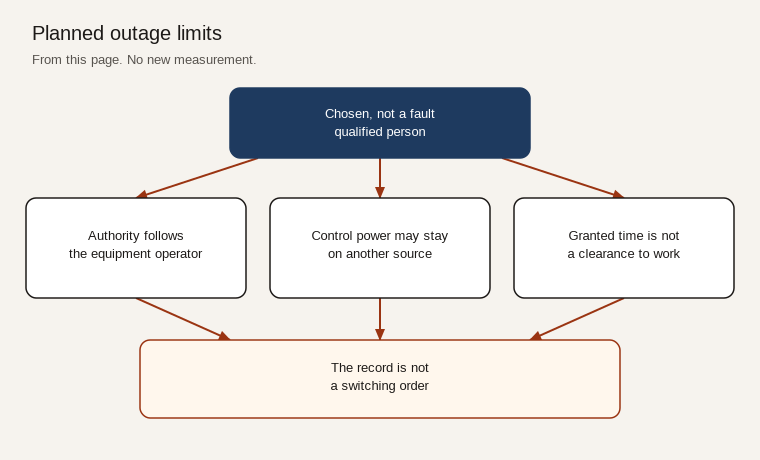
A planned window is chosen, not a fault, authority follows the equipment operator, control power may stay up, and granted time is neither a clearance nor a switching order, so a qualified person assesses the actual site.
A planned outage is chosen; a fault is not
The NERC Glossary of Terms defines a fault as an event on an electric system such as a short circuit, a broken wire, or an intermittent connection. That continent-wide entry, effective June 18, 2007, was still in the glossary file checked in November 2026. People do not schedule a fault. The same glossary uses “sustained outage” for a transmission line left de-energized after a fault or disturbance when reclosing fails. That is the aftermath of an unplanned event, not a work appointment.
Transmission statistics draw a different line. The January 2026 Transmission Availability Data System instructions call an outage automatic when a switching device operates on its own and takes an element out of service. A non-automatic outage follows manual or supervisory operation, including work during maintenance, testing, inspection, construction, or commissioning. In that document a planned outage is a non-automatic outage with advance notice for maintenance, construction, inspection, testing, or other deferrable third-party activity. An operational outage is also manual, but it cannot be deferred: it avoids an emergency or holds the system inside limits. Manual switching errors are classed with operational outages, not with the planned label.
The deferral test is the useful distinction. If the interruption can be moved when moving it is desirable, that system calls it planned. If moving it would raise risk to people, property, or equipment, or leave the system outside limits, it is not planned there, even though a person opened a device. A breaker that trips on a fault is ordinarily an automatic outage. The same breaker opened next Tuesday under an accepted request is not a fault record.
Those instructions say planned outages are not reportable. An empty column does not prove the work never happened, and a statistics exclusion for very short switching is not a method for operating equipment. IEEE 1366-2022, the active distribution-reliability guide on the IEEE SA listing checked in November 2026, supersedes the 2012 edition. The listing does not publish clause text. An index split between planned and unplanned interruptions is not a clearance. A fault during planned work is a new event, classified by what the device did, not by the original request.
One phrase, several decisions
On a retail feeder the phrase usually means the utility will interrupt its own service. Dominion Energy’s Virginia page, read in November 2026, describes a planned outage as a temporary turn-off for scheduled maintenance or upgrades, with notice ahead of time, and an unplanned outage as one from storms or accidents with no warning. The work it lists includes tree trimming, grid hardening, preventive maintenance, upgrades, undergrounding, and meter changes. BGE’s page, also read in November 2026, says the utility sometimes shuts power off so crews can reach equipment safely and tries to give date, time, and length in advance. Neither page lets a customer open customer-owned gear or operate utility devices. Utility service can be off while a generator or a second feeder still feeds part of the building.
Inside PJM the labels change again. Manual 10, revision 47, effective November 18, 2026, defines a generator planned outage as a scheduled removal, in whole or in part, for inspection, maintenance, or repair, with PJM’s approval and a predetermined duration. Maintenance outages and forced outages are separate categories, and an operations ticket need not match historical availability codes.
Manual 03, revision 72, effective the same day, requires transmission owners to report scheduled and forced outages of reportable facilities, generally those whose status can affect a monitored constraint or a free-flowing tie. A building shutdown plan does not make customer gear a PJM facility. “Turnaround” describes how much of a plant stops. It does not name the electrical boundary. Whether rooftop solar keeps producing is a separate question, covered in Soleil’s guide on solar panels during a power outage, and it depends on the inverter and any backup mode, not on the utility having scheduled the interruption.
Who can authorize the window
Authority follows who operates the equipment. No single desk grants every window.
Where OSHA’s electric-power rule applies, the employer and any system operator have set roles. As of November 2026, 29 CFR 1910.269 covers operation and maintenance of generation, control, transformation, transmission, and distribution lines and equipment, including utility installations and equivalent industrial installations open only to qualified employees. Standby generators used only to supply a workplace sit under Subpart S. The section does not apply to construction except specified generation work and line-clearance tree trimming, and it does not apply to installations and practices covered by Subpart S. Ordinary building utilization equipment is not inside this section just because a weekend was called a planned outage.
Paragraph (m) covers de-energizing transmission and distribution lines for employee protection. Equipment de-energized by some other procedure must be treated as energized. If a system operator controls the lines and their disconnecting means, the employer names one employee to hold the clearance. If no system operator is in charge, that employee also performs the operator’s functions under the paragraph. Separate crews either share one clearance holder or each comply and coordinate. The rule then requires an ordered set of conditions before the equipment may be treated as de-energized. Only the employee who requested the clearance may release it, unless responsibility is transferred. This page does not reproduce that order or any isolation sequence. Paragraph (d) is the separate hazardous-energy path for generation. A project calendar is not a lock applied by a system operator, and the crew briefing has to be repeated when conditions that affect safety change.
Construction of those lines is 29 CFR 1926.950. As of November 2026 it covers new lines and alteration, conversion, or improvement of existing ones, not work practices for unqualified employees. Following 1910.269 does not waive other construction duties. Before work, the host employer must tell the contract employer the voltages, switching-transient and induced-voltage hazards, grounds, circuit locations, pole condition, and relevant environment. The contract employer instructs its crew, names unique hazards first, and reports surprises within two working days. Coordinating those rules is not a sequence for opening devices.
On the bulk system, PJM accepts or rejects. Manual 10 says the member, not PJM, chooses the requested dates, and PJM rejects requests that harm regional reliability. A generator outage is planned only if the first request arrives no later than 30 days before the operating day it starts. PJM may withdraw approval with at least 24 hours’ notice, and only for reserves or reliability tied to emergency procedures. A transmission outage that forces a generator off must be told to the plant no later than six weeks ahead or the request can be denied. Manual 03 lets PJM approve, deny, or move any transmission outage for reliability, whatever the submission date.
A Dominion or BGE customer notice is narrower still. It records the utility’s decision to interrupt utility service. It does not appoint a contractor on utility equipment, and it does not control energy on customer gear. The employer still has that duty under whichever rule fits. A qualified professional must decide that fit for the site. This page cannot.
What an accepted window does not prove
Acceptance means a stated interruption was allowed or expected under that system’s rules at that time. It does not let workers treat the gear as de-energized. As of November 2026, 1910.269 still treats equipment de-energized some other way as energized. A letter, a screen icon, or one open switch is not the full condition. A generator, tie, charged cable, or stored energy can remain.
The window also does not freeze the work that was actually done. Manual 10 allows a generator planned-outage extension only when the original scope needs more time, requested at least 48 hours before the end. Unexpected problems are a different category, and missing that notice can make the extra hours unplanned. Planned work extended into the peak-period maintenance season is treated as forced. On transmission, weather or a PJM-directed move keeps planned priority. An owner-driven date change or a changed equipment list can lose on-time status and be judged again.
Notice and clock time are likewise unproven. Dominion says notices can miss people because of technical trouble or old contact data, the duration is approximate, and power may return early. BGE says a planned outage is sometimes canceled on short notice for weather or other operating conditions. Test sheets, settings, and marked drawings are separate evidence. Voltage restored, or an operations ticket closed, shows a source was reported back. Neither accepts the work. A fault after return is a new event.
| Record | What it can show | What it cannot show |
|---|---|---|
| Retail notice | The utility expected to interrupt its service | That customer gear is isolated, or that every occupant heard |
| Grid-operator acceptance | The request met reliability rules then | That employer energy-control steps were finished |
| Named clearance holder | Responsibility for that clearance was assigned | That tests, settings, and drawings are accepted |
| Voltage restored | A source was reconnected | That acceptance criteria were met |
| Missing statistics row | That file does not collect planned outages | That the work did not occur |
The control boundary is not the power boundary
The feeder can be open while a controller stays up on a station battery, a UPS, or another panel. A building panel can be dark while the process feeder is still live. NIST Special Publication 800-82, Revision 3, September 2023, is guidance for securing operational technology while respecting performance, reliability, and safety. Checked in November 2026, the NIST page describes those systems as programmable equipment that acts on the physical world, including industrial controls and building automation. A September 21, 2026 note points to a draft Revision 4, with comments due November 30, 2026. Revision 3 was still the final issue. It does not judge a site, and taking power off is not one of its controls.
A power window does not approve a settings change, a bypassed interlock, or silenced alarms. Write whether each controller stays up, and on which source, then confirm it. Neither a utility display nor a facility energy screen is a voltage test, and neither lets one party operate the other’s equipment.
An illustrative warehouse
This example is illustrative. It is not a Soleil project and not a work method.
A Northern Virginia warehouse will replace a customer-owned main breaker while the utility opens its service gear for a stated morning. A generator feeds a house panel, a grid-tied inverter normally stops when the utility is gone, and the fire alarm is on its own circuit. The utility window, if it holds, covers only the utility’s interruption. It does not let a contractor operate utility devices, decide whether the generator can backfeed, or describe the inverter. If the alarm rides the breaker being changed, someone with authority over that system has to arrange protection another way. A failed check does not turn the printed stop into permission to energize, or into an approved extension. Voltage later shows restoration only, not an accepted breaker or a revised drawing. A qualified professional must assess the actual site. For an occupied renovation, building sequence is a separate question, which Soleil’s construction practice addresses without replacing the electrical authorization.
Questions that change the decision
How is a planned outage different from a fault when both darken the building?
A fault is unintended. Protection and operators respond after it appears. A planned outage is chosen in advance and can be moved when moving it is the sound reliability or safety choice. An automatic trip in the middle of planned work is a new event. The original meeting title does not reclassify it.
Who may authorize the window?
Only the operator of that equipment, under the rule that covers it. A utility letter does not clear customer switchgear, and a facility manager’s date does not clear a PJM facility. When 1926.950 applies, host and contract employers still exchange hazard information. They do not inherit each other’s operating authority.
What changes in scope, cost, compatibility, or approval?
The window fixes a boundary and a length. Work outside it is cut, fed another way, or moved, and labor, temporary supply, and a second trip all move with it. No price is stated here. Sources that stay live have to match the tests. Design approval, grid acceptance, employer energy control, and test acceptance stay separate.
Can the window be taken back?
Yes. BGE may cancel on short notice for weather or operating conditions. Dominion’s duration is approximate. PJM may withdraw a generator planned outage for reserves or reliability and may move a transmission outage whenever reliability requires it. A schedule that cannot absorb that loss treats a revocable operating decision as fixed.
Does power coming back prove the work is done?
No. It proves a source was connected. Done means test records, an exception list, people and temporary grounds clear under the applicable rule, and drawings that match the gear left behind. Extra time caused by unexpected failures may sit in a different outage category than the one approved at the start.
Does the outage also shut the control system off?
Only when that controller is fed from the circuit that actually opens, and no battery, UPS, or second source holds it. State whether each controller should be on, on a named alternate, or off, then confirm it. A dark process floor does not show that alarms or protection communications died with it.
Bring the boundary with the date
Soleil Energy’s power practice covers substation, switchgear, transformer, distribution, and commissioning work from generation through the point of use. The public page asks for voltage class and the work window together. A useful discussion brings the one-line, the electrical boundary, the loads that must stay up, who operates each side of the service, and the test and handover records required before the equipment is treated as ready. A qualified professional must assess the actual site. These categories are a map of decisions, not a clearance, a switching order, or a ruling that a given standard applies to a project.
Project requirements depend on the site, equipment and applicable rules. Confirm design and installation decisions with the appropriate qualified professional.
