
Smart EV charging controls when an electric vehicle draws electricity, how fast it draws it, or both, so a session can meet a driver’s energy need while answering a price period, site capacity, or a utility signal. A charger with only a network connection can show status, start a session, or take payment and still charge at full rate the moment a vehicle is plugged in. That is networked charging, not controlled charging.
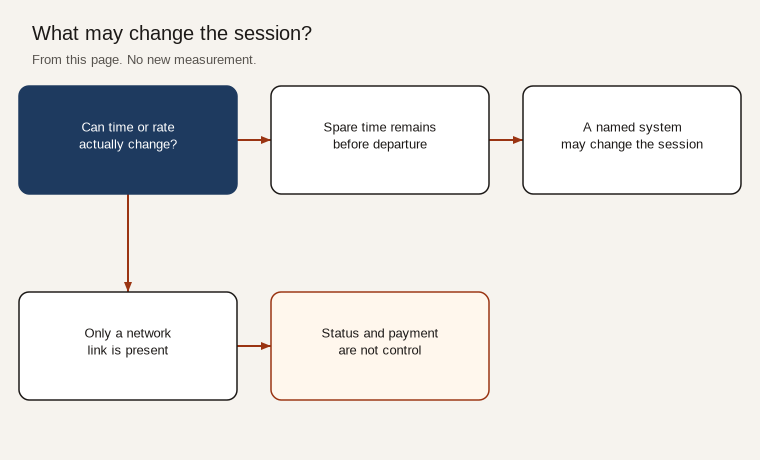
Treat a network link that only reports status and payment as not control, and treat a named system as able to change time or rate when spare time remains before departure.
Timing and rate are the function
A June 2024 laboratory survey for the Department of Energy defines smart charge management as controlling the power exchanged between chargers and vehicles so the customer’s need is met while the session also responds to an external power or price signal. The report record uses the broader phrase “charge management” for tariffs and pilots as well as direct control. The control has two jobs: finish the energy the driver needs, and answer something outside the car.
The Alternative Fuels Data Center uses the same words for a utility form: remotely increasing, decreasing, or stopping charging. A site can stagger its own chargers, and a driver can tell a car to wait. None of those is defined by an app or a payment screen.
Charging level is separate. The station overview sorts Level 1, Level 2, and DC fast charging by hardware path and available power. Smart charging decides whether a session uses that rate now, uses less, or starts later. The nameplate is a ceiling, not a schedule.
Shifting only the start time moves the clock. Trimming the rate lowers the load and usually lengthens the session. A product can do one, both, or neither.
A network connection does not create that function
The same Data Center page separates networked and non-networked equipment. Networked stations use the internet for use data, payment, monitoring, or support. Non-networked stations charge without that layer. Neither description requires a change in rate or start time.
Open Charge Point Protocol, or OCPP, is the open language between a charging station and a management system. The Open Charge Alliance describes it as keeping the appliance separate from the back end. The Data Center notes that OCPP 1.6 or newer lets a host change networks without replacing hardware. That is an ownership choice, not proof that load is managed.
OCPP 1.6, released in 2015, includes smart-charging support for load balancing and charge profiles. OCPP 2.0.1, from 2020, added further smart-charging functions and is not compatible with 1.6. OCPP 2.1, released in 2025, keeps 2.0.1 application logic and adds stronger tools for sharing energy across stations, plus bidirectional and distributed-energy functions.
As of the Alliance’s certification update effective October 2025, Smart Charging remains an optional OCPP 1.6 profile. A station can take payment without that profile in use. Ask which version is purchased and whether the optional functions will actually be on.
Price response and direct control are different deals
One arrangement leaves the choice with the driver or the site. A time-of-use rate makes some hours more expensive. A person or a local timer decides when to charge. If nobody moves, the rate does nothing. If many sessions crowd the first cheap hour, a new spike can form at the edge of the window. The laboratory survey counts EV-specific tariffs as charge management, and it reports that the path from a utility signal to a particular car is still fragmented. A published rate is not a tested control path.
The other arrangement lets someone else change the session: the Data Center’s remote increase, decrease, or stop, or a site controller sharing a feeder among ports. Ask who may change the session, how far, whether one session can be overridden, and what energy is still expected at departure. Those terms belong in the rules. They are not implied by the word smart. If the car, the network, and a building controller can all act, name which instruction wins and what the charger does when that instruction never arrives. A qualified electrician or engineer makes that call for the circuit and the listing.
Slack is what makes a slower session possible
Control needs spare time. If the stay is only long enough to deliver the required energy at the full available rate, slowing or delaying the session misses the departure. Short public stops often look like that. Many home and workplace stays do not.
An illustrative session, not a Soleil project and not a recommended setting, shows why. Twenty-four kilowatt-hours over a six-hour stay leaves no spare time at four kilowatts and about three hours of slack at eight kilowatts. A two-hour departure finishes neither way. These figures are not a setpoint and not a building limit.
A published workplace case uses the same idea without a number to copy. At the National Laboratory of the Rockies garage, drivers enter needed energy and parking duration, and software schedules stations so the group peak falls while each stated need is still met. The Department of Energy account describes a ceiling held under that garage’s transformer, with sessions staggered rather than every station held down all day. That ceiling fit that transformer. This page does not offer one for any other site. The same inputs can also place charging when on-site solar is producing, as a Federal Energy Management Program note describes for a site that cannot send surplus generation to the utility. Vehicles have to be present while the array produces.
Name which system is allowed to decide
Several products get called smart because each can touch timing or rate. They do not share authority.
| Where the control sits | What it can change | What it does not settle |
|---|---|---|
| Timer inside the vehicle | When that car asks for power | Other cars, the building service, or which meter sets the bill |
| Schedule or current limit in one charger | Start time or rate at that port | Whether the adopted code allows a reduced load in the service calculation |
| Site energy management | How ports, and sometimes other loads, share a feeder or service | A utility enrollment or another vendor’s network rules |
| Charging network, often over OCPP | Charge profiles sent to stations it operates | What the vehicle will accept, or the physical limit of the circuit |
| Messages between car and charger | Charging requirements, and in a later standard, bidirectional sequences | The price on the account, or the permit drawings |
| Utility or aggregator | A price, or a direct change to enrolled charging | The equipment listing and the authority having jurisdiction |
The 2024 survey’s first gap is site-level control: many grid programs never see the other loads on the service. Grid response and building load sharing are related, not identical. Name which of the car, the charger, and the network wins, and require the listing to define a loss of communication.
Protocols carry messages; they do not choose the tariff
The Open Smart Charging Protocol sends a capacity boundary, including a forecast for the coming day, from the distribution operator or the site owner to the operator’s back office. Versions date to 2015 and 2020. The Alliance says it is not actively developing the protocol. It is a documented interface, not a default requirement. OCPP can carry a charge profile, but it does not know other building loads unless another system tells it, and it does not set the tariff.
ISO 15118 is the link between vehicle and charger, not the link to a cloud service. The scope of ISO 15118-20:2022, in the British adoption read for this page, specifies those messages, including bidirectional sequences. A session can still be delayed or current-limited with no ISO 15118 exchange. A data-sheet line is not a working path.
Export is a different power flow, not a smoother delay. IEEE 1547-2018 covers interconnection of distributed resources that act as sources. Charging that only draws power is a load. Export may fall under utility interconnection rules that name this standard or a successor. Confirm that with the utility before designing for it. Soleil Energy’s published charging scope is installation and load management, not every bidirectional platform. An ENERGY STAR “connected” listing, as the Data Center describes it, means open standards and remote or demand-response capability. It does not enroll a site.
Code may recognize a limit; it does not pick one
A published reproduction of the 2023 National Electrical Code, Section 625.42, states that charging loads are continuous for that article and that the service and feeder are sized to the product ratings unless controls in 625.42(A) or (B) limit the installation. Where an energy management system under Section 750.30 manages the load, the maximum equipment load is the maximum that system permits. Integral load management must be marked, and another subsection covers restricted access to an ampere setting. The reproduction is on a continuing-education page that points to the National Fire Protection Association for the official text. The same page shows that 2020 already let an automatic load-management system set that maximum.
That text is not a design and does not name a demand cap. As of November 2026 this page does not decide which edition or amendments apply in a Maryland county, in Arlington, or in the District. A licensed electrical professional applies the edition in force, the listing, and the utility’s service rules, including behavior if the control fails or a vehicle rejects the reduced rate.
Port counts, permits, and ownership sit in Soleil Energy’s commercial EV charger guide. A homeowner comparing a circuit with a panel change should start with the Level 2 home installation guide, then ask whether timing or rate control is needed once the circuit is known.
The bill changes only when the meter and the tariff do
A cheaper hour changes the bill only if the meter that sets the bill records the shift. Some rates cover the whole building. Some measure only the charger or the vehicle. Moving charging on a flat energy rate, with no demand charge, changes the clock and not the price. A lower peak matters only when the tariff bills demand and the controlled interval is the one the utility uses. Soleil Energy’s demand-charge guide separates billed demand from energy use for solar and storage. The same split applies here, and the account’s rate schedule still governs.
Programs move. The commercial guide, current as of late October 2026, records closed Maryland workplace credits and a federal charging-equipment credit that stops applying after a stated 2026 placed-in-service date. Pepco, Baltimore Gas and Electric, Dominion Energy, and Southern Maryland Electric Cooperative do not share one offer. As of November 2026, use the rate-schedule name on the account and confirm the option with that utility. The infrastructure trends series counts ports by level, network, and region. It does not say whether those ports ever change rate or start time.
A connected charger is also a connected device
A product that can change a session from elsewhere is a control device. A CISA advisory revised on March 17, 2026 describes a weakness in ISO 15118-2 that could let a nearby party insert itself between a vehicle and a charger. The advisory says this is not exploitable across a remote network, points to transport-layer security as required in ISO 15118-20, and restates ordinary control-system practice: keep the equipment off the public internet, separate it from business networks, and maintain any remote access that is actually required. That is an orientation for design, not a configuration and not a judgment that a product is safe or unsafe.
The 2024 survey’s matching gap is that cybersecurity and data-privacy expectations are not in one certification from signal to vehicle. Ask who may send a charge profile and where session data goes. This page does not assess a product or a building. Before ordering, write down the slack, the goal, which system may change a session, whether export is in scope, and which meter will see the change. None of that is a clock time or a power cap.
Common questions
Is a Wi-Fi or app-connected charger automatically smart?
No. Ask whether the installed software changes start time, charging rate, or both, or whether that behavior appears only after a later enrollment. Connectivity alone leaves rate and timing unmanaged unless the car or another system supplies them.
Does managed charging remove the need for a service upgrade?
Not by default. The reproduced 2023 text allows certain listed controls to become the maximum load in the service calculation, only under the edition the authority having jurisdiction enforces. Ask what the installation does if a vehicle ignores the control or communication fails. Software is not a smaller service by itself.
How is a driver-set schedule different from a utility-managed program?
A driver-set schedule needs no enrollment. A utility program lets the utility or its vendor change enrolled charging under accepted rules, sometimes with a credit or a special rate that may cover the whole building or only measured charging. Read the override and the departure energy. Do not copy another utility’s hours onto this account.
Do the car and the charger have to use the same communication standard?
They have to agree on power. They do not have to use ISO 15118 for ordinary controlled charging; a car timer or a current limit can change timing or rate without it. ISO 15118 matters for that standard’s messages or for export. OCPP links the station to a network and replaces neither the car nor a building controller. The 2024 survey found no single certification for the chain from a utility signal to a vehicle, so test the path this site will actually use.
What does smart charging change about scope, compatibility, or approval?
It adds a control scope: which system may change a session, what happens if that system is unreachable, and whether the cars accept a delay or a lower rate. Approval can change if a listed energy-management arrangement is used in the service calculation, because the authority having jurisdiction and the utility still have to accept it. Nothing here sets a price or a right to skip a permit or a load calculation. A workplace can run that control locally, with no utility program, and still owes the code, the service rules, and any demand charge already on the account.
Bring the parking pattern and the service to the same discussion
It is worth a design conversation when vehicles sit longer than the energy requires, when several ports would stack on a tight service, or when a tariff or on-site solar rewards a different hour. It is a weak fit when the only goal is a payment app.
Soleil Energy installs home, workplace, and fleet charging, including load management where capacity is tight, in a published area centered on Maryland, Northern Virginia, and Washington, DC. Named coverage includes Prince George’s, Montgomery, and Howard counties and Arlington, with no District office. Share where vehicles park, how long they stay, when they must be ready, and what is known about the service, and Soleil Energy can discuss charger count, electrical capacity, and whether load management belongs in the design.
Project requirements depend on the site, equipment and applicable rules. Confirm design and installation decisions with the appropriate qualified professional.