
A solar ground fault is an unintended electrical connection between a current-carrying conductor in a photovoltaic (PV) system and ground, grounded metal, or the equipment grounding path. Current then flows outside the path the circuit was built to use. It can create a shock hazard, a fire hazard, equipment damage, or an inverter shutdown. It is not the intentional grounding of frames and enclosures. An alarm that names this fault is a reason to stop and call a qualified person.
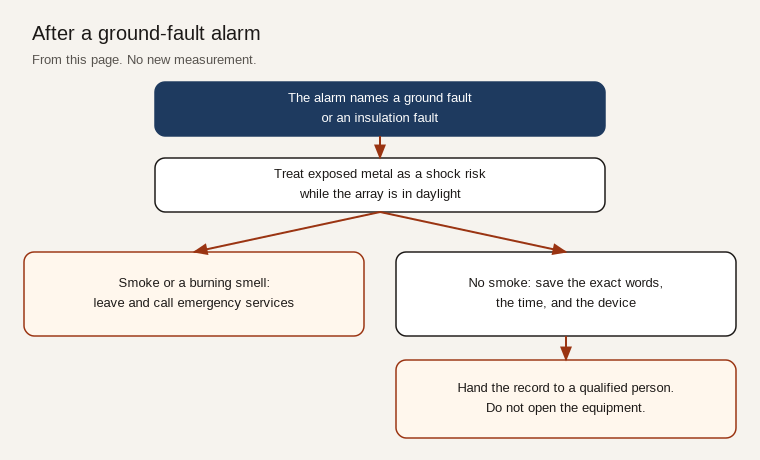
A ground-fault or insulation alarm names the event, the shock risk stays in place while the array is in daylight, and the owner saves the exact record instead of opening equipment or resetting for production.
An unintended path is not the grounding system
Frames, racking, conduit, and cabinets are connected to an equipment grounding conductor so exposed metal stays near grounding-system potential. That connection is intentional. A ground fault is insulation failing, or a conductor touching metal or earth, so array current leaves its circuit.
The OSHA construction eTool describes a ground fault as current taking another route to ground, including through a person, and says a ground-fault circuit interrupter compares outgoing and returning current and trips at approximately 5 milliamperes. That device protects tools and receptacles. It does not watch the modules. A direct-current array in daylight is a different source, and a bathroom or job-site interrupter is not the array’s ground-fault device.
A December 2015 National Renewable Energy Laboratory subcontract report, hosted by the National Laboratory of the Rockies, separates equipment grounding from whether a current-carrying conductor is itself referenced to ground. A fault puts current on the equipment-grounding network. If that network is loose or missing, metal can become energized. Until a qualified person has assessed the site, treat a reported fault as if exposed metal might be hazardous.
Daylight keeps the hazard in place
A stopped inverter is not a de-energized array. OSHA’s solar electrical page states that panels generate electricity and that workers can face shock, burns, electrocution, and arc flash. Its lockout/tagout page adds that solar equipment can generate electrical energy and that people servicing panels can be hurt by unexpected energization. For an owner the boundary is concrete: do not open combiners, pull module connectors, separate strings, or climb the array to find a wire. Do not touch frames, rails, hanging conductors, or a forced-open cabinet. Covering modules is an employer control on that OSHA page. It is not an owner method, and it is not reliable on a large array.
Smoke, fire, arcing, or the smell of burning insulation means leave and contact emergency services, and say the property has a solar array. The Department of Energy inverter overview, updated March 31, 2025, describes the inverter as the device that turns panel direct current into alternating current and notes that a household inverter can monitor the system. A monitor line is not proof every conductor is safe to handle.
What the detection equipment is for
Article 690 text reproduced in the National Fire Protection Association’s February 7, 2024 public-input report requires ground-fault detector-interrupter (GFDI) protection, to reduce fire hazards, on PV DC circuits above 30 volts or 8 amperes. A narrow exception covers certain solidly grounded source circuits of no more than two modules in parallel that are not on or in a building. The protection must detect faults in the DC circuits, including functionally grounded conductors, be listed for that function, and then disconnect the faulted conductors or, in a functionally grounded system, stop output and separate those circuits from the ground reference. It must indicate the fault where someone can readily find it: a light, a display, a monitor, an alarm signal, or a web notice. That is the report text as read in November 2026. The enforced edition can be older, newer, or amended.
The same text says most PV systems are functionally grounded rather than solidly grounded. On a functionally grounded system with an interactive inverter, the AC equipment grounding conductor is most often the ground connection used for both ground-fault protection and equipment grounding. The report warns that not every inverter, charge controller, or converter includes this protection, and that some converters can hide part of the array from other detectors.
Older arrays can miss a fault that is already there
Many earlier U.S. arrays put a fuse or breaker between one current-carrying conductor and ground. The October 2015 field guide from Brooks Engineering, published by the National Renewable Energy Laboratory and hosted by the National Laboratory of the Rockies, calls the faults that style of detector misses a blind spot. A detector that responds only to a large current in that bond can leave a lower-level fault in place, especially on the conductor already referenced to ground. A second fault can then use the path the first one made.
The guide tells technicians to assume damage when a detector indicates a ground fault, until qualified testing shows otherwise. False indications happen, it says, less often than real faults. This page does not describe how to find the fault or how to measure leakage.
The December 2015 installation report says an open fuse removes the defined path from that conductor to earth, so the conductor that had sat near ground can be driven away from it. A dark inverter is not a safe cabinet for a facility employee to open. This page gives no trip settings. If a newer inverter says insulation or isolation, copy those words and leave the message in place.
Not an arc fault, and not an offline app
The same NFPA report treats DC arc-fault protection separately. Circuits at 80 volts or greater between conductors are to have listed arc-fault protection, with exceptions for some wiring methods and some circuits not on buildings. That function looks for an arcing break in a conductor, connection, or module. A ground fault is current leaving for metal or earth. Both can start fires. Listing for one is not listing for the other.
The 2015 field guide says field experience suggested these two faults were the most common reasons for fires in PV arrays. That is a 2015 judgment, not a current count. Treat either alarm as a fire and shock issue until a qualified person says otherwise.
An app that only says offline is a third problem. The data link can fail while the array still runs. Soleil Energy’s guide to a solar monitoring system that is offline separates a lost connection from a production failure. A ground-fault or insulation message is an electrical alarm, not a router task.
How the insulation usually gets damaged
The December 2018 operations report from the National Renewable Energy Laboratory, Sandia National Laboratories, and the SunSpec Alliance, hosted by the National Laboratory of the Rockies, uses a wire scraping a module frame as the example of a ground fault. Open-air conductors, sun-brittle ties, wind, tight ties, animals, and buried runs damaged by rodents are the ordinary causes. A July 2024 Department of Energy cable-management brief adds the next step: failed ties leave wiring slack, wind abrades it, and the inverter may trip. The brief names shock, electrocution, structure fire, and wildfire as the worst results.
Water, a cracked connector, a loose junction box, and damage after roof work are not a route to walk with a meter. After a storm, the 2018 report assigns making damaged circuits safe, inspection, repair, and re-commissioning to people with the required training and protective equipment. The report also lists locating and repairing a ground fault as corrective DC work for a master electrician.
What you can notice, and where you stop
Stay where you do not cross the array. Read a display without opening a door, or a portal you already can open. Record the exact words, the time, and the device. Note weather, recent roof work, or debris you can see without approaching a damaged conductor. Photograph the screen. Then stop.
| What you see | What it suggests | What you do not do |
|---|---|---|
| Ground fault, isolation, insulation, or GFDI | Reported leakage or a fault to ground | Reset it over and over to force production |
| One inverter down, others producing | Possibly one input or one device | Open the dead unit to compare fuses |
| Hanging or chewed cable, from a safe distance | Damaged insulation is plausible | Touch the cable, frame, or rail |
| Smoke, burning smell, or a loud arc | Immediate fire and shock risk | Stay nearby |
| Offline app, no fault text | The data link may be the issue | Treat the array as proved healthy or faulted |
| A fault in rain that later clears | It may be intermittent | Mark the ticket closed |
The middle column is a note for the person you call, not a diagnosis. A qualified professional must assess the actual site. The message rarely names the damaged foot of cable, and it does not say the frames are safe or that another inverter or a battery is unaffected.
What the repair can change
The work shifts from watching a portal to finding damaged insulation and restoring listed protection. It might be a connector, a wire run, a junction box, the detection device, or other loose conductors. The 2018 report describes that kind of work. It does not name a price.
Replacement protection has to be listed for the job and, where that Code text says so, identified for the combination of converter and GFDI device. A new inverter or module-level electronics can change what the permit and the utility accepted. Ask the authority having jurisdiction and the utility before parts are ordered.
If the installer is gone, the shock hazard and the paperwork are separate. Soleil Energy’s guide for when a solar installer has gone out of business covers contracts, warranty issuers, and unfinished approvals. A fault does not prove which warranty applies. For what a maintenance contract should name, see commercial solar operations and maintenance. Those tests belong to the provider, not to site staff answering an alarm.
Which edition actually applies
The Article 690 wording above is the February 7, 2024 NFPA report. As of November 2026, local tables do not all match it.
Arlington County’s building standards page, read November 22, 2026, lists the National Electrical Code, 2020 edition, with no state amendments in that row, effective January 18, 2024, as its guide to the Virginia Uniform Statewide Building Code. It does not say which edition covered an array permitted years earlier.
Maryland’s Department of Labor code matrix, dated March 18, 2026, does not give every building one edition. Outside modular and state-owned buildings, the electrical row says the local jurisdiction adopts the code. Modular and state-owned buildings are listed at the 2020 edition. A State Fire Marshal row lists the 2017 edition with the state fire prevention code. Those rows are not substitutes. Washington, DC uses its own codes; this page does not name that edition. Confirm the edition, amendments, and whether the repair is an alteration with the permit office.
A fault does not rewrite an old array to the newest book. An older fuse-referenced design can still have the 2015 blind spot.
An illustrative morning alarm
Illustrative example, not a Soleil Energy project: after a windy, wet night, a warehouse portal shows a ground-fault or insulation message on one of three string inverters, and that inverter is not producing. From the lot, a manager sees a cable loop hanging under one row, photographs the message, notes the time and weather, and does not send anyone up with a meter or new ties. A qualified contractor decides whether the row is safe to approach and whether other slack wire needs the same repair. The photo does not prove the loop is the fault.
Bring the fault record to an assessment
Save the exact text, time, device name, and a screenshot. Add make and model from papers or from a label you can read without opening an enclosure, whether the system is owned or leased, who may authorize work, recent roof or storm events, and any drawing you already have. Do not map strings by unplugging modules.
Soleil Energy’s monitoring and O&M service covers monitoring, maintenance, and fault diagnosis and repair, including systems the company did not install. Response time is agreed per site. The service-area page names Prince George’s, Montgomery, and Howard counties, Arlington and nearby Northern Virginia communities, and Washington, DC, and states there is no DC office. An assessment uses the records and the equipment. It is not a remote verdict on one conductor, and it is not a code determination.
Questions that change the next call
What does a solar ground fault change about scope, cost, compatibility, or approval?
It can turn a portal check into wiring repair, new supports, or a new protection device. Cost follows access and how much is damaged, and this page states no price. The replacement has to be listed for the equipment it protects. Changing the inverter or the permitted design can require the authority having jurisdiction and the utility.
Is an insulation-resistance alarm the same thing as a ground fault?
Not always. Insulation resistance is how well conductors are still separated from ground. A ground fault is an unwanted connection. Some inverters alarm as that separation falls, before a hard short. Either message means stop.
If the frames are grounded, is a shock still possible?
Assume it is, until a qualified person says otherwise. The grounding path can be missing, or defeated by a fault an older detector never saw, as the 2015 field guide describes.
Why not keep resetting the inverter?
Production can return while the insulation stays damaged. On an older fuse-referenced design, an open ground-fault device can remove the reference the detector used. Moisture and wind can hide a fault on a later look. The 2015 guide says to assume damage after an indication.
Do microinverters and batteries change the stop rule?
No. Any PV conductor can fault to metal or earth. Module-level electronics and battery converters move the detection point, and the reproduced Code text notes that some converters can block it if they are not listed for the combination. A battery can stay energized after the solar inverter is dark.
Who should look if the installer is gone?
A qualified electrical professional at the site. Soleil Energy takes many systems it did not install, inside the service area named above. Bring the fault record and whatever permits and warranties you still have.
Stop, then hand off the record
The devices that watch for a solar ground fault are there to sense it, limit it, and announce it. They do not find the damaged spot or make the array safe to inspect. Keep the exact message, stay off the equipment, and have a qualified person assess the site. In Soleil Energy’s coverage, start with the monitoring and O&M service and the record you saved.
Project requirements depend on the site, equipment and applicable rules. Confirm design and installation decisions with the appropriate qualified professional.
