
Solar pile testing is a field measurement of how one driven, drilled, or similarly installed foundation pile moves when a static tension, compression, or lateral load is applied. On a ground-mounted solar project it is used to see how that pile and the soil around it respond together. It is not a soil boring, and a result from one part of a site does not by itself describe another part.
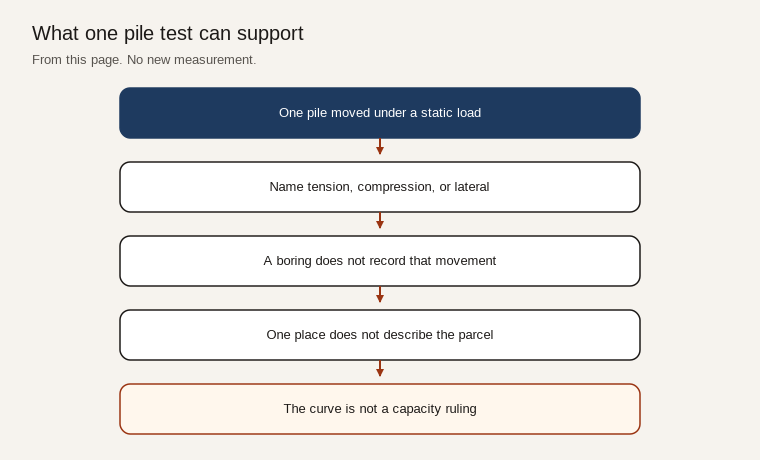
Name the direction of the static load, keep a boring or a production log from standing in for that movement record, and do not treat one pile on one part of the parcel as a description of the rest.
What the measurement is for
A ground-mounted array needs a structure that can support the modules and withstand wind, rain, hail, and corrosion. The Department of Energy’s solar design overview, last updated July 8, 2022, notes that ground-mounted arrays may use trackers that follow the sun. Wind can lift a row or push it sideways, rack weight pushes down, and snow or seismic demand can add cases. Which case governs is a structural calculation for the site.
A pile test asks how this element, installed this way, in this ground, moved under a defined load in a defined direction. ASTM D3689/D3689M-25 says a field tension test gives the most reliable relationship between axial load and axial movement for the element tested, and that the standard does not itself analyze foundation capacity. The compression and lateral methods draw the same line. The crew produces a record. A foundation engineer interprets it. “Piles were tested” does not say the direction, the head movement, the section, or which part of the parcel was represented.
Tension, compression, and lateral tests are not interchangeable
The test has to follow the installation method production will use. A driven-section result does not describe a drilled shaft of a different length.
Axial tension
A tension test, often called a pull test, pulls the pile along its axis and records head movement. Wind uplift is a common reason to specify this direction on a ground-mounted row. If the pile is instrumented, the record can also show how resistance is distributed along the shaft.
ASTM D3689/D3689M-25 describes a quick test, a maintained-load test, and a constant-rate-of-uplift test, and different procedures can produce different curves. The quick and constant-rate procedures are typically finished in a few hours. A maintained test uses larger steps and longer holds and is thought to show more about creep, with a coarser picture of the load where movement grows. The foundation engineer approves the procedure. Tension results are sometimes used to inform compression capacity, but stiffness and structural capacity can differ between the two directions. The public text sets no numeric test load, movement limit, or refusal rule.
Axial compression
A compression test pushes the pile downward and records settlement. ASTM D1143/D1143M-26 says the record can inform side resistance and end bearing when instrumentation separates them, and that consolidation settlement is beyond those procedures. ASTM’s D18.11 list, read on November 22, 2026, shows D1143/D1143M-26, D3689/D3689M-25, and D3966/D3966M-25 as the current compression, tension, and lateral methods. A citation of D1143-81 is a withdrawn edition.
Lateral load
A lateral test pushes the pile sideways and records lateral movement at the head. ASTM D3966/D3966M-25 describes this as the most reliable relationship between static lateral load and lateral movement for the element tested. With instrumentation, the record can be used to characterize resistance along the element, bending, and deflection. The standard’s scope does not include the lateral-capacity analysis.
Load height changes the moment, so a jack at rack height is not a ground-line test. The lateral method also calls out the near-surface subgrade, and a single pile can differ from a pile in a group.
A boring describes soil; a pile test measures a pile
A boring, test pit, or cone sounding describes materials at a point. In the Texas Windstorm Insurance Association Building Code 2024, which uses International Building Code section numbering, classification comes from borings, test pits, or other exploration, and the registered design professional sets that program. Where deep foundations will be used, section 1803.5.5 calls for the investigation to cover foundation type and capacity, spacing, driving criteria, installation, inspection, load-test requirements, materials, the bearing stratum, and group effects, unless enough information already exists.
A blow count does not load the tracker pile, and a tube sample does not reproduce driving disturbance or the pile’s shape. Without the boring plan, one test has no map of which other piles sit in similar ground.
This page read that code language on November 22, 2026. It did not confirm the edition or amendments in force in Maryland, Virginia, or the District of Columbia. The project engineer and the authority having jurisdiction decide whether that section applies. ASTM methods are voluntary until a contract or an adopted code requires them.
| Record | What it can support | What it does not do |
|---|---|---|
| Boring, sounding, and lab log | Strata, classification, and parameters for calculation | Measure movement of the production section |
| Static pile test | Load versus movement for one element and one direction | Map the parcel or set a code factor by itself |
| Production installation log | What was installed, where, and with what equipment | Replace a load test that was never run |
One location does not describe the rest of the site
Fill, a soft pocket, a dense layer that stops a pile short, and a change in groundwater can sit inside one property line. The compression, tension, and lateral methods linked above say a multi-element program can show that variation. Extending one result still requires essentially the same subsurface conditions, pile type, length, size, stiffness, and installation method and equipment. The foundation engineer decides whether that match exists.
Where Texas Windstorm section 1810.3.3.1.2 applies, at least one control element is tested in each area of uniform subsoil, and the building official can require more. Later elements are treated as equivalent only if type, size, relative length, installation method, and subsoil match and, for driven elements, the penetration rate is no higher than the test pile’s with the same hammer through a comparable distance. If any condition fails, the section does not make that leap.
An illustrative pair, with invented numbers, is not an acceptance limit and not Soleil Energy experience. Both piles share a section, an embedded length, and steps of 4 kips, 8 kips, and 12 kips. Stiff clay moves 0.05 inch, 0.12 inch, and 0.28 inch. Loose fill moves 0.20 inch, 0.55 inch, and 1.10 inch. Neither curve is permission to shorten every pile. A test on fill by a substation pad does not describe undisturbed ground at the far fence.
What the report should let the designer decide
The report should identify the section, embedded length, and stickup; the location on the boring plan; the hammer or drill, any predrill, and any early stoppage, damage, or splice; groundwater and whether final grade was in place; the load direction, procedure, and edition; the reaction; and whether the reference frame was independent of it. Give load and head movement at each step, including unloading. A peak number without the curve hides the shape of the movement. Say whether telltales or strain gauges separated shaft and toe. If they did not, do not imply that split. Close with the interpretation and which other piles it is being applied to.
Methods are not interchangeable. Texas Windstorm section 1810.3.3.1.3 permits the Davisson offset limit, the Brinch-Hansen 90 percent criterion, the Butler-Hoy criterion, or another method the building official approves. An archived Federal Highway Administration report, FHWA-HRT-05-159, Chapter 4, makes the same point on a Boston highway project: the specification chose the failure criteria, and static jack tests were compared with dynamic signal-matching rather than treated as the same measurement. That June 2006 report is not a solar specification, and it cites ASTM D1143-81, an edition later withdrawn. Here, capacity is an interpreted point on a curve.
The maximum load applied is not an allowable design load. Where the code text read for this page applies, the registered design professional determines ultimate axial capacity with settlement in mind, and allowable compression and uplift are limited relative to that capacity, with a different uplift treatment when wind or seismic demand causes the uplift. Those limits belong to that adoption. This page does not set a safety factor, a test load, an embedment, or a pass line.
A tested pile is not a clean bill for every pile
A control test samples one element. Even where a code lets that result stand in for similar elements, production piles still need their own observation.
The UpCodes display of North Carolina Building Code Chapter 17, Table 1705.7, requires special inspections while driven elements are installed, judged against the geotechnical report and the construction documents. The table calls for materials and lengths, test-element capacity and any added tests, a driving record for each element, and location, plumbness, hammer, blows per foot, penetration, tip and butt elevations, and damage. On November 22, 2026 the display header read as a 2024 code while the viewer path was labeled ibc-2021. North Carolina amends the model code, and another jurisdiction can change the table. The test-pile curve does not fill in a missing log.
A pile that stops early, walks off location, bends, or is driven with a different hammer has left the conditions that made the test meaningful. The foundation engineer chooses the remedy, with the building official where the code assigns that role. Federal Highway Administration GEC-12, updated June 27, 2017, is the publication page for Design and Construction of Driven Pile Foundations. The volumes linked there were not read for this page. A shared use of driven steel does not put a solar project under that highway publication. The code section read here also names ASTM D4945, a high-strain dynamic method, for certain compression control tests. This page did not read the current D4945 text. A blow count is not a static jack-test record unless the project engineer accepts that substitution.
What a short static test cannot show
ASTM notes that creep, material deterioration, and strength loss can change long-term behavior, and that one test may not represent the whole foundation over time. A one-day pull does not measure corrosion, coating damage, or frost heave.
Driving and filling can change pore pressure in clay and silt, so an early test can misstate friction. Final grade, ditches, and scour can remove the soil that resisted the test pile, which matters especially for lateral resistance. ASTM warns that reaction-element friction can interact with the test pile. A textbook chapter written around Australian Standard AS 2159, not a US code, describes the usual hardware: a jack against reaction piles, anchors, or a weighted platform, with head movement read on a frame independent of the reaction. That LibreTexts section is not a US specification. If the reference beam sits on the reaction frame, the record can include the frame. One load cycle is not a wind history unless the procedure says so. Group action, tracker torque, and rack stiffness sit outside a single-pile head curve.
What the findings change, and what they do not
Large movement may call for a different length, section, or installation method, or for something other than a driven pile. Early stoppage may require predrilling, a layout change, or more tests. Two soil units may need two criteria. None of those choices is a depth this page can assign. The program is scope too: locations, directions, procedure, a reaction frame sized for the jack, which piles are sacrificial, and who interprets the curves. Locking the tracker order first turns that question into a schedule problem.
Other reviews stay separate. Soleil Energy’s commercial solar site checklist treats ground-mounted work as its own look at land rights, zoning, soil, drainage, access, and the cable route. A pile test does not clear zoning or drainage. The commercial solar interconnection guide covers utility review and permission to operate, with Maryland as the detailed case. A foundation curve does not say whether the circuit can accept the power.
Before the jack is ordered, name the directions, the height of any lateral load, how many tests fall in each soil unit, and the hold point if a pile stops short, is damaged, or misses location. Any refusal limit is the designer’s.
Frequently asked questions
What is a solar pile pull test?
It is a static axial tension test: a jack pulls the pile upward, usually against a reaction beam, and instruments record head movement. ASTM D3689/D3689M-25 measures that deflection for the element tested. Order the full curve, not a single “ultimate” figure, and keep the maximum load applied separate from whatever allowable value the engineer later assigns.
Why is a boring not enough?
Borings support a prediction. The load test checks one installed section and method. Use borings to place the next test, and the load test to challenge the prediction. Neither record fills the other’s gap.
Does a test in one soil unit cover the next unit?
Only if the engineer judges the ground, the pile, and the installation essentially the same, and any adopted code conditions for that leap are met. Do not average two curves into one site value.
Who decides which standard applies?
The specifications and the authority having jurisdiction. The Texas Windstorm and North Carolina texts are two adopted codes using model section numbers, not a ruling for Maryland, Northern Virginia, or the District of Columbia. Confirm the edition and amendments before treating a factor or an inspection table as mandatory.
Does meeting the test criterion finish the foundation?
No. Production piles still need location, plumbness, tip or embedded length, the driving record when driving is the method, and notes of damage or early stoppage. A later proof test on production piles has to be specified on its own.
When should compression be specified if uplift governs?
When bearing, settlement, or constructability is the open question, or when someone wants to treat the pull test as compression capacity. State the direction on every reported value, because stiffness can differ.
Put the foundation questions in the delivery scope
Pile testing sits with layout, drainage, and rack design, not inside the utility interconnection review. Soleil Energy’s utility-scale solar scope includes engineering, procurement, and construction from civil through mechanical and electrical completion, plus the substation and utility coordination described on that page. A scope review can identify which foundation decisions are still open, who will specify and interpret the tests, who will inspect production piles, and which of those tasks sit inside the delivery boundary. Bring the boring plan, any issued rack loads, and a list of what the investigation has not covered. That conversation does not design the piles or accept a test result.
Project requirements depend on the site, equipment and applicable rules. Confirm design and installation decisions with the appropriate qualified professional.