
An uninterruptible power supply maintains continuity of power to selected loads when the normal input fails or is disturbed. It uses stored energy and power conversion. It is not an engine-driven generator, and it is not a switch that only moves a load between two sources. The power rating states how much load it can support at one time. The stored energy states how long that support can last. A qualified professional must assess the actual load.
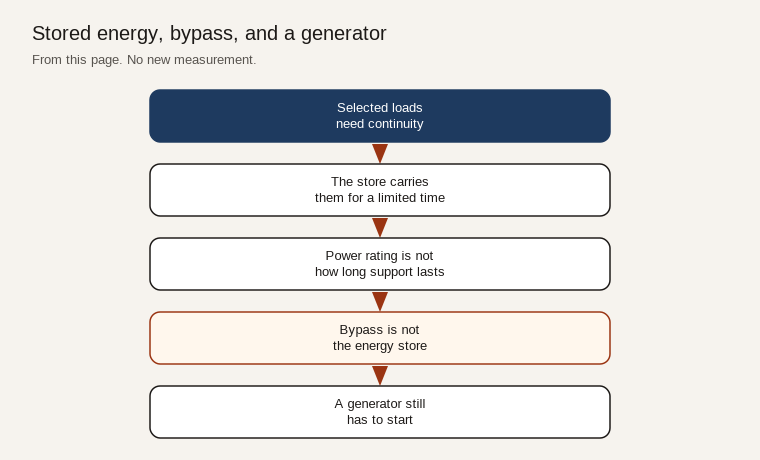
Stored energy carries selected loads for a limited time, a bypass path is not that store, and a generator or an automatic transfer switch does not hold the energy that bridges a source change.
Power rating and stored energy answer different questions
Power is a rate: how much the equipment can deliver at one moment. Energy is an amount: how long the store can keep delivering. A single catalog number does not state both.
The power limit may be real power, in watts or kilowatts, or apparent power, in volt-amperes or kilovolt-amperes. Electronic loads often draw distorted current, so heating or current can bind the unit before the real-power number on a cut sheet. Compare the limit the manufacturer declares for that mode with the measured load, not with a receptacle count.
A battery, flywheel, or capacitor holds a finite amount of energy. Support time depends on the energy actually available, the load actually on, conversion losses, temperature, age, and the manufacturer’s end point. A higher power rating does not lengthen runtime. The same store is used up sooner as the load rises. This page does not calculate a battery, a runtime, or an efficiency.
The Department of Energy, on its UPS page last updated in December 2024, describes a UPS in its battery-charger test procedure as converters, switches, and energy storage that maintain continuity of load power if the input fails. That page covers that subset of battery chargers. It is not a sizing rule for a fixed industrial system, and it does not make every site battery a UPS.
How the supply maintains continuity
In a common static UPS, a rectifier keeps the store charged from incoming alternating current, and an inverter supplies the load. While the input stays in range, the load is fed according to the topology. When the input leaves that range, the inverter draws on the store, and only for as long as that store can support the power the load is drawing.
A static bypass can tie the load to another source when the inverter is overloaded or out of service. A maintenance bypass is a separate path used so the module can be isolated. Neither path is the store. If the load is on bypass, an input failure is carried only by the source feeding that bypass. The one-line has to show the normal path, the stored-energy path, and the bypass as different lines.
UL Solutions describes a UPS as equipment that supplies a load when the main source fails, from a battery, a supercapacitor, or a flywheel, and notes that nonessential loads may drop while selected equipment stays up. Faster storage does not convert energy into a higher power rating, and it does not make support open-ended.
IEC 62040-3:2021, published on 21 April 2021, sets performance and test requirements for electronic UPS whose primary function is continuity of load power, within alternating-current input and output not exceeding 1 000 V and storage not exceeding 1 500 V DC. It excludes ordinary distribution boards, stand-alone static transfer systems under IEC 62310-3, rotary UPS under IEC 88528-11, and direct-current UPS under IEC 62040-5-3. The specification has to say which of those the project means.
Input dependency changes what the load sees
ENERGY STAR groups AC products by how the output depends on the input in normal operation: voltage-and-frequency dependent (VFD), voltage independent (VI), and voltage-and-frequency independent (VFI). The names describe behavior, not a brand order.
A VFD unit, also called passive or standby on that page, normally feeds the load from the incoming supply. On an outage the inverter takes over. ENERGY STAR states that this class does not correct voltage fluctuations, so a sag can move the load onto the store while the building still has power. A VI, or line-interactive, unit adds voltage correction so ordinary sags need not spend the store, but frequency still follows the input. A VFI, or double-conversion, unit runs through a rectifier and an inverter in normal operation. ENERGY STAR states that this shields the load from input voltage and frequency variation without depleting the store, because the inverter is already feeding the load. A later move to bypass is a different event.
Some units have more than one normal mode. The 2021 edition of IEC 62040-3 added tests for them, and the mode that will actually run belongs in the specification. Federal Energy Management Program guidance updated in December 2024 says more conditioning is generally associated with lower efficiency, so protection should match the application. That purchasing guidance covers consumer, commercial, telecommunications DC-output, and data-center products, and it excludes industrial UPS and equipment that is part of transmission or distribution. An efficiency label is not an industrial design approval, and this page does not choose a class.
A UPS is not a generator or a transfer switch
A generator, a transfer switch, and a UPS answer different failures. Putting them on one drawing does not make them one device.
| Equipment | What it contributes | What it does not do |
|---|---|---|
| UPS | Carries selected loads from stored energy, within its power rating, while the store lasts | Does not create fuel or replace a long-running engine |
| Generator | Supplies power after it starts, stabilizes, and has fuel and capacity | Does not feed the load while it is still starting |
| Automatic transfer switch | Connects the load to a source that can already carry it | Does not store energy or close an open-transfer gap |
In a common open transition, the switch leaves the normal source before it connects the alternate, so the load is briefly on neither. A closed transition can parallel sources briefly and raises interlocking and utility-acceptance questions for a qualified engineer. A static switch inside a UPS, a maintenance bypass, and the building transfer switch remain three different objects.
NIST Special Publication 800-82, Revision 3 (September 2023) states the dependence without a formula. Where an emergency generator exists, it says UPS battery duration may only need to cover a few seconds. Where the site relies on external power, it says the duration may need to be hours. Either way, it says the arrangement should allow a safe shutdown. That passage is security guidance, not a sizing standard and not a runtime to copy. A qualified professional still assesses the actual load.
A building battery or a solar array is a different system
UL Solutions separates a UPS from an energy storage system even when both use batteries and inverters. A UPS carries selected loads through a disruption and often waits, charged, until then. Storage that cycles with the grid does that continuity job only if the controls and the circuit list say so.
A grid-tied photovoltaic array is not a UPS. Soleil Energy’s homeowner guide on whether solar panels work in an outage explains that a standard grid-tied system stops delivering when the grid is down unless it can separate and run from storage. An inverter that must stop exporting is not the path inside a UPS. Soleil Energy’s battery storage work is backup established from the real load, not by itself a double-conversion specification or an emergency classification.
NFPA 111, with the 2025 edition listed as current on NFPA’s development page, covers stored-energy systems that supply selected circuits when the normal source fails, including the source, transfer equipment, controls, and supervision. As of November 2026, whether that standard, a generator standard such as NFPA 110, or a National Electrical Code article applies depends on the adopted edition. Maryland, Virginia, and the District of Columbia do not share one adoption date. UL Solutions points to provisions for information-technology rooms and for emergency, legally required, and critical-operations supplies, and notes that fire and building codes also send this work toward NFPA 110 and NFPA 111. A product listing is not that determination.
What changes in the electrical scope
Start with the circuit list: loads on the UPS output, loads that are shed, and loads that see a generator only after transfer. Racks, a controller, egress lighting, and a mechanical plant do not share one duration or one code path. The feeder, fault current, grounding, and harmonic current have to match the mode in use, because rectifier current is not resistive-load current. Cooling has to remove conversion heat. Batteries add weight, ventilation, and a fire-code path that follows chemistry and location. None of that is settled by the power rating.
A maintenance bypass holds the load on another source only if that source exists and the facility accepts the condition. Cutover, a transfer test, or replacement of the store can require a window when protected loads are at risk or are dropped on purpose. The process owner has to name that window.
The same NIST guide, final as of November 2026, treats loss of the primary source as a design condition: some operational-technology systems need an orderly shutdown, and continued operation needs an alternate supply that does not depend on the outside source. It also notes that controls for UPS units and generators can themselves be attacked. The Revision 3 publication page notes that a later public draft was open for comment through 30 November 2026 and is not the baseline. The guide selects neither a topology nor a battery.
OSHA’s electric-power eTool states that 29 CFR 1910.269 does not normally apply to emergency or standby generators or to ordinary building systems such as lighting. Those fall under Subpart S, and the rule itself sends supplementary emergency and standby generating equipment there. Construction of transmission and distribution lines and equipment is in 29 CFR 1926.950. The boundary can change if the circuits are part of a utility-type installation open only to qualified employees. This page does not assign that boundary and does not describe energized work.
Records that make commissioning usable
A usable record shows the path left in service. It needs a one-line of the normal input, the stored-energy path, static bypass, maintenance bypass, any generator, and any transfer switch, using the nameplate names. It needs the output circuits, the circuits left outside, the normal mode, the storage type, and the basis for any runtime figure. A copied runtime is not a measurement of this load.
It should also say which test was witnessed, which alarms had to appear, what the approved window allowed, and which settings changed. A move onto the store, a return to normal, and a move to bypass are different demonstrations. These are acceptance questions, not a switching procedure, and this page does not set delays or a discharge method.
An illustrative source-transfer bridge
A team adds a generator and an automatic transfer switch for a server room and a process controller, and the sketch assumes the switch hides the utility failure. The following example is illustrative. It is not a Soleil Energy project and not a sizing method.
In an open transition the switch leaves the utility before the generator is connected, and the generator still has to start and be accepted. Neither source carries the load during that interval. A UPS on only those circuits can bridge it from stored energy if the power rating covers the simultaneous load and the store covers the real duration. The generator and the transfer switch do not hold that energy. On maintenance bypass the store is out of the circuit, and covering the servers does not cover a controller on a different output. A qualified professional has to assess the actual load. This sketch specifies neither a battery nor a runtime.
Common questions
Does a UPS replace a generator?
No. Stored energy covers the gap only while it lasts and only inside the power rating. A generator extends operation after it is accepted and fueled. It does not ride through its own cranking unless a stored-energy path is actually feeding those loads.
Does an automatic transfer switch ride through an outage by itself?
No. It connects the load to a source that can already supply it. It stores nothing across an open break and does not start the engine. Open and closed transition change the studies required, and a UPS static bypass is still a different device from the building switch.
Why is runtime not printed as the power rating?
The rating is how much at once. The store is how long. Heat, age, and a distorted electronic current all move the result away from a new-unit figure taken on a resistive load. A submittal number should name the load, temperature, end-of-life basis, and mode. Copying it onto another circuit list is not an assessment.
Is a facility battery the same equipment as a UPS?
Only when the controls and the circuits make it so. Storage that cycles for load management is not, by that duty, a reserve held for a disruption. A grid-tied solar inverter that must stop with the grid is a third case. Emergency and legally required uses are decided under the adopted code and the listing, not by the product name.
What should the handover add to the proposal?
The as-built path: which source carried the load on bypass, which alarms appeared, and which settings changed. A proposal can name a topology. The handover has to show the mode left in service. If drawings, nameplates, and alarms use different names, the next outage is planned from memory.
What does this change about approval?
It can change the code article, the listing, the studies, and who witnesses acceptance. Emergency, legally required standby, and optional standby uses are not substitutes. OSHA coverage can also differ between ordinary building work under Subpart S and transmission or distribution work. Confirm the adopted edition with the authority having jurisdiction and a qualified electrical professional.
Bring the circuit list and the outage window
Soleil Energy’s power practice includes studies, switchgear and protection, distribution equipment, testing, and commissioning, and it starts from the voltage and the work window the site can give. A plug-in unit for one workstation is a different job from the interface among a UPS, a generator, transfer equipment, and the building distribution. For work in Maryland, Northern Virginia, or the District of Columbia, bring the voltage, the circuits that must stay up, whether a generator and a transfer switch already exist, the outage window, and the records expected at handover. Keep the power rating separate from the stored energy. That conversation does not size a battery and does not classify an emergency system from a form.
Project requirements depend on the site, equipment and applicable rules. Confirm design and installation decisions with the appropriate qualified professional.