
Value engineering is a function-and-cost study. A team states what a project element must do, compares the resources that function consumes, and develops alternatives that keep essential performance. Naming a cheaper product does not finish the work. The owner has to record a named decision to accept, condition, or reject the proposal. An unordered substitution skips both the study and that decision. As of November 2026, SAVE International describes value as function performance divided by resources.
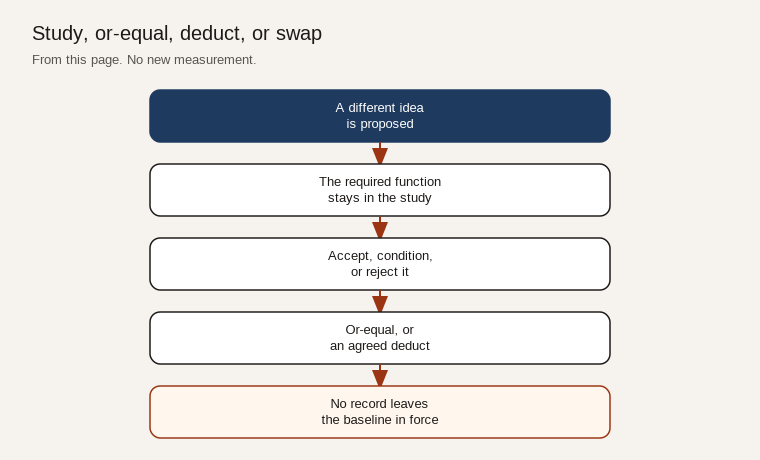
A function study needs a named accept, condition, or reject decision, an or-equal keeps the written requirement, a deduct removes a function on purpose, and an unrecorded swap leaves the baseline in force.
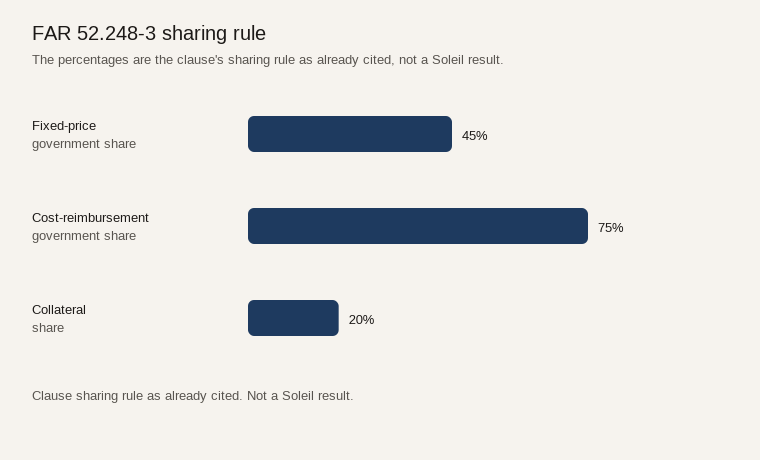
The fixed-price share, the cost-reimbursement share, and the collateral share follow the sharing rule already cited for FAR 52.248-3, not a project result.
Compare the function with the resources it consumes
A roof or a schedule activity is not the function. The function is the result that element must produce, such as excluding rainwater or keeping a corridor available during a renovation. SAVE International describes the value methodology as a systematic process used by a multidisciplinary team, led by a qualified facilitator, to improve value by analyzing functions. On that page, value is reliable performance of functions at the lowest overall cost: function performance divided by resources. Resources may be money or time.
Holding required performance with fewer resources can improve value. Cutting resources while required performance drops does not, even if the first price falls. SAVE states that a Certified Value Specialist usually leads. That describes a facilitated study, not a license rule, and a price list is not a study.
41 U.S.C. 1711 requires each executive agency, not a private owner, to analyze functions of its programs, buildings, and supplies. Qualified personnel do that work, directed at performance, reliability, quality, safety, and life cycle costs. The useful carryover is that object: functions and life cycle cost, not a stack of deducts.
Acceptance is a phase, not a courtesy
SAVE’s public job plan, as read in November 2026, has eight phases: preparation, information, function analysis, creativity, evaluation, development, presentation, and implementation. Implementation is sponsor or stakeholder acceptance of the alternatives that will be incorporated. A list of ideas is not that phase. Acceptance can be yes, yes with conditions, or no. A conditional yes names what may proceed and what must be confirmed first. Silence, or a field instruction to use the cheaper item, is not acceptance.
The Federal Highway Administration describes a systematic review during concept and design by a team not involved in the project. The operative Federal-aid rule is 23 CFR part 627. As displayed on the eCFR on November 19, 2026, that job plan has seven phases and ends in resolution: recommendations are evaluated, resolved, documented, and implemented. Name which plan the contract means. Mixing the labels, without saying who decides, leaves a report that cannot be audited.
A federal construction proposal waits for a decision
The Federal Acquisition Regulation keeps the study separate from the change. FAR 48.101, under FAC 2026-01 effective March 13, 2026, describes value engineering as the formal technique by which contractors may voluntarily suggest more economical methods and share in resulting savings, or may be required to identify those methods. It attempts to eliminate, without impairing essential functions or characteristics, anything that increases acquisition, operation, or support costs. In the voluntary approach, allowable development and implementation costs are paid only if a proposal is accepted. In the mandatory approach, the agency funds a stated effort. FAR 48.102 says profit or fee on the instant contract generally should not be reduced because a proposal is accepted, and profit or fee is excluded when instant or future contract savings are calculated.
FAR 48.202 tells the contracting officer to insert FAR 52.248-3, Value Engineering: Construction (Oct 2025), when the amount is estimated to exceed the simplified acquisition threshold, unless an incentive contract is contemplated. The clause is not used in incentive-type construction contracts. If tracking collateral savings will cost more than the benefit, Alternate I removes that paragraph.
As read in November 2026, a proposal under that clause must change the instant contract and reduce price or estimated cost without impairing essential functions or characteristics. A change in quantities only, or of contract type only, does not qualify. The file has to show the difference, the effect on performance, separate estimates for the baseline and the proposal, development and implementation costs, collateral effects, and the date by which a modification must be issued if the reduction is still available.
The contracting officer decides unilaterally. Acceptance of all or part is a modification citing the clause. Rejection is written. The contractor may withdraw before acceptance. Until a notice to proceed or that modification, the existing contract still governs, and installing the alternate early is an unordered substitution. The clause calls for a status within 45 calendar days after receipt, or a reason for delay and an expected date inside that period. Delay in acting is not a government liability.
Sharing exists only if this clause is in the contract. The government’s share is instant contract savings minus government costs, multiplied by 45% on a fixed-price contract or by 75% on a cost-reimbursement contract. Instant contract savings are the estimated reduction in the contractor’s cost of performance, minus allowable development and implementation costs. The modification reduces the price by those savings and adds the contractor’s share back, so the net change is not the gap between two quotes. Collateral savings are measurable net reductions in operation, maintenance, logistic support, or government-furnished property costs, excluding acquisition savings. If accepted, the clause adds 20% of projected collateral savings for a typical year, after government costs not already offset, and that share will not exceed the contract’s firm-fixed price or estimated cost at acceptance, or $100,000, whichever is greater. The contracting officer determines the amount. The clause also requires a value-engineering clause in any subcontract of $90,000 or more. These are clause terms, not a forecast for a private building.
Architect-engineer contracts do not share the result
FAR 48.102 requires architect-engineer contracts to include a mandatory value-engineering program aimed at total ownership cost, with no sharing of savings. That paid study is not the same event as a constructor’s accepted proposal. FAR part 36 can classify the work as an architect-engineer service when registered architects or engineers must perform it. The classification does not set the license for a private site, and a price log is not design.
Unordered substitution is a different act
| Path | Claim | Required before the work changes |
|---|---|---|
| Function-and-cost study | A required function can be kept at a better balance of performance and resources | A named decision: accept, accept with conditions, or reject |
| Or-equal | A different product meets the requirement already written | The specification’s procedure, and a finding that the requirement did not change |
| Deduct | A function or performance level will be removed | A scope decision that the function is no longer required |
| Unordered substitution | A product or method is swapped with no such record | Nothing sufficient. The baseline still governs |
An or-equal that quietly lowers a characteristic is not value engineering. A deduct is honest only if the owner agrees the function can go. An unordered substitution is the bid-day sheet with a price and a product name, and no function, no changed characteristic, and no maintenance effect. The four paths stay distinct in every delivery method. What changes is when the baseline is still inexpensive to revise.
When the decision has to be made
In design-bid-build, a study can still revise what bidders will price. After bids, the conversation often becomes a hunt for deducts. After award, the work changes only when the person with authority accepts the idea. On a federal contract with FAR 52.248-3, that person is the contracting officer.
DBIA treats one contract for design and construction as the difference from separate contracts. In the progressive form it describes, selection is based primarily on qualifications, and design and price advance together. While the price is open, alternatives can be studied. Once a requirement is fixed, a later change still needs a named decision. Two-phase selection under FAR subpart 36.3 is a competition procedure, not a value job plan.
Do not paste Federal-aid highway thresholds onto a private building. As of the November 19, 2026 eCFR text, 23 CFR 627.5 requires an analysis before final design on applicable projects, including a National Highway System project estimated at $50 million or more and a National Highway System bridge project at $40 million or more. Design-build highway delivery is excused from that requirement. Construction manager/general contractor projects that meet the tests still need approved recommendations in the plans before the construction price is requested, from a team that did not design the project. State rules can be stricter. They are not the rule for a private warehouse.
A federal price change can also lead the contracting officer to revisit performance and payment protection under FAR subpart 28.1. That adjustment is not a function analysis, and it does not turn a swap into an accepted proposal.
Life-cycle cost needs a boundary
SAVE’s ratio is not first cost alone. Collateral cost in the construction clause is operation, maintenance, logistic support, or government-furnished property. FHWA also weighs life-cycle cost, and neither source sets one study period for every building.
Say what the comparison includes, who supplied the maintenance assumption, and when the priced reduction expires. If maintenance is unknown, say so. A lower first price then shows only a lower first price. A shorter schedule is not a gain if the occupied building loses a function it must keep.
An illustrative decision named VE-R1
The following comparison is illustrative. It is not a Soleil Energy project and not a market price.
An owner is reviewing the main roof of a one-story warehouse before the specification is priced. The boundary is the membrane, the cover board, and the attachment. Structure, drains, and any future solar equipment are outside it. Three functions are written down: exclude rainwater at the performance already specified; accept occasional foot traffic for equipment service; and avoid a choice that would block a later solar layout the owner has not approved.
In this illustration the baseline first cost inside the boundary is $180,000. One alternate keeps the specified membrane chemistry, changes the cover board and attachment, and shows a first cost of $158,000. The facility lead expects the same inspection cycle for both, and neither note claims a longer service life. A second idea is a different membrane chemistry at $141,000, on one line, with no function sheet. The first-cost difference for the same-chemistry alternate is $22,000, from $180,000 minus $158,000, only inside the boundary. That figure is not the warehouse price and not a percentage of the contract. The chemistry line is lower and still fails as value engineering, because the functions were not compared.
The project executive signs decision VE-R1. It accepts the cover-board and attachment alternate on two conditions: the structural engineer confirms the load path, and the specification is revised before purchase. It rejects the chemistry line as an unordered substitution. That line may return only as a full comparison, or as an or-equal if the written requirement would not change. The issued drawings govern until VE-R1 is signed. The decision does not approve solar. Later solar is outside VE-R1. Soleil Energy’s guide on replacing a roof before solar covers that timing, not this roof study. Split unlike ideas the way VE-R1 does, so one stamp cannot hide a rejected swap. Leave a blank maintenance cell blank rather than treating it as zero.
Questions to settle before the documents change
How can an owner tell a study from a low number?
Ask which requirement would change. A low number may be competition or a missing scope item. If the backup does not name the function, keep it out of the value log. Subtract development cost before comparing a gross quote with a net one.
Who may accept, condition, or reject?
Under FAR 52.248-3 the contracting officer may accept in whole or in part, and must reject in writing. The contractor may withdraw before acceptance. On a private project, match the signature on VE-R1 to the role named in the contract. Put conditions in that same document so the purchase order cannot revive the rejected line.
Do federal sharing rates apply to a private contract?
Only if the contract incorporates them. The 45% and 75% government shares, the 20% collateral share, the $100,000 cap, and the $90,000 subcontract threshold are terms of FAR 52.248-3 as of November 2026. Incentive-type federal construction contracts do not use that clause, and architect-engineer contracts do not share savings. Pasting the clause into a private set of drawings also pastes data-rights language that may not belong there. Have counsel write the private bargain instead.
Does design-build remove the need for a function study?
Not in general. FHWA does not require the highway analysis on design-build delivery, and it still expects the analysis on qualifying construction-manager/general-contractor projects before the construction price. That split is in 23 CFR part 627. It is not a rule for a private building. A single design-build contract can make an unordered substitution easier to disguise. It does not make the substitution a study.
What if the idea drops a function the owner still needs?
Reject it, or issue a new requirement that deletes the function on purpose. A quantity-only cut is not a federal value engineering change proposal. Continued operation of an occupied floor can itself be a function. A shorter schedule that drops that function is a different project, even if the first price falls.
May the original designers run the study?
They can supply ideas. FHWA wants a team that did not design the project. SAVE describes a qualified facilitator and says a Certified Value Specialist usually leads. Acceptance still stays with the named owner decision. A qualified design professional must assess code, structure, fire, and accessibility for the site. The workshop does not seal the drawing.
Bring fixed requirements to the delivery conversation
A proposal is value engineering only when the function is stated, baseline and alternate resources are compared inside one boundary, and a named owner decision accepts, conditions, or rejects it. Otherwise it is a suggestion, a deduct, an or-equal, or an unordered substitution. As of November 2026, the texts cited here are the public sources for the federal and highway rules. They do not replace the contract or a design professional’s reading of the site.
Owners who need to align delivery method, budget, and the constraints a study must not erase can discuss that scope with Soleil Energy’s construction team. Bring the requirements that cannot move, the drawings or outline specification, the occupancy limits, and any change that is not yet accepted. Soleil Energy’s published service area names Prince George’s, Montgomery, and Howard counties in Maryland, Arlington County in Northern Virginia, and work in the District of Columbia, where the company states it has no office.
Project requirements depend on the site, equipment and applicable rules. Confirm design and installation decisions with the appropriate qualified professional.
