
A circuit breaker interrupting rating is the highest current, at a stated voltage, that the breaker is identified to interrupt under standard test conditions. It is a limit of the device, not a measurement of the fault current a building can deliver. An assembly’s short-circuit current rating is a different limit. Neither mark, by itself, proves the breaker is adequate where it is installed. A qualified professional has to assess the actual site.
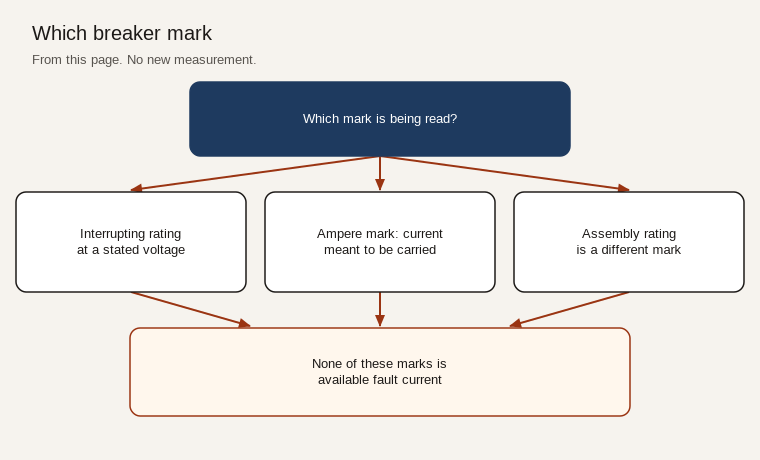
Read the interrupting rating as the highest current the breaker is identified to interrupt at a stated voltage, and keep the ampere mark, the assembly short-circuit rating, and available fault current as separate facts.
| Mark | What it answers | What it leaves open |
|---|---|---|
| Interrupting rating | The highest current at a stated voltage that the breaker is identified to interrupt under standard test conditions | The fault current the building can deliver |
| Ampere rating | The current the device is marked to carry | The fault current it was tested to interrupt |
| Assembly short-circuit current rating | The prospective fault current an apparatus can be connected to without damage beyond defined acceptance criteria | The breaker’s own interrupting rating |
| Series-combination caution | That identified devices were applied together and that the replacement must be the identified component | Using the downstream interrupting number as the series rating |
| Available fault current | The current at the line terminals, taken from the sources and a study | A value stated on the breaker nameplate |
What the interrupting rating is asked to cover
The rating answers a narrow question. If a fault drives current through this breaker at the voltage for which the interrupting figure was established, is the device identified to open and clear that current under the standard test? The NFPA 70 public-input record for the cycle that produced the 2023 edition states it as the highest current at rated voltage that a device is identified to interrupt under standard test conditions. An informational note there separates fault duty from ordinary switching: some equipment has an interrupting ability implied in another rating, such as horsepower or locked-rotor current.
Schneider Electric’s molded-case FAQ uses nearly the same sentence, with “intended” rather than “identified,” and says each voltage carries its own interrupting figure on the breaker. The rating must be equal to or greater than the available short-circuit current where the breaker is applied. That comparison is the duty. The nameplate is not a calculation method, and this page does not provide one.
As of November 2026, OSHA’s text of 29 CFR 1910.303(b)(4) says equipment intended to interrupt current at fault levels shall have an interrupting rating sufficient for the nominal circuit voltage and the current available at the line terminals. A second sentence covers equipment that interrupts current at other than fault levels. The rating is asked to meet the current at those terminals. The label does not state what that current is.
The next paragraph is a different duty. Section 1910.303(b)(5) requires the overcurrent devices, the impedance, the component short-circuit current ratings, and other characteristics to be selected and coordinated so a fault can be cleared without extensive damage. The assumed fault is between circuit conductors, or between a conductor and the grounding conductor or metal raceway. Clearing the current and limiting damage are related. They are not one rating.
The ampere mark is not the interrupting mark
On molded-case breakers rated 100 A or less, UL Solutions’ marking and application guide puts the current rating on the handle or the escutcheon. That is the number people see first. It is the current the device is marked to carry, not the fault current it was tested to interrupt. Two breakers can share that ampere rating and still carry different interrupting ratings, or the same interrupting current at different voltages. A purchase order that copies only the ampere rating, pole count, and family name has not specified the interrupting duty.
A high interrupting figure does not mean the breaker may run continuously at its ampere rating in every enclosure. Unless it is marked for continuous operation at its full current rating in a stated enclosure, that loading question is separate. Adjustable trip settings change when the breaker starts to open. They do not rewrite the interrupting rating, and a coordination study is not a new interrupting test.
Short-circuit current rating is not this rating
The two names are not synonyms. In the 2020 edition of NFPA 70, as quoted by IAEI Magazine, short-circuit current rating is the prospective symmetrical fault current at a nominal voltage to which an apparatus or system is able to be connected without sustaining damage exceeding defined acceptance criteria. The same article quotes 2020 section 110.9 as the interrupting-rating rule for equipment intended to interrupt fault current, and 2020 section 110.10 as the rule aimed at clearing a fault without extensive damage. IAEI treats the first as the overcurrent device’s interrupting performance and the second as the equipment’s connection limit.
Older Code language said “interrupting capacity.” IAEI notes that manufacturers have used AIC, ampere interrupting capacity, and that the 1978 edition changed the Code term to interrupting rating. AIC belongs with the device. SCCR belongs with the apparatus or system. Calling a panel rating “AIC” hides which hardware was evaluated.
UL’s marking guide states the equipment consequence. If the breaker’s marked interrupting rating exceeds the marked short-circuit rating of the end-use equipment, such as a panelboard, the combination is still limited to the lesser rating on that equipment. A higher breaker nameplate does not raise the assembly, and the assembly mark does not become the breaker’s interrupting rating.
UL’s machinery short-circuit FAQ, written against the 2021 edition of NFPA 79, says the available fault current at each machine supply disconnect must be known before a panel rating can be called adequate. The same FAQ states a component default that is easy to misread as a site fact: terminal blocks have a default short-circuit current rating of 10 kA per UL 508A Table SB4.1. That figure is a component assumption in a panel method. It is not the building’s fault current, and it is not a breaker interrupting rating.
What the nameplate does not prove about the site
A nameplate can list the manufacturer, the voltages, the ampere rating, and the interrupting pairs and still leave the installation unproved. It does not state available current at the line terminals, and under UL’s lesser-of rule it does not raise an assembly whose marked short-circuit rating is lower. One breaker label also does not show whether another component or a tested combination sets that assembly limit.
It does not prove the system matches the voltage mark. UL separates a straight voltage rating from a slash rating such as 480Y/277 V: circuit voltage may not exceed the higher number, and voltage to ground may not exceed the lower. In the guide’s high-leg example, a three-pole 120/240 V breaker is not intended on a 240/120 V three-phase four-wire delta, because the high leg is 208 V to neutral. Grounding on the actual system still has to be established. The example is a marking limit, not a survey.
AC and DC are separate marks. An AC interrupting rating does not cover a DC fault. Above 250 V DC, the guide says the breaker is generally connected with poles in series and is marked with the permitted arrangement. A qualified professional uses that arrangement. It is not improvised from an AC label.
The interrupting figure is a symmetrical rms value. The guide requires the words “Interrupting Rating” or “Current Interrupting Rating,” allows “Maximum RMS Symmetrical,” shows every voltage pair together, and does not permit an asymmetrical interrupting rating on the molded-case breaker. That number is not a site X/R ratio. This page does not restate test power factor or X/R from a standard that was not read in full. A frequency other than 60 Hz is marked when it applies.
The mark does not freeze the sources or the breaker’s condition. A later generator, transformer, tie, or distributed resource can change available current. IEEE 1547-2018 covers interconnection of synchronous machines, induction machines, and inverters or converters, and its catalog page sets no interrupting rating and no fault contribution. OSHA’s examination rule treats broken, overheated, or corroded parts as a condition that can affect safe operation. Coordination and incident energy may use the rating. They are not the rating.
Families, series ratings, and replacements
Not every device with a handle was evaluated as the same product. UL’s circuit-breaker services overview evaluates molded-case breakers to UL 489, and low-voltage power circuit breakers to UL 1066 with ANSI/IEEE C37.13 and ANSI/NEMA C37.50. Supplementary protectors evaluated to UL 1077 are not, in UL’s words, intended to provide the branch-circuit protection the National Electrical Code requires. UL also says a certified replacement investigation covers the breaker and associated parts only. The end application, and any series combination, has not been investigated. A listing mark does not show that a spare is the identified series component, or that the panel rating survives the swap.
IEEE C37.13-2024, published December 20, 2024, covers enclosed low-voltage AC power circuit breakers at a rated maximum of 1058 V and below. The public scope discusses ratings and preferred ratings. The catalog page does not list interrupting values, and those values are not the molded-case marks. UL lists medium-voltage breakers for metal-clad and metal-enclosed switchgear as their own category. A molded-case interrupting figure is not evidence that a power circuit breaker or a medium-voltage breaker meets another standard’s short-circuit duty.
A series combination is a claim about more than one device. UL’s machinery FAQ describes a breaker used above its own marked interrupting rating only on the load side of an acceptable device with a higher rating, either as a tested combination or, where permitted, by a licensed professional engineer’s calculation. This page does not walk through that calculation or say how to choose the upstream device. As of November 2026, OSHA 1910.303(f)(5) requires a visible field marking for that application, including a statement that an identified replacement component is required. The downstream breaker’s own interrupting number is not the series rating.
A current-limiting mark is separate. UL’s guide requires the words “Current Limiting” plus peak let-through and I-squared-t data, or a reference to them. The guide’s definition is a breaker that does not use a fusible element and, in its limiting range, holds let-through below a half-cycle wave of the available symmetrical current, up to the interrupting rating. The mark does not replace that rating. The machinery FAQ says that simply adding a current-limiting device on the line side does not, by itself, establish that downstream equipment is protected.
UL’s marking guide also assigns a figure when the interrupting rating is absent. Molded-case breakers with a rating other than 5000 A are marked. If no interrupting rating is marked, it is 5000 A. The NFPA public-input record described a branch-circuit overcurrent device as having an interrupting rating no less than 5000 amperes. An unmarked breaker is not an unlimited breaker, and 5000 A is not a finding that the site is within that value. As of November 2026, confirm the adopted code sentence. The marking guide is the product rule read for this page. A later transformer, tie, motor, or on-site source can still make an old comparison obsolete. IEEE 1547-2018 does not supply a current to add, and a stamped study covers only the assumptions it names.
An illustrative set of marks
Illustrative only: before a shutdown, a spare is offered because the handle ampere rating and the manufacturer match the installed breaker. The side label shows one interrupting rating at one voltage and a lower interrupting rating at a higher voltage. The panelboard’s short-circuit current rating is lower than the breaker’s higher figure. A field marking says the equipment was applied as a series combination and that the replacement must be the identified component. The spare does not match the type and carries no series identification.
Those four marks cover load current, tested interruption, the assembly limit, and the series claim. None states the fault current available that day. This scene is not a Soleil Energy project and not a method for picking a breaker.
Which edition applies, and what to bring
Records make an assessment possible. They do not perform it. Bring the breaker type and every voltage and interrupting pair, the assembly short-circuit rating and any series caution, and the one-line with the date and assumptions of the last fault study. Those papers show which claim is missing. They do not show that today’s available current is inside the marks.
The edition is its own record. As of November 2026, NFPA’s NFPA 70 page identifies the 2026 edition as the current National Electrical Code and describes a reorganization that began in the 2023 edition and continues toward 2029. Publishing an edition is not adoption. The 2020 wording quoted by IAEI, including sections 110.9 and 110.10, cannot be assumed to be the sentence an inspector will apply.
Maryland does not show one electrical edition for every building. The Maryland Department of Labor building-code matrix dated March 18, 2026, and read on November 22, 2026, lists the 2017 National Electrical Code on the State Fire Marshal row for the State Fire Prevention Code, for buildings other than modular and state-owned buildings. The Labor row lists the 2020 National Electrical Code for modular and state-owned buildings. Ordinary buildings are marked locally adopted. Northern Virginia and the District of Columbia are separate authorities. OSHA’s paragraphs are a workplace rule within their scope, not the building permit or the product listing.
Soleil Energy’s power practice includes switchgear, protection, and short-circuit studies. A useful scope conversation starts with the voltage, photographs of the breaker and assembly marks, any series caution, the date of the last fault study, and the outage window. It does not select a breaker from a glossary, and it does not replace a qualified professional’s assessment of the actual site.
Questions that change the work
Is AIC the same thing as interrupting rating?
For the device, yes. IAEI traces interrupting capacity as the older Code term and AIC as manufacturer usage for ampere interrupting capacity, later renamed interrupting rating in the Code. Schneider defines it as the highest tested current at rated voltage. Without that voltage, and without saying whether the figure is the breaker’s or the panel’s, the shorthand is not a specification.
Which mark governs when the breaker figure is higher than the panel figure?
UL’s guide keeps the combination at the lesser short-circuit rating on the end-use equipment. The breaker mark does not upgrade the panel. A marked series combination is a third figure, and only for the identified devices.
Can a current-limiting mark stand in for interrupting rating?
No. Let-through data run up to the interrupting rating. They do not replace it. Adding a current-limiting device upstream does not, by UL’s machinery FAQ, establish protection downstream by itself. A series rating still needs the field marking and the identified replacement.
Does a matching ampere rating make a replacement acceptable?
No. The ampere rating carries neither the interrupting pairs nor the series identity. UL’s replacement evaluation stops at the breaker and its parts. If the sources have changed, even an exact type has to be set against the current now available at the terminals.
Who decides that the rating is adequate at this site?
A qualified professional assesses the actual installation. The authority having jurisdiction decides the edition. As of November 2026, Maryland, Northern Virginia, and the District of Columbia are not one code regime, and NFPA’s current published edition is not automatically the adopted text. OSHA may apply to the workplace even when it is not the construction code.
Project requirements depend on the site, equipment and applicable rules. Confirm design and installation decisions with the appropriate qualified professional.
