
A short-circuit current rating is the marked prospective fault current, at a stated voltage, that an electrical assembly is identified to be connected to without damage beyond its evaluation criteria. The marking describes that assembly. It does not measure the fault current available at the building, and it is not the interrupting rating of a breaker or fuse inside the equipment. A qualified professional must assess the actual site.
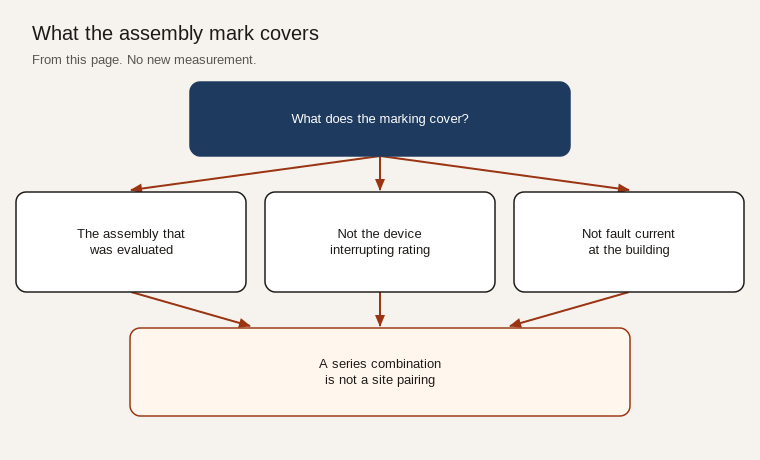
Use the short-circuit current rating for the evaluated assembly at a stated voltage, and do not treat it as the breaker interrupting rating or as the fault current available at the building.
What an assembly rating is asked to cover
The rating is asked to cover the assembly as evaluated, not one part removed from the enclosure. For a panelboard, UL Solutions’ panelboard application guide says the marking “Short-Circuit Current Rating,” in rms symmetrical amperes, means the overcurrent devices can open under fault conditions and the bus can withstand the magnetic forces of that current. The guide ties the marking to National Electrical Code section 110.10 and calls the value the steady-state fault current the panelboard can withstand without extensive damage. It may vary with voltage. The investigation standard named there is UL 67. The marking does not describe the transformer, the feeder, or a generator added later.
An industrial control panel is a different assembly. UL Solutions’ combination motor-controller fact sheet states that Article 409 of NFPA 70 requires the panel to be marked with a short-circuit current rating, and that UL 508A Supplement SB is an accepted method for determining it. Supplement SB is a listing method for the panel builder. This page does not reproduce it, and it is not a way to assign a rating from a catalog.
Listed industrial machinery has a further split. UL Solutions’ machinery short-circuit current rating FAQ, written against the 2021 edition of NFPA 79, says Supplement SB is how the rating is determined and NFPA 79 is the standard for designing and building the machine. As that FAQ describes clause 16.4, the nameplate still shows the short-circuit current rating. It is not relabeled “available fault current.”
OSHA 1910.303(b)(4) requires an interrupting rating sufficient for the voltage and the current available at the line terminals of equipment that must interrupt a fault. Section 1910.303(b)(5) separately requires the overcurrent devices, the impedance, and the component short-circuit current ratings to be coordinated so the fault can clear without extensive damage. The assumed fault is between conductors, or from a conductor to the grounding conductor or metal raceway. The UL machinery FAQ adds that each supply disconnect on a multi-supply machine needs its own comparison.
What the label does not prove about the site
A nameplate does not measure available fault current. That current depends on sources and impedance outside the enclosure, and the sticker does not update itself when a transformer, feeder, parallel source, or generator changes.
It also does not prove the installed devices are the ones the rating assumed. UL’s panelboard guide says the assembly rating is limited to the lowest interrupting rating of any device installed, and that special markings must be followed when devices are added or replaced. A similar-looking breaker can change the assembly rating while the door label stays put.
Component defaults are not a survey of the building. The UL machinery FAQ states that terminal blocks have a default short-circuit current rating of 10 kA under UL 508A Table SB4.1. That figure is the standard’s default, as stated on UL’s page when read on November 22, 2026. It is not the available fault current at a site, and it is not a selection value. A qualified professional must assess the actual installation.
Field changes can leave the label behind the hardware. UL’s panelboard guide notes that cutting bus material or adding holes can affect short-circuit performance, and OSHA 1910.303(b)(2) requires listed equipment to be used according to its listing instructions. An upstream current-limiting device is a separate assumption. UL defines one as a device that, in its current-limiting range, reduces fault current well below what a comparable solid conductor would let through. The machinery FAQ says adding one ahead of a panel does not by itself establish protection: it has to limit the peak to the ratings of the panels it supplies. This page does not give that selection method.
An interrupting rating belongs to the device
UL’s panelboard glossary keeps the terms apart. An interrupting rating is the highest current at rated voltage that a device is intended to interrupt under standard test conditions. A short-circuit current rating is the maximum rms available current to which a device can be connected, in amperes and volts. The guide’s phrase “interrupting capacity” still describes the device. It is not a synonym for the assembly rating.
A breaker can meet the interrupting rule while contactors, overload relays, terminal blocks, drives, or bus remain outside it. Those parts were not given the breaker’s interrupting rating. Filing the breaker number as the panel rating answers the wrong question. UL’s combination fact sheet allows a higher combination rating only when every specified part is present and installed under the stated conditions. Anything else in the power circuit needs more evaluation, and a substitution that leaves the list is no longer that combination.
| Question | Assembly short-circuit current rating | Device interrupting rating | Available fault current |
|---|---|---|---|
| What it describes | The evaluated assembly, at a stated voltage | The device meant to interrupt fault current | Current the system can deliver at a point during a short circuit |
| Where it is recorded | Assembly nameplate or listing mark, with any stated conditions | The breaker, fuse, or other interrupting device | A separate study, or a field record of that study where the adopted code requires one |
| What it does not prove | Site current, or the rating of a part added later | The rating of bus, contactors, blocks, or other components | That the installed assembly was evaluated for that current |
A series combination is a separate listing
A series combination rating is not an assembly short-circuit current rating, and it is not two breakers a reader may pair because each catalog page looks high. UL’s panelboard guide describes breakers used above their own interrupting rating only on the load side of a specific overcurrent device. The marking lists those combinations by manufacturer, type, and rating, and the combination interrupting rating cannot exceed the line-side device. The blanks are filled by the evaluation, not chosen on site.
Where breakers or fuses are applied on series ratings the manufacturer marked, OSHA 1910.303(f)(5) requires a visible field marking that the equipment is a series combination system and that an identified replacement component is required. An unidentified substitute breaks the combination.
UL’s machinery FAQ treats a series rating as a field procedure, not the preferred repair when a machine rating is too low for the site. A calculation requires a licensed professional engineer to show the downstream breaker stays passive while the line-side device interrupts. A test has to include the end-use equipment. This page supplies neither path and does not name a combination to copy.
A series rating of two overcurrent devices does not become the short-circuit current rating of an industrial control panel. Using it to cover an unevaluated contactor, drive, or distribution block invents a listing nobody issued.
Available fault current is calculated for the site
Available fault current is the largest current the system can deliver at a point during a short circuit, given the sources that contribute and the impedance between them and that point. OSHA looks at the current available at the interrupting device’s line terminals. The machinery FAQ looks at the current available at each machine supply disconnect. Neither says to read that current from the assembly nameplate.
This page does not give a calculation method. Utility data, transformer impedance, conductors, motor contribution, and on-site generation belong in a study under the adopted code. A qualified professional must assess the actual site.
New generation is one reason an old study expires. IEEE 1547-2018 is the IEEE standard for interconnecting distributed energy resources. The listing read for this page covers performance, testing, abnormal-condition response, and commissioning for synchronous machines, induction machines, and inverters or converters. It does not state an assembly short-circuit current rating or a fault-current value. Contribution from those resources is a separate study input. An arc-flash result that never compares available fault current with the panel rating has not shown that the marking is still adequate.
An illustrative mismatch
Take an illustrative packaging line, not a reported project. The machine arrives with a listed control panel. The nameplate states a short-circuit current rating at a stated voltage. The main breaker inside carries a higher interrupting rating. The facilities file keeps the breaker photo and drops the nameplate.
The building later replaces a transformer and adds a second source, and no one repeats the study. The breaker photo is treated as proof the machine is still suitable. It is not. The interrupting rating was never the assembly rating, and neither figure was the available fault current, which is what changed.
The same gap appears if a technician adds a power distribution block and a different contactor. The original combination covered only the named parts under its conditions of acceptability. The old nameplate does not adopt the new parts. A qualified professional has to assess the revised panel and the revised supply.
Questions to settle before a replacement
A replacement can match the trip rating and the frame and still fall outside the combination the label depends on. Before a breaker, fuse, contactor, drive, or distribution block is ordered, the file should answer a few questions. These are records to collect, not a sizing method, and they do not authorize a new number on the enclosure.
| Record | Why it matters |
|---|---|
| Nameplate wording, voltage, and short-circuit current rating | The rating may depend on a stated voltage or a stated upstream device |
| Series-combination caution and the identified replacements | An unidentified substitute breaks the combination |
| Fault-current study, its date, and the sources it included | A later transformer, feeder, or generator can make the study obsolete |
| Whether the power circuit still matches the evaluated parts | Added parts are not covered by silence on the old label |
If those records disagree, or one is missing, the missing step is a site assessment by a qualified professional. A device described only as higher rated can leave an unevaluated part in control of the assembly.
Which code edition applies, as of November 2026
The National Electrical Code applies to a permit only in the edition a jurisdiction adopts, including amendments. UL’s panelboard guide notes that code section numbers can change. As of November 2026, the places named on Soleil Energy’s service-area page do not share one electrical edition.
Virginia’s Department of Housing and Community Development states on its codes page that, effective January 18, 2024, Virginia adopted the 2021 I-codes and the 2020 National Electrical Code. Local building departments enforce the Uniform Statewide Building Code. Confirm amendments and any transition rule for the permit in hand.
The District of Columbia Department of Buildings states that the 2017 DC Construction Codes include the 2014 National Electrical Code, as amended in DCMR Title 12, effective May 29, 2020. Some earlier permits follow the transitory provision in section 123. That page is not a ruling for one address.
Maryland is not one permit edition on the pages read here. The Building Codes Administration says the Maryland Building Performance Standards set the state editions of the International Building Code, International Residential Code, and International Energy Conservation Code, and that localities may modify them within stated limits. That page does not name one electrical edition for every permit. The Board of Electricians’ January 27, 2026 minutes separately record that, under Business Occupations and Professions §6-205(a)(3), the Board enforces the most recent National Electrical Code on the schedule that statute sets after publication for complaint evaluation, while localities keep their own permit schedules. As of November 2026, confirm both if both apply. OSHA 1910.303 is a workplace rule for covered employers, not the adopted building code.
Common questions
How does an assembly rating differ from a breaker’s interrupting rating?
The assembly rating is the prospective current the evaluated equipment is identified to be connected to. The interrupting rating is what the breaker or fuse is intended to interrupt under standard test conditions. UL defines them separately, and OSHA places them in different paragraphs of 1910.303. A high breaker rating does not raise the other power-circuit parts.
Does the nameplate report available fault current?
No. UL’s NFPA 79 FAQ says the nameplate shows the short-circuit current rating, not the available fault current at the line terminals. Compare the nameplate with a study of the supply. The nameplate does not create that study.
Does a current-limiting fuse ahead of the panel settle the rating?
Not by itself. The UL machinery FAQ says the device must limit peak current to no more than the ratings of the panels it supplies. Choosing it is an engineering decision. This page does not give selection steps.
Can two breakers be declared a series combination on site?
Only if the manufacturer marked that pair, or if a path the adopted code allows has been completed for that equipment. OSHA requires a visible field marking and identified replacement parts. Two high catalog numbers are not a combination, and a series rating is not the panel’s short-circuit current rating.
What should be rechecked after a transformer or generator is added?
Recheck available fault current, the old study’s date and sources, and every supply. Assembly markings do not update themselves. IEEE 1547-2018 sets interconnection performance rules and does not replace that study. A qualified professional must assess the site after the sources change.
Who decides the installed equipment is suitable?
Someone qualified for the study and for the assembly standard has to make the comparison. The authority having jurisdiction decides what the permit requires. Nameplates and an older study are inputs, not a determination that the marking still fits the building.
Bring the markings and the study together
Read the assembly rating and any condition that ties it to a specific overcurrent device, the interrupting rating of each device that must open a fault, and any series-combination caution. Set those facts next to a current available-fault study for the actual terminals. A missing item is the work, not a guess from the highest number on the door.
Soleil Energy’s power team includes short-circuit studies with protection coordination, switchgear work, and commissioning. For a replacement or a marking that no longer matches the supply, start with the one-line, the nameplates, any fault-current document, and the outage limits. Soleil Energy serves Maryland, Northern Virginia, and Washington, DC, as stated on its service-area page. The comparison still has to be made for the site itself.
Project requirements depend on the site, equipment and applicable rules. Confirm design and installation decisions with the appropriate qualified professional.
