
A construction scope of work is the written boundary of the labor, materials, and services a contract price is offered to cover. It states what is included, what is excluded, and where one trade’s responsibility ends. A drawing set, an allowance, and a bidder’s qualification are related papers, not substitutes for that boundary. As of November 2026, the form that ranks those papers still depends on the contract you sign.
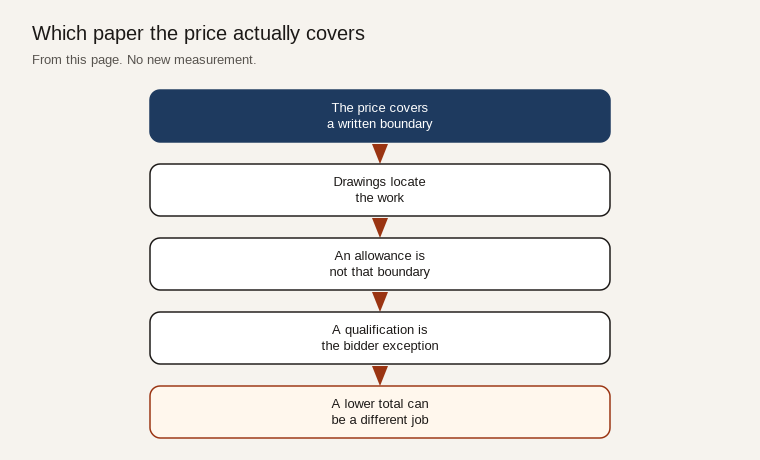
A drawing set, an allowance, and a bidder qualification are different papers from the written boundary, and two totals can be ranked only when they price the same inclusions and exclusions.
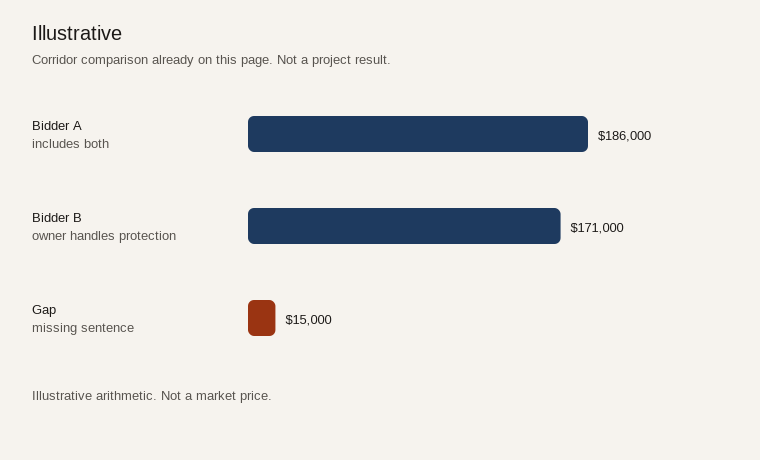
These figures are illustrative arithmetic already written for the corridor example, and they are not a market price or a project result.
The price is an offer against a described job
A construction price is an offer to perform a described set of work, not a promise to deliver the building in the abstract. Two totals can be ranked only when they price the same inclusions, exclusions, access limits, and trade assignments. A lower number on a narrower description is a different job, not a better deal.
The document changes with the delivery method. FAR 36.102, read here under FAC 2026-01, effective March 13, 2026, defines design-bid-build as design and construction contracted separately and in sequence, and design-build as both in one contract with one contractor. DBIA’s design-build page states that same split. It also describes a two-step path, capability then design and price, and a progressive path that selects on capability and develops design and price afterward. Those capability records are not a bid qualification that deletes work.
FAR 36.302 requires a federal design-build scope that defines the project and states the Government’s requirements. It may include criteria, preliminary design, budget, and schedule. It need not be a finished drawing set. If a contractor writes it, FAR subpart 36.6 applies. FAR 36.202 points construction specifications to part 11, and FAR 11.002 says agencies should, to the maximum extent practicable, state functions, performance, or essential characteristics rather than dictate design too early. That is federal policy. It does not force private specifications to be performance-only. Deviations can restate the text, so the solicitation controls.
A drawing set is not the scope
Drawings show location, relationships, dimensions, and details. They are a weak place to assign who furnishes a product, who installs it, who protects an occupied corridor, or who repairs existing work the new work disturbs. A sheet can carry a note. Without an inclusion and exclusion narrative, those edges stay inferred.
An AIA best-practice note dated November 30, 2023, issued without endorsement, says explanatory text belongs in the specifications unless it applies to one drawing, and that drawings should say they depict the work’s general nature. AIA’s working-drawings article is practice guidance, not a code and not a ruling that drawings lose every conflict.
CSI’s standards overview, read in November 2026, calls MasterFormat a shared language for work results contractors can price, procure, and build, aligned with drawings and specifications. The page presents MasterFormat 2026 as the current release. It is a filing system, not a contents list. Name the edition actually used. SectionFormat/PageFormat, described there, arranges section text so omissions and duplication are less likely. It is not a required scope outline.
Federal silence is a clause question. FAR 52.236-21 (Feb 1997) gives an item in the specifications but not on the drawings, or on the drawings but not in the specifications, the same effect as if it were in both. If they differ, the specifications govern, and other discrepancies go to the contracting officer in writing. “Provided” means furnished and installed unless the contract says otherwise. FAR 36.521 requires that clause on fixed-price construction, or fixed-price dismantling, demolition, or removal, expected to exceed the simplified acquisition threshold, and allows it below. Confirm the threshold and whether the solicitation inserts the clause. A private agreement does not inherit it.
An allowance is inside the price, and it is not the scope
An allowance is a stated amount in the contract sum for a named item whose final cost is unknown when bids are taken. The item stays in the contract. The selection does not. An exclusion removes the item. A missing sentence leaves the parties arguing about whether it was ever included.
AIA Contract Documents explains allowances through A201. The explainer read for this page says listed allowances sit in the contract sum; the owner directs items and vendors, subject to a reasonable objection by the contractor; the allowance covers materials and equipment delivered to the site, including taxes, less trade discounts; handling, labor, installation, overhead, and profit stay in the contract sum outside the allowance; the contract sum changes by change order if actual cost differs; and the owner must select on time. A contingency, in that explainer, is a reserve for costs that may never occur, not a named item. The allowance explainer is general information, not legal advice and not the edition you sign. Supplementary conditions can put labor inside the allowance.
The allowance still does not describe the job. “Lighting allowance,” with no quantity, no statement of what the sum includes, and no adjustment rule, lets two bids share a label and hide different contents. Do not use it to skip a trade interface. An unchosen carpet can sit in an allowance. That sum does not assign who patches the corridor. Patching is in a sentence, or it is in nobody’s number.
A qualification is the bidder’s exception, not the owner’s scope
When prices are compared, a qualification is a condition the bidder adds. It may drop a trade, limit hours, move temporary protection to the owner, or tie the price to a later material quote. It is not the owner’s scope unless the owner accepts it into the contract. Until then, it is a proposal to build a different job.
Federal sealed bidding is stricter than private negotiation. FAR 14.404-2 rejects a bid that misses essential requirements, and rejects a bid that adds conditions modifying the invitation or limiting the bidder’s liability, because acceptance would prejudice others. One example is a price qualified as subject to “price in effect at time of delivery.” A condition goes to substance when it affects price, quantity, quality, or delivery. A low bidder may be asked to delete a condition that does not. FAR 14.404-5 is different: unless the solicitation says otherwise, a bid may stay responsive if award is accepted only for all items or a stated group, and that all-or-none qualification cannot be withdrawn after opening.
A private owner may accept a qualification, but the raw totals still should not be ranked. Reject the exception, reprice everyone against one addendum, or normalize each number to the original scope. A design-build volume about team capability is a third meaning. It does not delete utilities or temporary protection. Pull any exclusion out of that volume before calling the total complete.
What an omitted sentence does to the price
An omitted sentence does not erase a physical need. It removes that need from the description bidders must price. Estimators price what they can point to. Each firm fills the gap with its own assumption, often the assumption that keeps the number lower. The spread then looks like a market range when part of it is a scope range.
Illustrative arithmetic, not a market price and not a Soleil project: drawings show new flooring and a temporary partition in an occupied corridor. No sentence assigns dust protection or after-hours cleanup. Bidder A includes both and totals $186,000. Bidder B assumes the owner handles protection and totals $171,000. The $15,000 gap is the price effect of a missing sentence, not a discount on one promise. Awarding the lower figure without an addendum does not erase the need. The work returns as a change, a dispute, or effort that was never priced against the other bidders.
The costly missing sentences are short: who furnishes and who installs, who patches, who locates utilities the survey omits, who keeps an occupied school’s exits open. Where FAR 52.236-21 applies, “provided” already means furnished and installed. Silence in a private scope does not borrow that meaning. An allowance does not fill the gap, and a qualification is often the bidder’s record of the assumption. Rank the dollars only after every offer uses the same sentence.
Write the interfaces that change the number
No universal section list exists. MasterFormat files work results. It does not decide which results this building has. Write only the decisions that would change a bid if reversed, and make every bidder price the same version.
| Decision that changes the number | What must be explicit before bids are compared |
|---|---|
| Furnish and install | Who buys, who installs, and who ties the product to adjacent work |
| Work by others | Owner-furnished items and what separate contracts will not provide |
| Occupied access | Hours, exits, dust control, and who approves the sequence |
| Existing work | What stays, what is removed, and who repairs damage |
| Allowances | The item, what the sum includes, who selects, and how a difference is adjusted |
| Exclusions and addenda | What is out, which exceptions are rejected, and which addenda every price includes |
The table is one procurement’s comparison aid, not a required outline. Skip a row the project does not have. An occupied renovation that skips access will collect prices for a vacant building.
Unified Facilities Guide Specifications section 01 11 00, Summary of Work, February 2024, Change 2 dated May 2026, is a NAVFAC shell for USACE, NAVFAC, and the Air Force Civil Engineer Center. Its note calls for use under that guide and tells the editor to delete text the project does not need. Occupancy language is for a building that stays in use. Government-furnished items appear only if the contractor installs them. The UFGS 01 11 00 text is not a private outline. A private scope should still state whether the floor stays open, which hours are available, and who provides temporary protection.
Delivery method moves the document, not the edges
In design-bid-build the boundary is often split among a summary, technical sections, drawings, and addenda. The narrative assigns responsibility, the specification states quality and execution, and the drawings locate the work. “Replace the roof,” with no assembly, prices an undefined roof. A precise specification that never says the wing stays occupied may price an empty building.
In design-build, requirements are often priced before drawings exist. FAR 36.302 allows criteria and preliminary design, not only a performance paragraph, and DBIA’s progressive path develops design and price after a capability selection. The owner still has to fix what is required, what the owner furnishes, and what may move as design advances. Separate trade packages can each look complete and still leave patching or ceiling access unassigned. They add up to the building only if each interface, and each later addendum, is in every number you compare.
The conflict rule is the one in the contract
As of November 2026, no single rule decides whether the narrative, the specifications, or the drawings win.
Where FAR 52.236-21 is inserted, specifications govern a difference with the drawings, and other discrepancies go to the contracting officer in writing. An AIA Knowledge Community discussion quotes A201 Section 1.2.1 the other way: the contract documents are complementary, and what one requires is as binding as if all required it, with conflicts reported rather than ranked away. That quotation is in the AIA discussion thread, not in a licensed A201 read for this page. Participants note that a forced rank can discard information, because specifications state quality and products while drawings show extent and location.
Read the form you will sign. Public supplementary conditions often add their own order. This page cannot choose among documents still being assembled. Counsel on a formal procurement, with a qualified construction professional, should read the agreement, conditions, scope, drawings, and addenda together. Maryland, Virginia, and the District of Columbia do not share one construction-procurement statute.
Put the same boundaries under every number
Bids stop being comparable when totals are ranked before inclusions, exclusions, allowances, and interfaces are frozen. Write the sentences that change the price. Reject qualifications or normalize them. Name the classification edition without pretending the index is the scope. State which conflict rule the contract will use.
Soleil Energy describes commercial and government work, renovations, roofing, design-build under one contract, and phased school and government renovations while a building stays in use. That description is on the construction page. Coverage the company states for this discussion is Maryland, Northern Virginia, and Washington, DC, with the counties it names and with no DC office, on the service-area page. Bring the delivery method, budget constraints, drawings, written scope, allowances, and access limits. Do not start from an untied low total.
Questions to settle before ranking bids
How can a scope make inclusions, exclusions, and interfaces clear before bids are compared?
Give every bidder one attachment that states inclusions, exclusions, and interfaces in the same words. Price a different assumption as an alternate, not as a side letter. Compare base bids only when each total names that attachment and the same addenda. Neither CSI nor the FAR makes that attachment mandatory on every contract.
If the drawings show it, why might the price still omit it?
A drawing can show that an item exists and still omit who does the temporary work around it. If FAR 52.236-21 applies, work shown in only the drawings or only the specifications is still required. Furnish-versus-install, occupied hours, and repair of existing work still need an assignment. Ask bidders to mark which of those their number includes.
Is an allowance the same as leaving the item out of the scope?
No. An allowance keeps a named item in the contract sum and, on the A201 summary from AIA Contract Documents, adjusts that sum when actual cost is known. An exclusion assigns the item elsewhere. A contingency, in that explainer, reserves for costs that may not arise. A missing sentence is a fourth case: assumed, disputed, or never priced. Name which of the four you mean before sorting totals.
Does a lower bid with a qualification become the low price?
Not until the offers match. FAR 14.404-2 rejects sealed-bid conditions that modify the invitation or limit liability, including an effect on price, quantity, quality, or delivery. A private owner may negotiate instead. The lower number is still a different scope until the exception is deleted or every bidder prices it. FAR 14.404-5 can leave an all-or-none qualification responsive. Read the solicitation. This page is not a responsiveness decision.
Which paper controls when the narrative and the drawings conflict?
As of November 2026, the signed clause does. FAR 52.236-21 lets specifications govern a difference with the drawings. The A201 language quoted in the AIA discussion treats the documents as complementary and sends the conflict out for a report. Supplementary conditions may set a third order. Correct the clash by addendum while bidders can still reprice.
Project requirements depend on the site, equipment and applicable rules. Confirm design and installation decisions with the appropriate qualified professional.
