
General contractor vs construction manager compares who holds the trade contracts, who advises before a construction price exists, and who does not become the designer merely by taking the job. In a common design-bid-build arrangement, the general contractor prices a design the owner already commissioned and then engages the trades. A construction manager may advise only, or may advise and later construct. The label itself does not assign design responsibility.
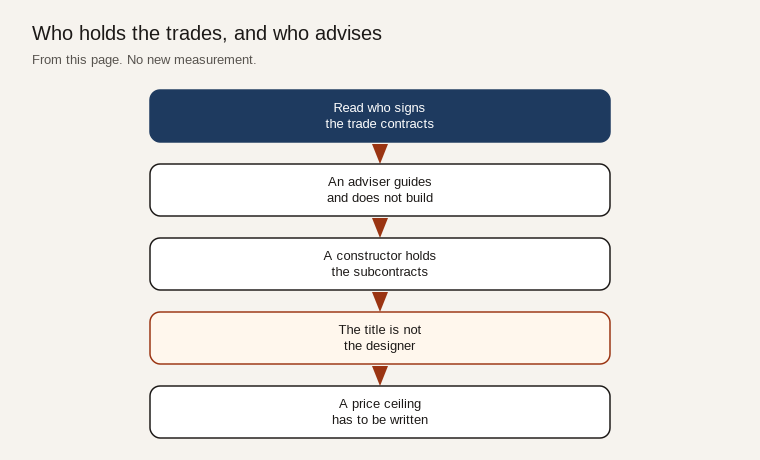
An adviser guides the owner and does not hold the trades, a constructor later holds those contracts and builds, and neither title assigns design responsibility or writes a price ceiling by itself.
The signed agreement does the assigning
General contractor, construction manager, constructor, adviser, and construction management at risk are often treated as one badge. The badge names a business. The agreement states the bargain: who may hire a trade, when a price is stated, what happens if the work costs more, and who answers for the drawings.
The catalog for ConsensusDocs 200 is a lump-sum prime, and the same description calls the constructor a builder, general contractor, design-bid-builder, or construction manager. The nickname does not turn that prime into an advisory hire, and calling an adviser a general contractor does not make the adviser the party that hired the trades. Read parties, subcontracts, price, and any design-delegation language in the draft that will be signed. A catalog is not that draft and is not legal advice for a site.
A construction manager is not one role
As of November 2026, AIA Contract Documents’ comparison separates the construction manager as adviser from the construction manager as constructor. That page is an overview, not the form the parties will sign.
The adviser guides the owner and does not build. The owner keeps the designer contract and separate contractor contracts. The adviser may estimate, review constructability, compare bids, and coordinate. The explainer says this manager does not hold trade contracts, does not perform the work, and does not assume construction risk. It points to A132, A232, B132, and C132.
The constructor advises while design is open, then holds the subcontracts and the duty to build. The explainer points to A133, A134, A201, and B133, and says these projects often include a GMP, meaning a stated ceiling for a defined scope. The letterhead does not create that ceiling.
| Question | Adviser | Constructor, often called at risk |
|---|---|---|
| During construction | Advises and coordinates | Advises, then builds |
| Trade contracts | Owner holds the prime contracts | Manager holds the subcontracts |
| Cost risk for construction | Stays largely with the owner | Moves to the manager under the written price |
Choose an adviser to sign each prime and keep construction-cost risk. Choose a constructor so one firm awards and directs the trades. A statute or an occupied building can still rule either choice out.
Who holds the trade contracts
Holding the trade contract means the agreement, the pay path, and the performance remedy run through that party.
On a federal design-bid-build buy, design and construction are sequential and sit in two contracts with two contractors. That is FAR 36.102. As of November 2026, the Acquisition.gov text carried FAC Number 2026-01, effective March 13, 2026. In that section, design means defining the requirement, producing drawings and specifications, and preparing the construction cost estimate. The builder’s title does not move design into the construction contract, and the trades sit under the construction prime unless the solicitation says otherwise.
ConsensusDocs 200 is the lump-sum form of that pattern, bid or negotiated, with the designer on a separate agreement and subcontracts addressed in the general conditions. The constructor is the party that engages the trades.
The adviser path reverses the stack. AIA’s explainer says the owner maintains multiple direct contracts with contractors. The adviser may help compare those primes and is not the party they contracted with. If a trade defaults, the remedy is on that prime.
The at-risk path puts the trades under the manager. AIA says the constructor holds the subcontracts. ConsensusDocs 500, titled with a GMP and a preconstruction option, lets the manager subcontract portions that are fully designed before the rest of the design is done. That is still the manager’s trade contract, not a transfer of design.
Maryland states a public version. As of November 2026, COMAR 21.05.10.01 defines a trade contract as the agreement by which the construction manager engages the trade. COMAR 21.05.10.05 says the manager assumes all risk for cost, schedule, and performance, and may buy those contracts together or over time. With procurement-officer approval, selection need not be low bid alone. A package the agency signs itself is outside that definition and should be named.
Virginia will not answer by title. As of November 2026, Code of Virginia § 2.2-4379 defines a construction management contract as one to coordinate and administer construction contracts for the owner, which may also include furnishing construction services if the contract says so. Coordination is the baseline. Holding the work is optional text.
Who advises before a construction price exists
Advice before a price exists means estimates, phasing, and constructability comments while no trade yet has a contract price. Bid-day questions only clarify a set already out for price.
AIA’s adviser works before the owner signs the primes. A missed estimate is a question under the advisory agreement, not a promise to build for that figure.
The constructor uses the same window and then crosses a line: estimate, propose a price, and, if the owner accepts, hold the trades. ConsensusDocs 510 offers preconstruction services on a form it also calls CM at risk, CM/GC, and CM@R, paid as the cost of the work plus a fee, with no GMP. Document 500 puts a GMP in the title and still starts with scheduling, budget, and design advice. Neither catalog states a fee percentage. This page will not invent one.
As of November 2026, Maryland splits that advice from the later ceiling. COMAR 21.05.10.01 defines preconstruction services as work before construction, including constructability analysis, value engineering, scheduling, site assessments, and cost estimates. COMAR 21.05.10.03 requires competitive sealed proposals to select the manager, and a separate Board of Public Works approval for preconstruction services at any dollar amount. COMAR 21.05.10.04 makes the GMP an amendment, based on documents not less developed than 50 percent construction documents for that scope. The manager warrants completion at or below the GMP, with change orders for owner-directed work outside the scope and not covered by the contingency. A schematic estimate is not that amendment, and a bid on a finished set is not that advice.
The label does not assign design responsibility
Design responsibility is who defines the result, who draws it, and who may seal it. The nickname does not decide.
FAR 36.102 keeps design and construction in separate contracts for design-bid-build, and defines design-build as both in one contract with one contractor. FAR 36.209, in the same FAC 2026-01 text, bars a construction award to the firm that designed the project, or its subsidiaries or affiliates, unless the head of the agency or an authorized representative approves. That federal rule does not govern a private Maryland job or a Virginia county building. On a federal project, design-build is its own path, not the result of hiring a construction manager.
DBIA’s explanation says other methods keep separate design and construction contracts, and that one contract for both is the difference. The page is an association description, not a statute. Advice on another firm’s drawings does not make an at-risk manager a design-builder.
Maryland’s definitions include design consultation, constructability analysis, and value engineering. None of those phrases is a seal. Virginia’s design-bid-build path is a design award, then a construction award to build from that design. Design-build is one party agreeing to both. The construction-management definition does not call the manager the designer.
Delegated design still has to be written down. The ConsensusDocs 200 and 510 catalogs list it in the general conditions. A trade may engineer a curtain wall, fire protection, or steel connection only if both agreements say so and that person may practice there. The prime’s title does not create the duty or lift the seal on the other sheets. A qualified designer has to make that call. The delivery label is also not a license. Confirm the contractor license and the professional license with the board for the site.
A price ceiling is a written term
The contract may provide a bid, a running estimate, cost plus a fee, or a ceiling amendment. The cover does not say which.
As of November 2026, Maryland defines the GMP as the agreed dollar amount for construction and construction-management services, including scope, trade cost, general conditions, contingency, and fees. That is a contents list, not a standard percentage. COMAR 21.05.10.02 says non-exempt agencies may not use the method on a project estimated at less than $10,000,000 without prior Board of Public Works approval. Savings below the ceiling may be shared. The section does not state the share.
Outside that chapter the ceiling is optional. ConsensusDocs 500 puts a GMP in the title. ConsensusDocs 510 sets no GMP. ConsensusDocs 200 is a lump sum for a defined scope, subject to changes, and needs no GMP amendment. A contingency the manager controls is not an owner allowance. Owner-directed work, thin documents, an owner-hired trade, or a site condition assigned to the owner can all move the cost. A number marked only “the project” is not yet a price.
A contract carries a bond only when required
A bond follows a statute or a clause, not the job title. It is a surety’s promise for a named principal.
As of November 2026, FAR 28.102-1 states that 40 U.S.C. chapter 31, subchapter III, formerly known as the Miller Act, requires performance and payment bonds for a federal construction contract above the amount in that subsection, with waivers that include foreign work where a bond is impracticable. In the lower band in the same subsection, the contracting officer selects two or more payment protections, with particular attention to an irrevocable letter of credit, before notice to proceed. That federal rule is not an adviser’s agreement and not every private contract.
A private contract carries a bond only if the owner or another law requires one. ConsensusDocs 200 and 510 list bond as a blank to complete. Silence is not a bond. The principal is the general contractor, or the at-risk manager who holds the trades. An adviser who never promised to build is the wrong principal unless the agreement takes on that duty and a surety issues it. State public-works bond statutes are separate and are not restated here.
An illustrative renovation, three ways
This illustrative example is a private Maryland clinic. The owner’s architect is already hired. Mechanical equipment and interiors will be replaced while the clinic stays open. It is not a completed project or a price.
Under design-bid-build, one general contractor prices the finished set and subcontracts mechanical work and interiors. Invoices go to that general contractor. A wall move goes to the architect, then to a change if the owner accepts it. Schematic-design advice was not part of the bid unless it was bought.
Under an adviser contract, the manager estimates and phases the work before any trade price exists. The owner signs both primes. An undersized unit is a dispute with whoever sized it and with the prime who priced it, not with an adviser who holds no trade.
Under an at-risk contract, the manager holds the mechanical trade once it is priced. A later amendment may add a ceiling, or the deal may stay at cost of the work plus a fee with no ceiling. The architect’s client is still the owner, and any layout the trade designs has to be assigned in the contracts.
The designer did not change. The invoice path did, and so did the moment a construction price existed.
These public rules do not travel
The texts above were read in November 2026, and each has a limited reach.
Maryland’s chapter applies to procurement agencies that are not exempt from that title. A private owner does not inherit the approval steps by being in Maryland. Section .05C was amended effective August 31, 2026, so read the current trade-notice timing rather than an older memo.
Virginia § 2.2-4379 defines the term for public bodies. A private Northern Virginia project is outside it. Do not paste one state’s price rule into the other’s solicitation. FAR parts 36 and 28 govern federal buys only. District procurement law is not stated here. The adopted building code stays with the local authority. A delivery method does not choose it.
Bring constraints, not a preferred title
A useful brief says whether a designer is already hired, whether the owner will sign multiple primes, whether a price is required before drawings are finished, and whether a statute limits the method. Firms can answer that brief. They cannot price a job title alone.
Soleil Energy states its limits on its service-area page: Maryland, Northern Virginia, and Washington, DC, naming Prince George’s, Montgomery, Howard, and Arlington counties, and no DC office. Inside that coverage, an owner can discuss delivery method, budget basis, and site constraints with Soleil Energy’s construction team. The conversation does not assign Soleil Energy either role on a job, and it does not choose the form.
Questions owners still ask
Does an adviser replace the architect?
No. AIA’s adviser sits beside the designer. Someone still seals the drawings under an owner agreement, unless the project is design-build. If the proposal says the adviser will handle design, ask who the architect of record is and who that architect’s client is.
Can the early adviser later hold the trades?
Only if the role is constructor from the start, or a later conversion the procurement rules allow. Maryland can approve preconstruction on its own and the price amendment later, once documents meet the level in COMAR 21.05.10.04. Comments during design are not a silent general contract.
Is at-risk management the same as design-build?
No. At risk is a construction role, and the designer can stay under a separate owner agreement. Design-build, in FAR 36.102, Virginia § 2.2-4379, and DBIA’s account, is one contract for both design and construction. Meetings do not assign the seal.
Who carries a bond?
The firm that promises the construction, when a statute or clause requires one. Above the FAR 28.102-1 threshold, that is the construction contractor, subject to the waivers there. An adviser is not the principal for attending meetings, and a silent private draft does not carry a bond.
Does the Maryland chapter govern every regional job?
No. It covers certain Maryland procurement agencies. Private Maryland work, a Virginia public body, a federal buy, and the District each use different text. The wrong text can skip an approval or use a method the buyer is not allowed to use. District requirements are not stated here.
Project requirements depend on the site, equipment and applicable rules. Confirm design and installation decisions with the appropriate qualified professional.