
Metal-clad vs metal-enclosed switchgear compares enclosure constructions. It is not a rating a name can assign to a site. In IEEE catalog language checked in November 2026, metal-clad switchgear is a medium-voltage assembly with drawout electrically operated circuit breakers and grounded metal barriers around stated parts. Metal-enclosed switchgear is the broader enclosed family, including interrupter assemblies and low-voltage power circuit breaker switchgear. A note that says only “ME” or “MC” does not identify the standard, the device, or the installation.
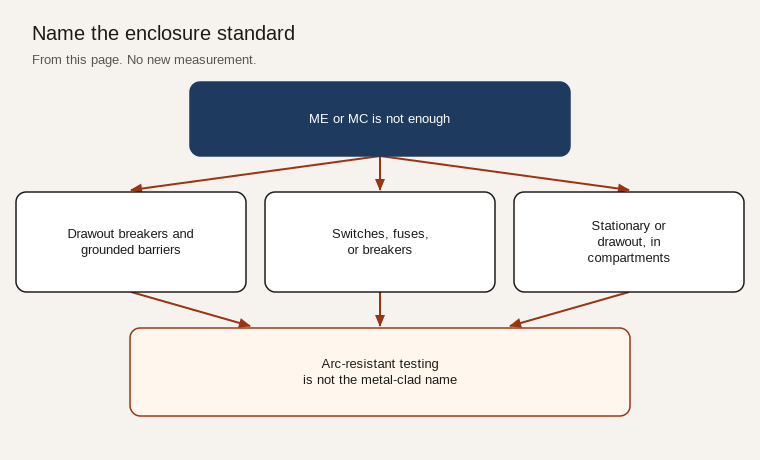
Match metal-clad gear to medium-voltage drawout breakers with grounded metal barriers, and treat metal-enclosed gear as the broader family that also includes interrupter assemblies and low-voltage compartmented breakers.
The two labels are not opposites
Treating the names as rivals misreads both the code vocabulary and the IEEE documents. In the National Fire Protection Association’s February 7, 2024 public report for the NEC revision cycle, switchgear is an assembly completely enclosed on all sides and top with sheet metal, except for ventilating openings and inspection windows. It contains primary power-circuit switching devices, interrupting devices, or both, with buses and connections. It may include control and auxiliary devices. Doors, removable covers, or both provide access.
The informational note in that report says all switchgear subject to NEC requirements is metal enclosed. It says switchgear rated below 1000 V or less may be identified as low-voltage power circuit breaker switchgear, and switchgear rated over 1000 V may be identified as metal-enclosed switchgear or metal-clad switchgear. It also says switchgear is available in non-arc-resistant or arc-resistant constructions. That wording is a development record, not proof of the edition a city, county, or utility has adopted. As of November 2026, the authority having jurisdiction still has to be asked which edition applies. The NFPA 70 development page is the public entry point for the code; it does not print this definition.
The same report defines a switchboard separately, as a panel assembly with switches, overcurrent devices, buses, and usually instruments, not intended for a cabinet. That comparison is a different page. “Metal-enclosed” does not mean the gear is open. The note treats NEC-covered switchgear as metal enclosed, then allows more than one name in the group. Arc-resistant construction is a further availability, not the definition of metal-clad gear.
What the metal-clad abstract states
As of November 2026, IEEE SA lists IEEE C37.20.2-2025 as the active metal-clad standard. The abstract says it covers medium-voltage switchgear that contains drawout electrically operated circuit breakers, compartmentalized to isolate components such as instrumentation, the main bus, and both incoming and outgoing connections with grounded metal barriers. It states rated maximum voltage levels from 4.76 kV to 48.3 kV, with main-bus continuous-current ratings of 1200 A, 2000 A, 3000 A, and 4000 A. It also includes associated control, instruments, metering, relaying, protective, and regulating devices as necessary.
That is a catalog abstract, not the construction clauses. The page that was read does not state a bus-insulation method, describe shutters, or set an interlock sequence. Those details are in the purchased standard and in the manufacturer’s design. They should not be invented from the title.
The edition changes the public rating language. On the same IEEE SA page, the 2015 abstract stops at 38 kV while still listing those four bus-current figures. The 2022 abstract uses the 4.76 kV to 48.3 kV span repeated in 2025. The superseded 1999 abstract described a broader medium-voltage assembly that could use drawout or stationary breakers, and it stated metal-clad voltages from 5 kV through 38 kV with bus ratings of 1200 A, 2000 A, and 3000 A. That text is not the 2025 rule.
IEEE SA records the 2025 edition as superseding 2022, with board approval on December 10, 2025, publication on June 30, 2026, and ANSI approval on September 16, 2026. An order that says only “C37.20.2” can be read against more than one text. The rating structure is not a finding that a site needs the top of the range. A qualified professional has to match the actual voltage, continuous current, and short-circuit conditions.
Interrupter switchgear is a separate enclosed assembly
IEEE C37.20.3-2023 is the active standard for metal-enclosed interrupter switchgear rated above 1 kV AC up to and including 48.3 kV AC. The abstract says the assemblies contain, but are not limited to, interrupter switches, selector switches, power fuses, circuit breakers, control, instrumentation and metering, and protective equipment, for control and protection of distribution apparatus and not only that use. The 2013 abstract on the same page already lists circuit breakers. The 2001 abstract lists switches, fuses, and control and protective equipment, and it does not list circuit breakers in that short text. An old reading of “switches and fuses only” does not describe the current abstract.
A catalog scope for the 2023 edition adds limits the short IEEE SA abstract does not repeat. Air at ambient pressure is the primary insulating medium, while individual components may use other insulation. The standard concerns enclosed, rather than open, indoor and outdoor assemblies in the title’s voltage span, including equipment in primary and secondary unit substations. It excludes gas-insulated substation equipment and switching devices mounted inside a transformer enclosure. It says construction requirements exist. Those clauses were not opened here, so barrier, insulation, and mounting rules are not listed. A specifier who needs them has to read the edition being invoked.
A bibliographic record for the edition, DOI 10.1109/IEEESTD.2023.10264853, lists both “metal-enclosed interrupter switchgear” and “metal-enclosed power switchgear” as keywords. The family name is not one product. IEEE SA lists the edition as active, superseding 2013, with board approval on June 29, 2023, publication on September 27, 2023, and ANSI approval on August 14, 2024. Its 48.3 kV title figure is higher than the 2013 title’s “1 kV to 38 kV” wording. An older “38 kV MEI” note may be citing a different title, not a universal limit.
Low-voltage metal-enclosed gear is a third standard
IEEE C37.20.1-2026 covers metal-enclosed low-voltage power circuit breaker switchgear at 1000 V AC and below and 3200 V DC and below. The abstract includes stationary-mounted or drawout-mounted breakers, manual or electrical operation, and low-voltage AC definite-purpose switching devices, in individual metal compartments, with one to four poles. It lists rated maximum AC voltages that include 1058 V and publishes preferred main-bus continuous-current ratings.
That abstract blocks a shortcut. This low-voltage standard uses individual metal compartments and allows both stationary and drawout devices. Calling every metal-enclosed lineup unbarriered fused gear does not match it, and it does not match the 2023 interrupter abstract either.
The 2026 edition supersedes 2015. IEEE SA shows board approval on February 12, 2026, publication on July 30, 2026, and ANSI approval on September 28, 2026. The edition still has to be named.
The displayed scope of ANSI/UL 1558, sixth edition dated April 2, 2025, addresses this low-voltage family. It covers metal-enclosed low-voltage power circuit breaker switchgear containing breakers and other interrupting devices, switches, control, instrumentation, metering, and protective and regulating equipment, for ordinary locations under the National Electrical Code. It says the requirements supplement IEEE C37.20.1, described there at 1000 V AC and below and 3200 V DC and below, and ANSI C37.51 conformance tests. The stated rating is 1000 V AC or less nominal and 1058 V AC maximum. That scope page does not make UL 1558 the listing standard for medium-voltage metal-clad switchgear.
UL’s dead-front switchboard marking guide, dated December 2021, still tells readers to confirm that it is current. As of November 2026, that preface was on the page. The guide investigates dead-front switchboards to UL 891 for ordinary locations rated 1000 volts or less, and its NEC references point at the 2020 edition. It warns that similar-looking equipment may instead be category DLAH, “Circuit Breaker and Metal-Clad Switchgear (over 600 volts),” or category WUTZ, “Switchgear Assemblies, Metal Enclosed, Low-Voltage Power Circuit Breaker Type.” The text read here does not name the UL standard used for DLAH or WUTZ. The mark, not the enclosure shape, is the evidence.
Arc-resistant testing is not the metal-clad name
The NEC note already separates arc-resistant construction from the metal-clad and metal-enclosed names. IEEE’s project page for PC37.20.7.1 does the same. As of November 2026 it is an active project, with PAR approval on June 6, 2024, not a finished guide. It addresses application and use of switchgear that is arc resistant under IEEE C37.20.7, the recommended practice for testing switchgear rated up to 52 kV for internal arcing faults.
The recommended practice was not opened, so accessibility types and room conditions are not stated here. “Metal-clad” does not say a C37.20.7 test was performed, and the project page does not say only metal-clad equipment can be tested. IEEE 1547-2018 is separate: it covers distributed-energy interconnection performance and tests, not these enclosure constructions.
What a specification still has to name
The public texts support the distinctions below. The table is not a selection chart and not a design.
| What must be named | C37.20.2-2025 metal-clad abstract | C37.20.3-2023 interrupter standard | C37.20.1-2026 low-voltage abstract |
|---|---|---|---|
| Device language | Drawout electrically operated circuit breakers | Switches, power fuses, circuit breakers, and protective equipment, among other devices | Stationary or drawout breakers, manual or electrical operation, in individual metal compartments |
| Voltage language | 4.76 kV to 48.3 kV rated maximum | Above 1 kV AC through 48.3 kV AC in the title | 1000 V AC and below, and 3200 V DC and below; abstract includes 1058 V AC |
| Separation language | Grounded metal barriers around instrumentation, main bus, and incoming and outgoing connections | Not in the short abstract; the catalog says construction requirements exist but they were not reproduced here | Individual metal compartments |
| What it does not decide | Bus insulation, shutters, or whether the site should use this construction | Whether a given lineup is fused, barriered, or breaker-based | Which preferred rating belongs on a given service |
Fault current, utility requirements, indoor or outdoor use, control power, and working space remain site facts. Gas-insulated equipment and switches mounted inside a transformer are outside the interrupter scope that was read. None of those limits picks the remaining gear. “Equal to metal-clad” is not a substitution clause. If a different IEEE assembly standard may be offered, the contract has to say which functions may change. If it may not, the alternate is not automatic.
Replacement limits, without a procedure
Drawout language does not mean a device from one lineup fits another. Compartment geometry, connections, control circuits, and ratings are design features. Two metal-clad assemblies can still be incompatible. The low-voltage abstract also allows stationary devices, so a plan that assumes every metal-enclosed breaker is removable is already ahead of that text. Changing a fused interrupter for a relayed breaker changes the study, the space, and the outage. This page does not rank those options or describe how to move a breaker. Qualified people do that work from the equipment instructions and the applicable safety rules.
An illustrative drawing shows the paperwork gap. It labels a transformer primary “ME switchgear” and a feeder lineup “MC switchgear,” with no edition and no statement of whether the primary device is a switch, a fuse, or a breaker. The feeder note does not say whether “MC” means the C37.20.2 construction or a nickname for low-voltage gear. The labels are not interchangeable and not complete. The next step is to recover nameplates, arrangement drawings, and device identities, then have a qualified professional compare them with the editions under consideration. The example is not a Soleil Energy project and not a recommendation to replace either lineup.
Records can be gathered without opening energized equipment: the standard and edition, any listing mark and category code, the one-line symbol, any arc-resistant test reference, and the outage window the facility can support. Nameplate photographs, taken under ordinary access rules, are records, not a work method.
Bring those records to a scope discussion
Soleil Energy’s power page describes switchgear and protection together with studies, specifications, installation, testing, and maintenance. That is a service description, not a finding that one construction fits a property. The service-area page, read in November 2026, names Prince George’s, Montgomery, and Howard counties in Maryland and Arlington County in Virginia, and it states that Washington, DC, is served without a DC office. Those counties are not an electrical classification, and the page does not claim national installation coverage.
A useful conversation starts with voltage, the one-line, nameplate or drawing references, the utility ownership boundary, and the outage window. A qualified professional must assess the actual site, including the adopted code, fault current, equipment condition, and manufacturer limits. This page does not select metal-clad or metal-enclosed construction for that site.
Questions that change the specification
Does metal-enclosed equipment exclude metal-clad gear?
No. The NEC note treats covered switchgear as metal enclosed, then allows over-1000 V equipment to be called metal-enclosed or metal-clad. Without a standard number, “metal-enclosed” can mean the interrupter standard, the low-voltage breaker standard, or only that general enclosed character.
Why do three IEEE numbers attach to two everyday names?
C37.20.2-2025, C37.20.3-2023, and C37.20.1-2026 name different assemblies: medium-voltage drawout-breaker gear, interrupter gear that can include breakers as well as switches and fuses, and low-voltage gear that allows stationary or drawout devices in individual compartments. Offering one in place of another changes the standard. The year matters because earlier abstracts, including the 1999 metal-clad listing, use different voltage spans and device language.
Is UL 1558 the medium-voltage metal-clad standard?
No. That scope covers low-voltage metal-enclosed power circuit breaker switchgear, used with IEEE C37.20.1 and ANSI C37.51, at 1000 V AC or less nominal and 1058 V AC maximum. Medium-voltage metal-clad gear is the C37.20.2 subject. If the mark says DLAH or WUTZ, record that category rather than guessing from the box. This page did not open a product directory entry for either code.
Does metal-clad mean an internal-arc test was done?
No. The metal-clad abstract does not mention an internal-arc test. The project page ties “arc resistant” to C37.20.7 for switchgear rated up to 52 kV, and the NEC note treats arc-resistant and non-arc-resistant forms as available choices. A required test has to be named with its basis. The installation assumptions are not supplied here.
Will one drawout breaker match another lineup?
The abstracts do not say so. They do not publish a shared compartment, a shared control connection, or permission to mix manufacturers. In the low-voltage standard, drawout is only one allowed arrangement beside stationary mounting. A qualified professional has to compare drawings and device limits. This page does not describe handling a removable device.
What if the one-line says only “ME” or “MC”?
Name the IEEE number and edition, the voltage basis, the main device, any required listing category, and whether an internal-arc test is required. In Soleil Energy’s published territory, those records are the starting point for a power-scope discussion. A qualified professional still has to assess the actual site before a construction is selected.
Project requirements depend on the site, equipment and applicable rules. Confirm design and installation decisions with the appropriate qualified professional.
