
Switchgear vs switchboard compares two enclosed assemblies that switch and protect power circuits. They are not two labels for one product. UL 891 uses “switchboard” for a dead-front assembly, with no live parts exposed on the front, nominally rated at 1,000 volts or less. IEEE C37.20.1 covers low-voltage switchgear that places power circuit breakers, or certain switching devices, in individual metal compartments. The name follows that construction, not the size of the room.
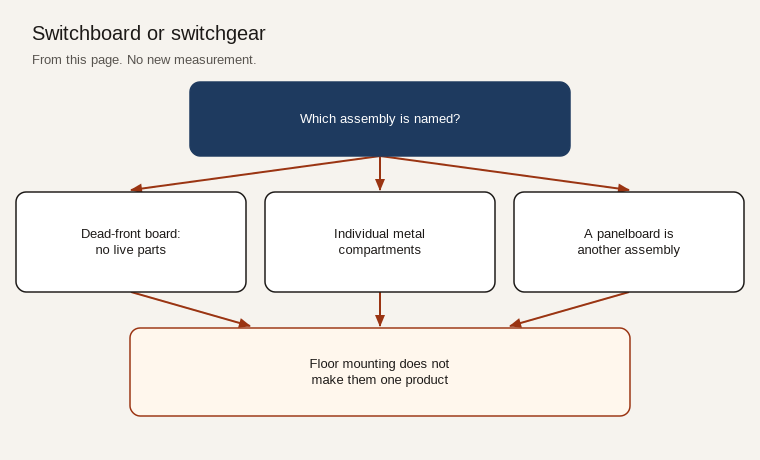
Name a dead-front switchboard when the assembly keeps live parts off the front, and name low-voltage switchgear when power breakers sit in individual metal compartments, because the two constructions are not one product.
The names get swapped when a bid describes a lineup
A floor-standing row of breakers can look like one family. Specifications then treat “switchgear” as a heavier word for a switchboard, or the reverse. The equipment that arrives can be listed and still be the wrong construction.
The mismatch usually sits in three documents. The narrative uses one name. The schedule cites another standard. The one-line never says whether each main device has its own metal compartment, whether a device is drawout on a specific adapter, or whether a short-time current rating was required. Pricing the words as synonyms does not make those documents agree.
This comparison is for engineers, procurement leads, and facility managers using US standards. It does not select a rating, a trip setting, or a method for energized work. A qualified professional has to assess the site, the available fault current, the adopted code, and the markings on the equipment proposed.
Read the published scope, not the photograph
As of November 2026, the public scope of UL 891, twelfth edition, last revised March 21, 2025, applies to dead-front switchboards nominally rated at 1,000 volts or less. It excludes live-front boards, theater dimmer boards, railway control or electrification boards, and constructions meant only to receive motor control center units. It covers switchboards only for circuits whose available short-circuit current is not more than 200,000 amperes, and it does not cover switchboards with short-time current ratings. That ampere figure is the standard’s coverage ceiling, not the mark on a board and not a number to copy onto a project. A listed board can be marked lower.
The low-voltage switchgear document is not a nickname inside UL 891. UL 1558, sixth edition, published April 2, 2025 and last revised June 26, 2026, covers metal-enclosed low-voltage power circuit breaker switchgear. Its scope includes power circuit breakers and is not limited to them: other interrupting devices, switches, and control or protective equipment may be included. It supplements IEEE C37.20.1 and the ANSI conformance-test procedures named there. The opened scope is 1,000 volts ac or less nominal, with a stated maximum of 1,058 volts ac. Those are bounds, not a voltage to assign. The same scope does not repeat UL 891’s short-time exclusion. That silence is not a duration or a current. A short-time rating, if required, has to be marked on the equipment being bought.
Compartments come from the IEEE abstract, not from the word switchgear
The active IEEE catalog entry read in November 2026 is IEEE C37.20.1-2026, published July 30, 2026. The public abstract describes metal-enclosed low-voltage switchgear with stationary-mounted or drawout-mounted power circuit breakers, or low-voltage ac definite-purpose switching devices, in individual metal compartments. The title bounds it at 1,000 volts ac and below, and at 3,200 volts dc and below.
Drawout construction is not required by a sentence that also allows stationary mounting. A drawout device does not prove the lineup was built to this standard, and a handle on the front is not a compartment. The abstract discusses ratings and tests; it is not the test procedure, and this page does not copy preferred bus currents from it. Compare the markings on the proposed assembly with the study for the site.
UL 1558’s June 26, 2026 revision summary says that revision changes requirements for multiple-source switchgear. UL 891’s March 21, 2025 revision summary lists multiple-source switchboards among the topics changed. This page did not read those clause texts. Where more than one source can energize a lineup, name the edition and the markings.
A breaker standard does not rename the assembly
UL 489, fourteenth edition, ANSI-approved March 7, 2025, covers molded-case circuit breakers and molded-case switches for service, feeder, and branch-circuit protection. It does not apply to low-voltage power circuit breakers. The device is judged with its enclosure when the complete product is investigated.
UL 1066, fifth edition, published August 8, 2022, applies to low-voltage power circuit breakers in enclosures, stationary or drawout, and does not apply to molded-case breakers. It says these breakers are intended for enclosures, switchboards (switchgear), panelboards, and similar equipment, and that drawout devices need specific adapters. Acceptability is decided on the complete product. The parentheses do not make the assemblies identical and do not turn a UL 891 board into UL 1558 switchgear. UL’s circuit-breaker overview treats medium-voltage breakers as a further evaluation, for metal-clad and metal-enclosed switchgear. That is a boundary, not this comparison.
Short-circuit current and short-time current are different claims
A short-circuit current rating is the marked ability of an assembly to be connected where a stated fault current is available. A short-time current rating, where one exists, is a withstand claim for a stated current and a stated time. UL 891’s scope excludes switchboards that carry a short-time current rating. Specifying a short-time rating and naming only UL 891 asks for equipment that scope says it does not cover.
That exclusion does not assign a duration or a current to switchgear. The IEEE and UL 1558 pages opened here do not publish one short-time duration for every assembly. A cycle count in a brochure is a claim about a specific design. Read it on that drawing and nameplate.
The installation rule is edition-specific. Tentative Interim Amendment 23-12 to the 2023 National Electrical Code, issued August 25, 2023, and effective September 14, 2023, revises section 408.6. Where that text applies, switchboards, switchgear, and panelboards need a short-circuit current rating not less than the available fault current. Outside one- and two-family dwellings, that current and the calculation date are field-marked at the point of supply. As of November 2026, this page does not establish whether Maryland, Virginia, or the District of Columbia has adopted that amendment. Confirm the enforced text with the authority having jurisdiction.
A certification mark means representative equipment was evaluated to a stated standard, not that the site was checked. UL’s panelboard application guide says a panelboard short-circuit marking covers the devices and the bus forces, and that it can be limited to the lowest interrupting capacity of an installed device. The guide warns its code numbers can change. Selective coordination is a separate study.
A panelboard is not a small switchboard
Switchboard versus panelboard is a third boundary. The same UL guide describes a panelboard as a panel, with buses and automatic overcurrent devices, made for a cabinet or cutout box in or against a wall and accessible only from the front. It identifies UL 67 as the basic standard.
NEMA’s product-group scope, revised July 2025, lists panelboards and distribution switchboards separately. Switchboards in that scope are usually on a framework designed for floor mounting. The file is a product-group scope, not a construction standard and not the adopted code. Floor mounting does not create switchgear, and a front-access wall cabinet is not a smaller copy of either assembly.
Metal-clad versus metal-enclosed is a different question
“Metal-enclosed” is already in the UL 1558 and IEEE C37.20.1 titles. It is not a synonym for metal-clad or for a dead-front switchboard.
IEEE C37.20.2-2025, published June 30, 2026, covers metal-clad medium-voltage switchgear with drawout electrically operated circuit breakers and grounded metal barriers around the main bus, instrumentation, and line connections. That question does not decide UL 891 versus UL 1558.
IEEE C37.20.3-2023, published September 27, 2023, covers metal-enclosed interrupter switchgear, and its title places that family above 1 kV alternating current. The abstract includes interrupter switches, fuses, and circuit breakers among possible devices. Do not use that comparison to choose a low-voltage switchboard.
What has to be written down before the names are interchangeable
A useful bid does not say “match the existing switchgear” when nobody photographed the nameplate. It states the facts that change construction.
| Fact the documents should state | What a vague name can hide |
|---|---|
| Assembly standard and edition | UL 891, and UL 1558 used with IEEE C37.20.1, are not aliases |
| Compartment and mounting | Individual compartments, group mounting, stationary mounting, or drawout mounting on a specific adapter |
| Device standard | UL 489 and UL 1066 are different device standards; the complete assembly is still investigated as one product |
| Short-circuit rating and any short-time rating | A coverage ceiling is not the mark; UL 891 does not cover short-time ratings |
| Available fault current | Where the cited amendment applies, the assembly rating must meet that current, and a dated field mark may be required |
| Access, sources, and outage limit | Front or rear work, more than one source, and whether a device change drops more than one circuit |
A blank cell means the names are not yet comparable. Filling the list is work for a qualified professional. The table is not a set of ratings to copy.
An illustrative package that is not one product
Illustrative example, not a Soleil Energy project and not a recommendation: a narrative calls the service equipment switchgear. The schedule cites a dead-front switchboard standard and never mentions a short-time rating. The one-line shows several devices on a common bus and does not say whether each device has its own compartment or whether a drawout device needs a specific adapter. No fault-current figure or calculation date is attached.
Those pages share vocabulary, not one assembly. A UL 891 switchboard and compartmented UL 1558 switchgear can each match a sentence in the narrative, and neither has been checked against a missing fault study. Make the standard, the mounting, the device standard, and the required ratings the same words in every document.
Replacement is limited by the room, the mark, and the outage
Replacement is limited by working space, cable direction, and which sections can move without rebuilding the bus. A front-accessible board against a wall is not automatically convertible to equipment that needs rear access, and old rear access is not proof of the current IEEE abstract. Under UL 1066, a drawout breaker belongs with a specific adapter, so one frame’s spare is not a generic spare for another. Whether one device can come out while other compartments stay in service is a question for the qualified person in charge. This page does not describe racking, testing, or energized tasks.
For substation construction covered by OSHA, 29 CFR 1926.966(c) requires the employer to keep a draw-out-type breaker open when employees remove or insert it, and to make the control circuit inoperable if the design permits. That duty covers the work the section covers. It is not a procedure for facility staff and does not by itself govern every commercial electrical room. Ask what must be de-energized. A drawout feature does not answer that. Name added sections and a second source before fabrication. Both recent UL revision summaries call out multiple-source equipment, and a later field change can fall outside the original investigation.
An interconnection standard does not choose the lineup
IEEE 1547-2018, published April 6, 2018, with amendment 1547a-2020 on the same catalog record, covers interconnection of distributed energy resources with the utility system. The abstract addresses performance, abnormal conditions, power quality, islanding, and tests for a 60 hertz source on distribution circuits. It does not define a switchboard, switchgear, or a panelboard. An on-site resource may land on a breaker in any of those assemblies. The resource standard still does not rename the gear or set its short-circuit rating. Confirm the utility and the customer class.
What remains a site decision
Nothing here chooses interrupting ratings, trip settings, bracing, arc-resistant construction, or a maintenance method. Arc-resistant performance is its own tested claim. Ordinary-location language in the UL 1558 scope does not describe a hazardous location. Before a purchase, a qualified professional should be able to point to the adopted code text, the fault current and its date, the assembly and device standards on the nameplate, stationary or drawout mounting, any short-time rating and its duration, the working space, and the outage boundary. Disagreement among those items is the finding.
Questions that change the purchase
Is every floor-standing breaker lineup switchgear?
No. NEMA’s July 2025 product-group scope already describes distribution switchboards as usually floor-mounted. Floor mounting does not create IEEE compartments or a UL 1558 investigation. Read the nameplate.
Does front-only access make the equipment a switchboard?
No. Dead-front in UL 891 means no live parts are exposed on the front. It does not close the rear, and it does not reject a front-connected compartmented lineup. Check access on the drawing and under the adopted installation rules.
Can a power circuit breaker be installed in a switchboard?
Yes, the breaker can be, if the complete product was investigated that way. UL 1066 names switchboards among the assemblies, and it does not convert that board into IEEE C37.20.1 switchgear. The compartment and any drawout adapter still have to match the investigation.
Does a listing set the short-circuit rating or prove coordination?
No. The listing ties the product to a standard. The marked rating still has to meet the available fault current. Where the 2023 NEC and TIA 23-12 apply, section 408.6 states that comparison and, outside one- and two-family dwellings, a dated field mark. Coordination is a separate study.
Where do metal-clad and metal-enclosed switchgear fit?
They are medium-voltage construction families. IEEE C37.20.2 is metal-clad. IEEE C37.20.3 is metal-enclosed interrupter switchgear and its title starts above 1 kV. Low-voltage power circuit breaker switchgear is already called metal-enclosed. That pair does not answer switchgear versus switchboard.
What should procurement freeze before treating the names as equal?
Freeze the assembly standard and edition, the device standard, the mounting, any short-time requirement, the marked short-circuit rating, the fault current and its date, the sources, the access, and the outage limit. Until the narrative, schedule, and one-line match, the package is not one product.
Bring the markings to a scope discussion
For a replacement or a new service in Soleil Energy’s published territory, start from those documents rather than from a preferred nickname. Soleil Energy’s power practice describes substation and switchgear engineering, sourcing, installation, testing, and commissioning within the voltage classes stated on that page. The service-area page identifies work in Maryland, Northern Virginia, and Washington, DC, names the counties covered there, and states that the company has no DC office. Bring the one-line, the equipment markings, any fault-current information, and the outage window. A qualified professional still has to assess the actual site before construction or ratings are selected. This explanation does not make that selection.
Project requirements depend on the site, equipment and applicable rules. Confirm design and installation decisions with the appropriate qualified professional.
