
Solar asset management is the ongoing technical and commercial oversight of an operating photovoltaic plant. It plans the work, interprets performance, administers contracts, and decides what the owner reports over the plant’s operating life. It is not the construction closeout package, and it is not a monitoring screen by itself. The screen can show a symptom. Asset management decides who acts, under which agreement, and which number the owner stands behind.
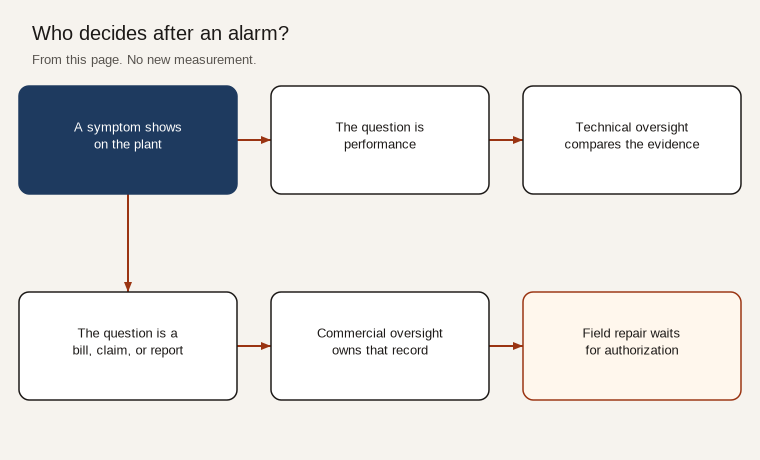
Send an alarm toward technical comparison when the question is performance, toward commercial notice when a bill or report must change, and toward field repair only when a contract authorizes the visit.
Oversight begins when the plant is the owner’s problem
The National Renewable Energy Laboratory’s 2018 operations and maintenance guide, prepared with Sandia National Laboratories and industry participants, defines asset management as planning, operating, maintaining, upgrading, and replacing or disposing of assets across their life cycles. The function contains field work and the business around it: budgeting, power-purchase or lease billing, accounting, service contracts, warranty enforcement, reserves, insurance, renewable energy certificates, performance reporting, as-built records, and utility or regulatory compliance. The guide treats that business work as asset management, not as ordinary field maintenance.
Construction closeout asks whether the plant was accepted. A portal shows what a logger last reported. Asset management asks whether the operating plant still meets energy, availability, safety, warranty, interconnection, insurance, and offtake duties.
SolarPower Europe’s 2020 guidelines, written for Europe and usable elsewhere only with local adjustments, put asset managers on commercial and financial management of the investment and on supervision of technical work. They manage a company or a portfolio, not only a power plant, and they quote an earlier ISO 55000 line: coordinated activity to realize value from assets. The ISO committee page says the 2024 edition adapted definitions. As of November 2026, treat both as vocabulary and read the agreements that actually bind the plant.
Technical oversight and commercial oversight decide different things
SolarPower Europe describes technical asset management as performance reporting, a check that operation matches permits and contracts, and advice on later changes such as repowering. The maintenance contractor often issues some of that reporting. When that overseer and the field contractor are different firms, coordination is indispensable. Commercial work is a different list: accounting, cash flow, contract administration, financing relationships, tax matters, and reports to investors or lenders.
Financiers often want production and revenue regardless of cause. Field crews need causes separated from weather and grid limits. One monthly total cannot serve both.
| Decision | Technical oversight | Commercial oversight | Field maintenance |
|---|---|---|---|
| An inverter alarm appears | Compare it with the meter, irradiance, and expected output | Note any bill, host statement, or attribute report | Diagnose and repair only if dispatched |
| Production misses the model | Separate weather, clipping, curtailment, soiling, and equipment loss | Use the comparison the contract named, including exclusions | Correct causes inside the maintenance scope |
| A part fails | Open the warranty file and the spare-parts plan | Identify which contract pays | Do the replacement the work order authorizes |
| A contract year ends | Produce the performance evidence the method requires | Issue the financial reports the owner owes | Provide the maintenance log the evidence cites |
A portfolio can justify a separate commercial manager. A host-owned rooftop often keeps bills and attributes with the owner and buys technical oversight with maintenance. A portal login that never names these decisions is not the job.
A monitoring screen is evidence, not the job
NREL lists monitoring as one of five operations activities, beside administration, conducting operations, work rules, and operator knowledge. Monitoring keeps the data path alive, compares results with an expectation, and supports reports. It is necessary and it is not the whole function. A monitor that collects weather, alarms, and tickets is not the same record as the contracts and maintenance history an owner still needs after a contractor changes.
A communications fault can hide an outage, or it can be only a lost connection while the meter still records production. When a portal goes offline, ask which of those happened. Inverter energy, a utility meter, and a weather-adjusted model are not interchangeable. IEC 61724-1:2021, in the IEC catalog, defines classes of monitoring systems and, in the 2021 edition, adds bifacial monitoring, updates irradiance and soiling measurement, and drops Class C. The catalog is not the standard text. “We have monitoring” is incomplete until the class, sensors, and measurement boundary are named, and until the owner, not only a former contractor, can open the history.
A performance comparison has to name its method
Where a performance contract exists, it measures a named indicator. NREL says that indicator is often annual energy delivery, and it recommends methods that account for weather, force majeure, and expected degradation. A plant can look strong on time-based availability and weak on a weather-adjusted performance ratio, or the reverse. The guide’s discussion of IEC 61724 distinguishes time availability from energy availability, which weights expected energy rather than the clock. It cites an older edition, so confirm the arithmetic in the current text and in the contract before using it to move money.
In the guide’s appendix example, performance ratio is measured energy divided by the energy implied by plane-of-array sunlight and nameplate capacity, with exclusions such as clipping, when direct-current power exceeds alternating-current capacity. The example also adjusts for defined force majeure and for loss attributed to the owner, utility, or host. A short window misleads because the ratio moves with season. The appendix is not a universal target. It only shows that the meter, sensor, exclusions, and the calculating party must be written down.
A different test is sometimes used at completion. IEC TS 61724-2:2025, in the IEC catalog, defines a power performance index as measured power under the test conditions divided by the output expected from the design. It applies to grid-connected plants with at least one inverter, only while output is not limited by inverter alternating-current limits, over a short run of favorable days, typically three to five days. The 2025 edition addresses bifacial modules, clipping, and curtailment. That completion test does not describe later soiling or grid limits unless the operating agreement adopts it.
Cell output also moves with temperature: higher cell temperature slightly raises current and reduces voltage by more, so heat changes production while the array is intact. Inverters convert direct current to alternating current and often provide the communications path. Advanced units may ride through small grid disturbances, change output as frequency moves, absorb or supply reactive power, or follow an operator signal. A low interval can be a failed string, heat, curtailment, or clipping. If storage shares the site, say whether stored energy is inside the comparison, who may dispatch, and what backup reserve stays untouched.
Closeout delivers a file; it does not operate the plant
SolarPower Europe treats handover, including a change of manager, as the start of the manager’s work. The file includes site records, design and construction documents, production data, contractor information, the operations manual, permits, contracts, and warranties. Those guidelines describe provisional acceptance after a short performance-ratio test and a later final acceptance. That sequence is a European industry description, not a rule for every US rooftop, which may instead close on permission to operate, inspections, matching as-builts, and warranty start dates.
Operations need a matching single-line and equipment list, commissioning results, warranty terms and serial numbers, the interconnection limits, monitoring access the owner controls, roof or land rules, and the person who may approve unplanned repairs. NREL calls the ongoing task curation: chasing gaps and filing records a later technician can find. If the first season already misses expectations, trace production against that baseline before rewriting maintenance around a plant that never passed its starting test.
Name the decision owner before the fault
Most operating disputes are scope disputes: the alarm was real, and nobody had agreed who climbs, who buys the part, who calls the manufacturer, and who tells the offtake counterparty. Assign alarm triage without implying staffed coverage just because a portal updates. Separate included repair from extra work, and tie cleaning, vegetation, snow, and pests to the site. NREL treats soiling, birds, snow, pollen, and heat as reasons the plan changes by location. Also name the spare-parts shelf, the warranty claimant, the utility contact, and who issues the performance pack and any attribute report, and from which meter. Roof rules and the authority to change settings will stop work if they are vague.
Commercial maintenance scopes specify the field tasks. Asset management checks whether that scope, the warranties, and the reports still describe the same plant. Inverter replacement and warranty terms become management problems when the installer is gone and serial numbers were never collected.
An illustrative month on a host-owned roof
This example is illustrative. It is not a Soleil Energy project and it is not a diagnosis.
A warehouse rooftop shows a communications alarm on one inverter for two weeks while the others keep reporting and the month’s energy is lower than the year before. Nobody has compared the utility meter or the plane-of-array sensor, and the preventive-only maintenance firm has not been asked to visit. Oversight compares the meter with the logs, checks irradiance, and reads whether the contract includes a mid-cycle visit or a restricted roof path. It also checks who may file a manufacturer claim and whether a host report or offtake statement must flag the interval. The visit is maintenance. Choosing the visit, the claim, and the report is asset management. If the installer has closed, finding a service firm starts from the equipment and the papers that remain.
Registration, safety, and remote access are separate tests
Daily oversight of a building array is not North American Electric Reliability Corporation registration. NERC’s Bulk Electric System definition reference, version 3 dated April 30, 2026, includes dispersed resources such as solar that aggregate above 75 MVA gross nameplate and connect through a system designed primarily to deliver that capacity to a common point at 100 kV or above. A registration reference with the same date states that, effective May 15, 2026, owners and operators must register non-BES inverter-based resources that have or contribute to an aggregate nameplate of 20 MVA or greater, connected through a system designed primarily to deliver that capacity to a common point at 60 kV or greater. Gross nameplate uses inverter apparent-power ratings. Operating limits are not subtracted, and split ownership does not remove the duty if the aggregate meets the threshold. Both papers are ERO Enterprise references, not a determination for a given site.
As of November 2026, a typical rooftop on a building service is far from those voltages and ratings. A plant with its own substation can differ, and a behind-the-meter exclusion applies only when its conditions are met. The applicable Regional Entity applies the criteria. A maintenance contract does not prove those duties exist or do not.
Electrical work sits outside the dashboard. OSHA’s solar electrical page states that workers face shock, arc flash, and burns, and that the applicable rules can be ordinary general-industry electrical standards or the generation, transmission, and distribution standard, depending on whether the installation supplies a distribution system. This page does not choose the standard or set switching steps. A qualified person assesses the site.
Remote access is part of the same plan. A 2021 NREL and Sandia report on cybersecurity in photovoltaic operations says plants increasingly use ordinary networks for metering, diagnostics, and control of curtailment and reactive power. It describes denial of service, ransomware that stops equipment, and malicious control, and it recommends a response plan with roles, utility contacts, distinct privileges, and removal of access that is no longer needed. That is planning, not a configuration recipe, and it does not mean a given plant meets a named security standard.
Settle the scope before comparing prices
Ask each proposer to mark the same rows. “Full service” usually means the lists do not match. Name the arrays and meters, including storage if it is in scope; the sensor list and who owns the history if the portal vendor ends; the performance indicator, exclusions, and who calculates; preventive tasks versus work billed extra; which commercial reports are included; who files warranty claims and where spares sit; roof rules and who may change settings; and which records return if the contract ends. A low fixed fee that excludes dispatch and reporting can cost more once an inverter fails. Compare the risk the owner still carries.
What this means where Soleil Energy works
These concepts are US practice. Coverage is separate. Soleil Energy’s service-area page names Maryland, Northern Virginia, and Washington, DC, including Prince George’s, Montgomery, and Howard counties and Arlington, and it says there is no Washington, DC office. Do not infer coverage outside the named counties from a regional headline.
Interconnection duties are not interchangeable across Baltimore Gas and Electric, Pepco, Dominion Energy, and SMECO, or across Maryland, Virginia, and the District. Commercial interconnection explains the general path. The operating duty is the signed agreement plus the current tariff for that customer class. As of November 2026, confirm both.
Soleil Energy’s monitoring and operations service covers performance monitoring, preventive maintenance, fault diagnosis and repair, portfolio views, and production reporting, including systems another firm installed. That is technical operating support. It is not a statement that Soleil Energy keeps the books, files taxes, or acts as an investment manager. An owner who wants that support can ask Soleil Energy for a system assessment and should bring the equipment list, recent fault history, monitoring access, and any performance or interconnection papers that remain.
Questions to settle before hiring
Is asset management the same contract as maintenance?
Not necessarily. Maintenance is authorized field work. Asset management decides which work is authorized, checks it against the performance method, and handles reporting around it. One firm can do both if the scope says which decisions stay with the owner.
When should commercial oversight be a separate contract?
Split it off when a lender, tax owner, or portfolio needs financial reporting the maintenance firm is not staffed to provide. Keep it with the owner when the site is a single host-owned system and the owner already handles bills, insurance, and attributes. The costly gap is the task each side assumed the other held.
What if the acceptance file is thin years later?
Rebuild nameplate photos, inverter and logger models, the utility meter, any permission-to-operate letter, and warranty registrations the manufacturer still recognizes. Missing commissioning data cannot be invented. Say so in the new baseline, and do not treat a fresh model as the original acceptance test.
What should a performance contract measure?
Name the indicator, the meter, the weather data, the exclusions, and who calculates. Energy delivery, a weather-adjusted ratio, time-based availability, and energy availability answer different questions. A short completion test does not govern a later year unless the agreement says it does.
Who acts after the installer has closed?
The owner still holds the obligations. A later firm can work from the equipment and remaining records, but missing logins and an unsigned roof rule delay the first repair. Keep those items in an account the owner controls before they are urgent.
Project requirements depend on the site, equipment and applicable rules. Confirm design and installation decisions with the appropriate qualified professional.
