
Solar curtailment is a reduction in a solar plant’s output below the alternating-current energy that plant could otherwise have produced from the sunlight reaching healthy equipment. The hold-down is intentional. A transmission limit, a price signal, an export cap, or a reliability instruction keeps the plant from delivering power it was ready to deliver. Curtailment is not inverter clipping, soiling, or shading.
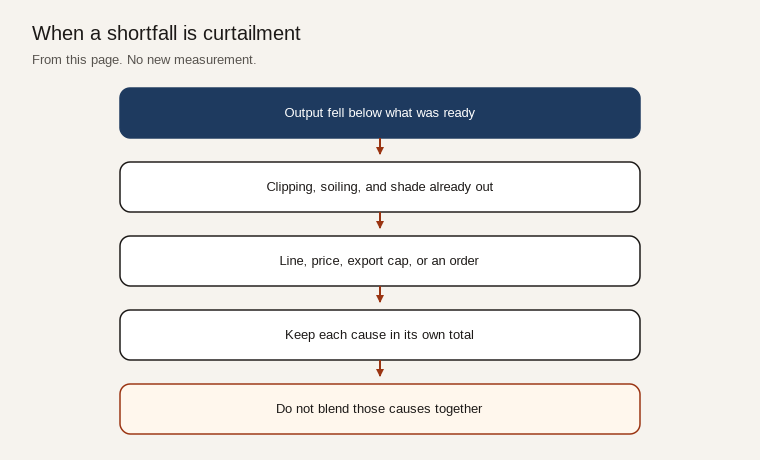
Count only energy the plant could have delivered after clipping, soiling, and shade, then keep a line limit, a price, an export cap, and a reliability order in separate totals rather than one blended loss.
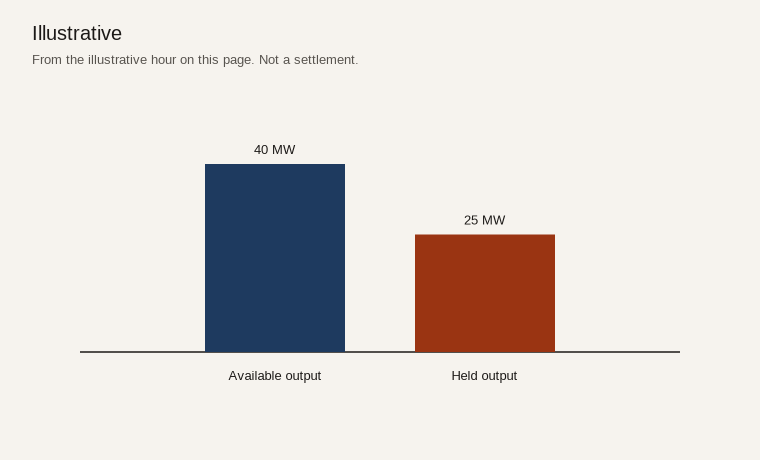
The bars repeat the illustrative hour already written on this page and are not a settlement or a project result.
Measure available output before naming the loss
A November 2024 fact sheet from the National Renewable Energy Laboratory, prepared with the Global Power System Transformation Consortium, describes curtailment of wind and solar as reduced production relative to what the resource would make available. Curtailed energy is available energy minus actual production. More generally, the fact sheet calls curtailment an intentional reduction of instantaneous power used to balance the grid. What Is Power System Curtailment?
Curtailment here is that reduction measured at alternating current: output held below what the plant could have delivered from the light that reached the cells, with the inverters still inside their own ratings. Soiling and shading change the light. Clipping is the inverter enforcing its rating. A grid instruction, a cleared price, or an export cap below the remaining alternating-current output is the curtailment.
The fact sheet splits operator reasons into oversupply and system security, and into transmission congestion and local constraints. Economic curtailment is the price path, and the price can be negative. An export limit can bind with no regional surplus.
The order is often a cleared dispatch
A May 28, 2025 Energy Information Administration article says California reduces wind and solar through price signals or, rarely, an order, when lines are congested or generation exceeds demand. California curtailments in 2024 California’s grid page, read November 22, 2026, says the market automatically curtails renewables, most often solar in spring and fall, and treats that as an accepted tool. Managing the evolving grid That account is California’s, not a PJM procedure.
The fact sheet says California’s operator and the Electric Reliability Council of Texas make the reduction inside security-constrained economic dispatch. Its emergency example is a British operator that bypasses the balancing market and orders generators down. That procedure is not a PJM rule.
PJM directs the high-voltage grid in all or parts of Maryland, Virginia, and the District of Columbia. Where PJM operates A February 2022 staff presentation describes the real-time market as a location-based auction about every five minutes, inside transmission limits, and says most wind and solar there are dispatchable. The offer is an economic minimum, an economic maximum, and a price. The owner can update the maximum to the next forecast. The reduction is set in the dispatch run. Locational prices come from a later run. Intermittent-resource energy markets Those price cases are a simplistic illustration, not the tariff. Confirm any settlement consequence in the current tariff.
PJM Manual 14H, Revision 07, effective August 19, 2026, requires Capacity Resource status or Energy Resource status. Capacity status needs transmission that can deliver output to network load and conveys Capacity Interconnection Rights. Energy Resource status uses different deliverability studies, allows only energy-market participation, and does not convey those rights. PJM Manual 14H The election does not price a later curtailment hour, and it does not mean an energy-only plant is reduced more often.
On November 18, 2026, PJM’s Markets and Reliability Committee was told that the Federal Energy Regulatory Commission had accepted, on February 20, 2026, an Effective Economic Maximum for wind and solar, with Manual 11 changes to communicate before a February 1, 2027 go-live. Wind and solar dispatch summary That parameter was not in force on November 22, 2026. The same slides expect dispatchable resources to submit accurate parameters, including ramp rates, and to follow the dispatch signal, and they say the change would leave settlement unchanged. Use the tariff, not the slide, for any payment.
A distribution-connected project can meet a utility export limit before wholesale dispatch. Soleil’s commercial interconnection guide covers Maryland utility steps and where PJM review can apply. It does not replace the dispatch manual.
Four causes that should not share one total
| Cause | What is binding | What the record should show |
|---|---|---|
| Transmission constraint | A line, transformer, or interface cannot carry the output | Which facility limited the plant, and that the cut was local |
| Negative or low price | The offer does not clear, so dispatch falls toward the minimum | Offer, locational price, and cleared output |
| Plant export limit | A controller or agreement caps delivery below inverter capability | The cap, whether it is fixed or moving, and which meter it uses |
| Reliability order | The operator holds the plant for security, reserves, or an emergency | Market dispatch versus a separate operating instruction |
Transmission constraints
A local line, outage, or fault can force specific plants down while the rest of the region is fine. In the February 2022 PJM illustration, a resource is generally dispatched down when the local system cannot take its output. More transmission can shrink that loss and still leave a regional surplus hour. Manual 14H, section 9.7.2, treats a higher maximum facility output or higher Capacity Interconnection Rights than the amount already in an interconnection service agreement, a generator interconnection agreement, or an active request as a new request. The studied ceiling is a planning limit, not the real-time instruction.
Negative prices
Economic curtailment follows a low wholesale price, which can be negative. Other revenue can still favor operation. The fact sheet names production tax credits as one stream an owner may compare with that negative price. This page does not say who receives a credit, and it is not tax advice.
The February 2022 slides say an intermittent resource’s physical minimum is often 0 MW. An offer near zero, or below zero when a subsidy or a purchase contract makes that rational, can match a low short-run cost. The illustration assumes a minimum of 0 MW, a zero offer, a maximum equal to the forecast, unlimited ramp, no losses, and no local congestion. A positive regional price then generally clears the plant at its maximum. A regional price below zero generally dispatches it to 0 MW. A different offer or minimum changes the result.
Export limits
An export limit caps power at a defined point, often the point of interconnection, by contract, controller, or remote command. The Department of Energy design overview, last updated July 8, 2022, says advanced inverters can communicate both ways with a utility, including possible remote control to help balance supply and demand. That page is not a tariff. Solar photovoltaic system design basics
Energy held below what the inverters could deliver is curtailment on this boundary. A cap that only matches the combined inverter rating is the equipment limit, and a second curtailment label counts the rating twice. Behind the meter, on-site load can stay served while export is capped. A wholesale plant can also be dispatched down with no export-limit product. The record has to name which cap, if any, applied.
Reliability orders
Some holds protect the system rather than clear a price. The May 28, 2025 Energy Information Administration article says California also curtails solar so natural gas units stay online for North American Electric Reliability Corporation standards and the evening ramp. The fact sheet adds frequency performance, a minimum set of synchronous machines, and reserve headroom. The plant follows that signal. A qualified engineer has to match ride-through, ramp, and protection to the requirements at the site.
Clipping, soiling, and shading are not orders
Clipping is the inverter’s ceiling. A November 7, 2023 System Advisor Model forum reply from National Laboratory of the Rockies staff describes power clipping as array direct-current output above the inverter’s direct-current input rating, after which the model limits alternating-current output to nameplate. A second limit keeps voltage inside the maximum power-point tracking window. How the model treats clipping Neither limit is a congested line or a price.
Soiling cuts light at the cell. The soiling map, last updated December 6, 2025, states that an insolation-weighted soiling ratio of 0.95 indicates 5% annual energy loss to soiling. That sentence defines the ratio. It is not a Maryland, Virginia, or District of Columbia measurement, and the method does not capture pollen and biological films well. Shading is uneven lost light. The Department of Energy overview notes that module-level inverters let shaded modules run apart from the rest. A tree or row spacing is a site condition. Soleil’s commercial site checklist screens shade, structure, service, and utility limits for a building and does not estimate wholesale curtailment.
Put clipping, soiling, and shading outside the available alternating-current figure, or the report will charge them to the grid.
What an owner can change, and what stays outside
The scheduling agent sets the economic minimum, the economic maximum, and the offer price, subject to market rules and any must-offer duty that comes with a capacity commitment. Updating the maximum with the forecast, as the February 2022 slides describe, keeps the target inside reach. The developer also chooses the studied ceiling and the Manual 14H energy-or-capacity election. Those choices change the study and the products. They do not move a congested line that day.
Storage moves midday energy. On October 30, 2026, the Energy Information Administration reported that, as of September 2026, over 16% of new U.S. utility-scale solar capacity added that year was co-located with operable battery storage, compared with 2% in 2017. Output can go to the grid or the battery as prices move, and prices in solar-heavy regions tend to fall when solar output is high. A battery can leave a low-price hour. It does not, alone, relieve a line it cannot bypass, and it does not cancel a reliability instruction.
The owner cannot refuse a reliability dispatch, and cannot paste a California or Texas percentage onto a PJM plant. This page states no current PJM curtailment share. An interconnection agreement does not freeze later congestion from new generation, outages, or load. A contract can assign dollars for a named curtailment class. It should leave clipping, soiling, shading, and outages outside that class when the priced risk is the grid and the price.
Payment rules are not national
The fact sheet says payment for a given type of curtailment depends on market structure, and that some generators are not paid for running below capability. Examples outside the United States are not a PJM formula. For Maryland, Northern Virginia, or the District of Columbia, read the tariff, the interconnection agreement, and the offtake contract as of the decision date. As of November 2026, take any payment amount from the current tariff. The manuals cited here do not state one.
The February 2022 slides describe a possible lost-opportunity credit when output is held below the level the locational price and the offer would support. For wind, the quantity uses a wind backcast, not the offered maximum alone. One case is high local voltage, which can require less real power while the price stays high. That is a 2022 explanation, not a solar formula and not a statement that every interval is paid. Confirm the current tariff before modeling a credit.
Keep the year on borrowed totals. In 2024, California’s operator curtailed 3.4 million megawatthours of utility-scale wind and solar, a 29% increase from 2023, and solar was 93% of that curtailed energy, the May 28, 2025 Energy Information Administration article reported. A July 13, 2023 Energy Information Administration article reported that in 2022 the Texas operator curtailed 5% of available wind and 9% of available utility-scale solar, and it suggested solar curtailment could reach 19% by 2035 if that Texas network saw no significant transmission upgrades. The 19% figure is that assumption, not a 2026 measurement and not PJM. This page does not adopt it as a forecast.
An illustrative hour keeps the boundary honest
The arithmetic in this paragraph is illustrative. It is not a settlement, a bill, or a Soleil Energy result. Available alternating-current output, already inside inverter ratings and based on light that reached the array, averages 40 MW for one hour. A dispatch or export cap holds the plant at 25 MW. Curtailed energy is 40 MW times 1 hour, minus 25 MW times 1 hour, which equals 15 MWh. That 15 MWh counts as curtailment only if the 40 MW figure already excludes clipping, soiling, and shading. Pair the interval with the locational price and with one cause before calling it value lost.
What the scope should name
| Item | Why it changes the number |
|---|---|
| Available-output definition | Shows whether clipping, soiling, and shading are already out |
| Constraint class | Separates a local line, a price, and a standing export cap |
| Dispatch or setpoint | Shows the instruction, not only the meter |
| Offer assumptions | Shows the minimum, maximum, and price that cleared |
| Market and year | Stops a California total from being used as a PJM input |
| Exclusions | States which losses sit outside the risk being priced |
Common questions
Does a curtailed hour mean the plant failed?
No. Curtailment means a dispatch, a price, an export setpoint, or a reliability instruction held the inverters below energy they could have delivered. A fault or a tracker off the sun is availability.
Is an export limit the same thing as clipping?
No. Clipping is the inverter rating. An export cap below that rating, while on-site load is still served, is the export-curtailment quantity. Dispatch can also reduce a plant with no export-limit setting.
Who can order a reduction in Maryland, Virginia, or the District of Columbia?
PJM can clear a lower real-time output in all or parts of those places. A distribution utility can cap export in the agreement and the site controls. California’s midday practice is not that PJM signal. Confirm the balancing authority.
If the price is negative, must the plant stop?
Not from the price alone. The February 2022 illustration reaches a minimum of 0 MW with a zero offer and the other assumptions on that slide. A different offer or another revenue stream can keep the plant online. Read the current rules.
Will storage remove curtailment?
It can move energy to a later hour, as the October 30, 2026 Energy Information Administration article describes. It does not bypass a blocked line or a reliability instruction, and those co-location shares are national figures for the stated years.
What should a production report keep separate?
Available alternating-current energy, delivered energy, clipping, soiling, shading, downtime, dispatch cause, and any export cap, each with the market and year of any outside statistic.
Start from the constraint in front of the plant
Name the limit on this plant before using another region’s annual total. Soleil Energy’s utility-scale solar work covers plant engineering and construction and the substation and interconnection interface, as principal or specialist depending on the project. Bring the interconnection position, the studied maximum output, the energy-or-capacity election for a PJM plant, and the boundary you want used for curtailment.
Project requirements depend on the site, equipment and applicable rules. Confirm design and installation decisions with the appropriate qualified professional.
