
Solar export limitation is a control that holds the power a solar system sends onto the utility system at or below an allowed value, measured at an agreed point such as a meter or the point of interconnection. The control is not the array’s nameplate rating, and it is not the same as using solar inside the site or as a grid operator reducing plants across a region. A qualified professional and the interconnecting utility set the actual limit.
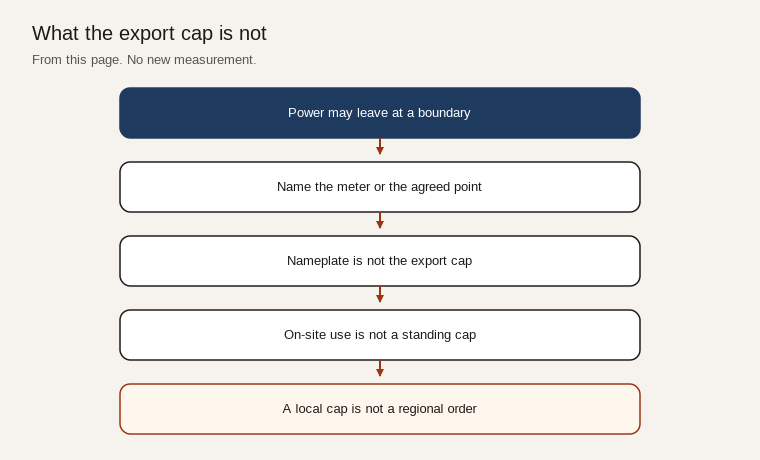
Hold export at the agreed meter or point of interconnection, keep that cap distinct from nameplate and from power the site is using, and keep a local limit distinct from a wider-grid order to reduce plants.
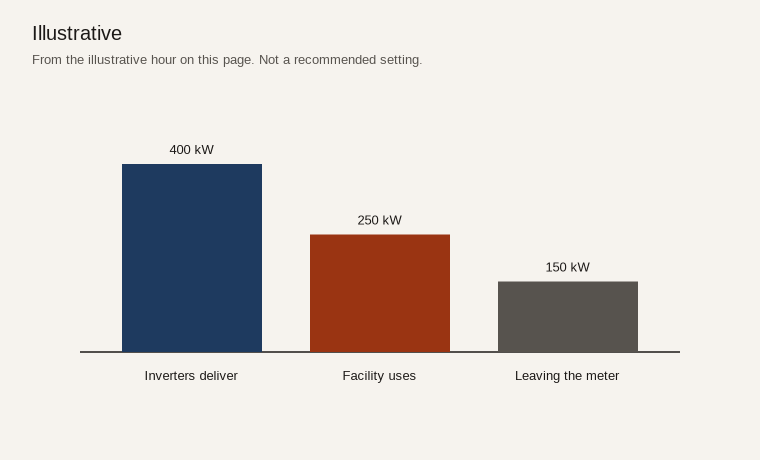
The bars repeat the illustrative hour already written on this page and are not a recommended setting or a project result.
The quantity being limited is power at a boundary
Export is power leaving the site at a defined electrical boundary. Maryland’s small-generator rules treat the point of interconnection and the point of common coupling as the same place. The Code of Maryland Regulations defines nameplate capacity as the manufacturer’s maximum rated output at that point. Net system capacity is the export capacity there: nameplate of the generators and storage, minus their electrical consumption where that applies, then any further limit from a control system, power relays, or similar settings. COMAR 20.50.09.06 evaluates the interconnection request on total exports at that net system capacity. The Library of Maryland Regulations text was read on November 22, 2026. A later amendment can change it.
20VAC5-314-10, read the same day, applies to generation and storage that will operate in parallel and inject. It excludes net-metering customers under the Commission’s separate rules and facilities under Federal Energy Regulatory Commission jurisdiction. Where it applies, 20VAC5-314-150 uses the maximum the facility can inject. A control, relays, or similar settings may replace that maximum only with the utility’s agreement that the method will not harm safety or reliability. Agreement is not to be unreasonably withheld. Otherwise the request is withdrawn or revised to the unreduced maximum. The utility may still study a higher output for system protection.
No District of Columbia Commission export-limit rule was opened in this check. The Maryland and Virginia texts do not set a national export number.
Nameplate, site use, and a reduced inverter rating
An export setting does not rewrite the nameplate. The Interstate Renewable Energy Council’s BATRIES toolkit, Chapter III, is March 2022 model language, not a Maryland, Virginia, or District rule. A utility need not accept every method it lists. It treats export capacity as power that can move onto the distribution system, equal to nameplate unless an accepted control limits it.
Self-consumption lowers net export only while site equipment is using the solar. It does not reduce the inverters when a large load stops, and a site can still export at noon in a year when it buys more energy than the array produces.
A configured power rating, as BATRIES describes it, stops the resource from generating above a value below nameplate. Applied at the inverter terminals, that setting also limits power that could have served on-site load. A site-level export limit can let production rise above the cap while the facility uses the difference, and reduce output only when measured outflow would exceed the cap.
Why a utility or the site equipment asks for a cap
Maryland defines hosting capacity as the aggregate generation a system, area, or component can take without infrastructure upgrades. A circuit can be closed, with no hosting capacity left, or restricted, with only reserve left. A limited export agreement is energy supplied to the grid that may be managed to stated ramp rates and generation levels. From January 1, 2025, utilities must publish how a customer requests one. The published text makes it available on request only to Level 2 and Level 4 customers, with the method mutually agreed. If the facility does not curtail and exceeds the agreed parameters, it must immediately cease to export real power until acceptable output control is reestablished.
A request under the PJM Interconnection tariff is outside Maryland’s hosting-capacity fee method in that section. A wholesale agreement can still cap injection at its own point of interconnection.
California’s hourly program does not apply in Maryland, Virginia, or the District. Pacific Gas and Electric Company’s Limited Generation Profile guide, effective July 9, 2025, lets an applicant propose hourly exports inside the buffer that guide states, held by a UL 3141 power control system at the point of common coupling. Fault current still uses nameplate. A nonconforming profile can be studied at full nameplate, and the agreement can require a witness test before permission to operate. The California Public Utilities Commission’s Limited Generation Profiles page traces the policy to Decision 20-09-035. Its status note stops in July 2023.
A panel, feeder, or service can limit local generation that shares conductors with utility current. UL Solutions’ white paper on UL 3141 treats export limiting as a watch at an external point, such as the point of common coupling, and only on the utility side. Customer-side overload control is a separate function, so a listing for one is not a listing for the other. Single-source overload control manages load and does not control local generation, so it cannot limit export. Maryland’s accepted-standards list, read November 22, 2026, includes the 2020 National Electrical Code, UL 1741 Edition 3 dated September 28, 2021, IEEE 1547-2018, IEEE 1547a-2020, and IEEE 1547.1-2020, unless the Commission specifies otherwise. It does not list UL 3141. A utility agreement can still require a certified power control system.
What the loop measures, and what IEEE 1547 does not set
A power control system, in BATRIES, is a controller, sensors, and inverters. A current transformer at the boundary drives setpoints. A source the sensor does not see, or a source the controller does not command, is outside the cap. Storage is the usual miss, and Maryland includes storage in net system capacity.
A relay can open a breaker. BATRIES describes reverse-power and minimum-import protection for non-export, and directional power protection when export exceeds a level. A power control system is described by open-loop response time rather than by a trip at a definite time, and a fast load drop can still export until output falls. Relay defaults in the toolkit are model language, not settings to install.
The Department of Energy’s solar design overview, updated July 8, 2022, says an inverter converts direct current to alternating current and that advanced inverters can communicate both ways with the utility. Communication may carry the reading or the setpoint. It is not the limit.
The IEEE 1547-2018 listing is an active standard, published April 6, 2018, with amendment 1547a-2020, for a 60 hertz source at typical distribution voltages. It is not an interconnection agreement. National Renewable Energy Laboratory slides, Highlights of IEEE Standard 1547-2018, revised September 21, 2021, apply it at the point of common coupling or the resource connection. The standard is technology neutral, not a design handbook, and not a prescription for operating the area system. The listing states no export value. BATRIES notes that a configurable terminal rating in that edition is testable under IEEE 1547.1-2020 and also limits power to local load. Where Virginia’s chapter applies, it requires IEEE 1547-2018 and published settings, including whether voltage-active power mode is enabled. When enabled, that mode reduces active power as voltage rises. It is not a fixed meter cap. Adoption varies by utility. These Maryland and Virginia texts were checked on November 22, 2026.
Zero export stays connected to the utility
Zero export, also called non-export, sets allowed net outflow to zero within the tolerance and duration the utility accepts. Loads on the site side of the sensor can still use solar, and the system stays in parallel, so a control fault can push power out. Maryland defines parallel operation as a sustained connection during which electricity can flow to the distribution system. Off-grid equipment that never parallels is a different design.
Maryland Level 3 is the non-export path, and those facilities may not use inadvertent export. The state definition is unscheduled export beyond a stated magnitude for a limited duration, generally from a miss in load following. For other facilities, the published default duration is 30 seconds unless the utility finds that duration violates its evaluation criteria. The magnitude is the number in the agreement. Crossing either limit requires the facility to cease exporting until acceptable control returns. The utility may still require verification.
BATRIES also describes a relative-rating method that compares nameplate with verified minimum load and restricts where that method may be used, including area and spot networks. A claim that the building always uses the array is not that method.
A local cap is not system curtailment
The U.S. Energy Information Administration, in an analysis dated June 26, 2024 and updated July 1, 2024, defines curtailment as deliberately reducing generation below what it could have produced. The causes named there are oversupply, when generation exceeds demand, and congestion, when lines cannot carry the power on the preferred path. A system instruction of that kind can arrive while the plant’s contractual export limit is not binding.
A local cap holds output when measured outflow would exceed the site agreement and the site cannot use or store the rest. PG&E’s guide keeps that profile separate from a later utility reduction for system conditions. The agreement should say who may change the cap.
Loss of the measurement is product-specific
After a large load trips, production stays high until the inverters come down. The allowed size and duration of that inadvertent export belong in the agreement. There is no single fail-open or fail-safe result in the documents read for this page. UL’s white paper says UL 3141 loss-of-control tests include loss of current or power sensing, loss of critical communications, and loss of power to the control circuit. The product must detect the fault and enter a safe, controlled state. The paper does not publish one output for every product.
SMA’s Data Manager page on meter-communication fallback says that if the meter at the point of interconnection stops communicating, control leaves closed-loop mode and passes curtailment in open-loop mode without the live site measurement. That fallback is on by default and cannot be disabled for that product. The Sunny Tripower page on plant-control failure states a different published default: the inverter’s full maximum active power when plant control is absent, unless a lower fallback was configured. A relay that opens a breaker is a third result. These descriptions are not instructions to change a setting.
UL Solutions’ service page, read November 22, 2026, still calls UL 3141 an outline of investigation used to certify power control systems, and it separates that role from an energy management system. PG&E’s 2025 guide asks for UL 3141 certification on the profile option. That certificate does not establish the sensor location or the accepted setpoint.
What to lock before the equipment order
Freeze the boundary before the equipment order. This list is for the developer, the engineer, and the utility. It is not a determination for a project.
| Decision | Write it down |
|---|---|
| Measurement point | Meter, point of common coupling, or the utility’s named point, and whether the limit is per phase or a sum |
| Export value and nameplate | Which screens may use the limited export, and where protection may still use nameplate |
| Sources inside the control | Solar, storage, and every other generator on the site side of the sensor |
| Shape of the limit | One cap, a schedule, or a signal that can lower output later |
| Lost measurement | The manual’s behavior when the meter or the plant controller is quiet, as the utility accepted it |
| Who changes the setpoint | The change process and the record, so a later edit cannot silently replace the studied value |
| Two kinds of shortfall | Output held for the local cap, kept separate from a wider-grid order |
Confirm the Maryland review level before treating limited export as available. The published path is Level 2 and Level 4, and Level 3 has no inadvertent-export allowance. In Virginia, confirm that 20VAC5-314 applies before quoting it. The engineer of record and the interconnecting utility set the number.
An illustrative hour, not a recommended cap
The arithmetic below is illustrative. It is not a Soleil Energy project, not a utility limit, and not a recommended setting.
In one bright hour the inverters can deliver 400 kW while the facility uses 250 kW. The meter then sees 150 kW leaving the site. If the agreement allows less export than that difference, the controller must reduce inverter output until measured outflow is inside the allowed value. Storage changes the hour only when it is inside the same measurement and the agreement allows charging or blocks discharge.
Common questions
How does export control differ from simply sizing a system below annual consumption?
Annual use totals energy over a long period. Export is power at the boundary during a short interval, so a site can buy more energy across a year than the array produces and still export at midday. Cutting nameplate also removes power the site could have used.
Is zero export the same as an off-grid system?
No. The utility connection remains, and a control fault can still push power out. Off-grid equipment does not parallel. Maryland’s Level 3 path may not use inadvertent export, and the scope still includes isolation and the loss-of-signal behavior.
Does an export limit replace an interconnection study?
No. Screens use the limited value only after the utility accepts the method. Protection may still use a higher output, and the package still needs the diagram, the sensor location, and the loss-of-signal behavior.
Where should the measurement sit?
At the boundary named in the agreement, on a sensor that sees every source that can export. An inverter terminal is a different quantity, and a per-phase limit needs a per-phase reading. That export function does not, by itself, protect customer conductors.
Who sets the limit in Maryland, Northern Virginia, and the District of Columbia?
The interconnecting utility writes the value, and a qualified electrical professional designs to that document. Use Maryland’s net system capacity rules only on a Maryland application, Virginia’s agreement requirement only where 20VAC5-314 applies, and the District’s own current text, which was not opened for this page. Northern Virginia has more than one utility.
How is a local export cap different from system curtailment?
The local cap is enforced by the plant at the agreed meter. System curtailment is a wider-grid reduction for oversupply or congestion, and it can arrive while the local cap is not binding. Record which event occurred.
Match the plant boundary to the agreement
Soleil Energy’s utility-scale solar scope covers the plant and the interconnection behind it, including substation work and utility coordination, when the project fits. A scope conversation can use the measurement boundary, the draft agreement, and the development stage. It does not decide that a utility will accept a given export value. Soleil’s commercial solar interconnection guide explains Maryland review levels, and the commercial solar site checklist lists site facts to gather first. Neither guide replaces the utility’s current standards or a regional transmission study.
Project requirements depend on the site, equipment and applicable rules. Confirm design and installation decisions with the appropriate qualified professional.