
Solar preventive vs corrective maintenance is the split between scheduled inspection that corrects wear and repair that starts after a fault or underperformance is found. Preventive work follows a plan shaped by the equipment, the site, and the warranty terms. Corrective work restores a failed or underperforming component, sometimes remotely and sometimes on site. The distinction sets scope, timing, and records. It is not one inspection interval for every plant.
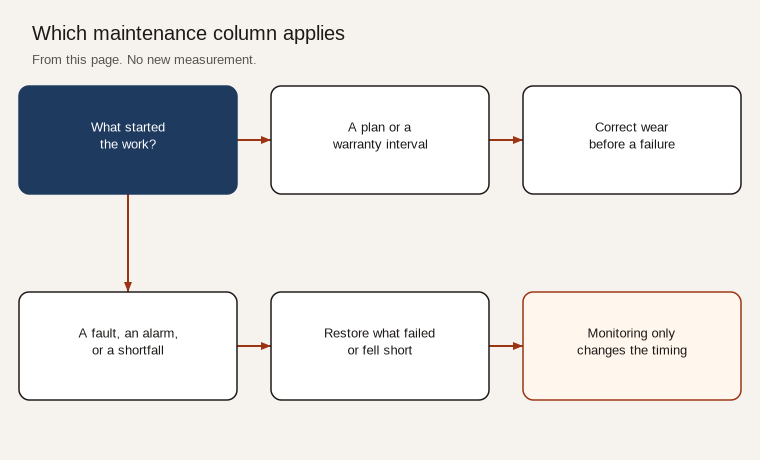
Put the visit in preventive maintenance when a plan or a warranty interval starts it, and in corrective maintenance when a fault, alarm, or shortfall starts it, while monitoring only changes the timing.
Two work types, one plant
A loose connector, soiled module, or stopped inverter can sit in either column. The trigger decides what the visit is for, who pays, and how fast someone should go.
The December 2018 guide from the National Renewable Energy Laboratory, Sandia National Laboratories, and the SunSpec Alliance sorts the work into administration, scheduled preventive maintenance, corrective repair or replacement, and condition-based timing. Condition-based work does not have its own task list in that guide. Logged data only decides when a preventive or corrective task happens. The O&M guide (NREL/TP-7A40-73822) says operations sets the frequency from equipment type, site conditions such as marine air, snow, pollen, humidity, dust, and wildlife, and warranty terms. Manufacturer intervals matter when they are what keeps a warranty valid. The Department of Energy still points owners to this guide.
| Question | Preventive maintenance | Corrective maintenance |
|---|---|---|
| What starts it? | A plan or a warranty-tied manufacturer interval | A fault, an alarm, or a production shortfall treated as a failure |
| What is the crew doing? | Inspecting and correcting wear, usually before an outage | Restoring a component that failed or fell short |
| How is it usually bought? | Inside a recurring scope | As an added response, unless it can wait for the next visit |
| What does monitoring change? | The date of a scheduled task | Whether a dispatch is justified |
Name the column before anyone prices the work. Module washing can land in either one.
What preventive maintenance is actually doing
In the 2018 guide, preventive maintenance holds output up and avoids costlier failures, balanced against cost, and the protocol depends on size, design, complexity, and environment. Another site’s plan is not proof this plant needs the same tasks. The cost-model appendix says to follow the manufacturer’s manual. Many of its inspections are annual only so an estimate has a multiplier. Much of the cleaning is condition-dependent, and vegetation is as needed. That modeling choice is not a code interval for Maryland, Northern Virginia, or the District of Columbia. A manufacturer, insurer, or power-purchase contract can differ. A common document is not a universal one.
A scheduled visit inspects and corrects wear: glass, module position, corrosion, heat marks, water or pests in boxes, disconnect position, and faceplate readings against conditions. Include trackers or transformers only if they are installed. Preventive conductor work, in the guide, means keeping wires secure. Open-air leads are easy to damage. Buried faults, often from animals in that discussion, are harder to find. Moving a rubbing lead on that visit is still correction of wear.
Cleaning is preventive when it limits soiling before the loss counts as a failure. Rainfall, the dirt source, access, and the production target decide whether washing is worth it. The IEA Photovoltaic Power Systems Program summary of report T13-25:2022 says the plan should fit size, design, complexity, and environment, and it lists module-level electrical sampling, soiling and snow, vegetation, and working monitors. Its climate notes are not a cleaning month for a Mid-Atlantic roof.
What corrective maintenance is actually doing
Corrective maintenance starts after a fault or underperformance is found. The 2018 guide defines it as repairing damage or replacing failed parts. Inverter and communications resets can be remote. Less urgent repairs can wait for the next scheduled visit. Delay a repair only when that near visit is the more efficient way to do it. A safety problem should be handled as soon as possible even if little energy would be recovered. Batching small residential calls is a travel choice, not permission to leave a hazard.
The Federal Energy Management Program longevity page, updated May 11, 2026, separates planned maintenance from unplanned repair and says most downtime is tied to inverters. Small string inverters and microinverters are generally replaced. Larger central inverters are usually repaired by swapping parts such as capacitors or circuit boards. That is a spare-parts pattern, not a diagnosis. The page also names hot spots, cracks, water intrusion, delamination, and wiring shorts, opens, and ground faults. A new fuse or a reset, without the cause, leaves the failure in place.
Department of Energy inverter basics, updated March 31, 2025, explain that one shaded or damaged module can pull down a string, while a microinverter confines the loss. The visit may be a string, a fuse, one inverter, or one module-level device. A plant can also stay online and still miss the energy weather and module age would suggest. That gap is corrective only if the contract says so. Separate expected aging from a defect before ordering parts.
Condition-based work only changes the timing
Monitoring decides whether a task moves up, waits, or becomes a dispatch. It is not a third trade. The 2018 guide uses logged data to time cleaning or to anticipate a failure. The IEA summary says plant size and complexity should set how close that watch is, and it points to IEC 61724-1 for minimum monitoring requirements. This page does not treat that standard as local law.
The operate-and-maintain page, updated May 20, 2026, defines performance ratio as actual production divided by modeled production for the measured sun and temperature, with age included. Availability is the share of time the plant could deliver if sun and grid were available. A poor ratio with the inverters online points to soiling, mismatch, or a partial direct-current fault. Low availability points to downtime. One number sends the wrong crew.
The 2018 O&M guide, citing a 2012 review, says degradation is often on the order of 0.5% per year, and it uses that default for new crystalline-silicon modules when the manufacturer states none. Outright module failure is treated as uncommon beside that gradual loss. A slow decline near the expected rate is not itself corrective. A step change, one odd string, or a hotspot may be. Department of Energy performance basics, updated May 5, 2026, note that cells lose voltage as they heat. A hot afternoon is not a fault. One hot module beside cooler neighbors may be.
The monitor is maintained equipment too. Contracts expire, staff change, and passwords get lost, so a dark portal is not proof the array stopped. Check a safe, already-visible display or the meter. Soleil’s guide to a monitor that has gone offline separates a lost connection from lost production.
How a contract should separate the two
Section 10.1 of the 2018 guide describes a common pattern: a fixed fee for operations, standard preventive maintenance, and an agreed response time, then added fees for corrective work and anything outside the list. Sample statements use a time-and-materials adder when a warranty does not cover the repair. A vague list turns every worn connector into a dispute. “Repairs” does not say whether a reset, a fuse, a module, or an inverter is included.
Response time is not an inspection interval. The 2018 O&M guide says to write it down and describes non-safety corrective service as typically 10 days or less. That is 2018 contracting practice in the guide, not a safety code. Balance the trip against lost production. Address safety conditions as soon as possible. Soleil Energy’s monitoring and O&M service agrees the time per site instead of publishing one number.
Large parts need a reserve or a line of credit. The guide says a failure probability still does not date the failure, and the IEA summary likewise recommends a replacement reserve. More visits do not pay for an inverter that fails after the warranty.
A product warranty covers materials and workmanship. A performance warranty covers output expected to decline. The 2018 O&M guide describes many module product terms then as about 10 to 12 years, and performance terms of 20 or 25 years, with output often ending near 80% of the initial rating after 25 years. That describes 2018, not a later purchase. Claims stall when handling or ventilation rules were missed, when the remedy is repair, replacement, or extra modules, or when labor is excluded. Read the equipment warranty. Soleil’s panel warranty guide is only a reading aid.
IEC 62446-2:2020, per the IEC catalog summary, covers preventive, corrective, and performance-related maintenance, including troubleshooting, worker safety, cleaning, and vegetation. The BSI note of May 31, 2020 says the text does not cover off-grid plants or storage, though parts may apply to the photovoltaic circuits, and it does not cover medium- or high-voltage gear. Inspections identify what should set the interval. As of November 2026, do not treat it as a maintenance code adopted statewide in Maryland, Virginia, or the District of Columbia. Confirm the controlling document with the authority having jurisdiction and the contract.
Why the site, not a calendar, sets the plan
A membrane warranty can require the roofer and the electrician. A leak is not an inverter reset. Soleil’s roof leak under solar panels guide covers which trade does the repair. Ground arrays add vegetation and drainage. The IEA summary’s temperate note is a vegetation check while cutting; its hotter humid note is wildlife, soiling, and ventilation. A humid Mid-Atlantic summer can share some of that. Neither note names a cleaning month. Storm preparation on a forecast is preventive. Recovery after damage is corrective.
Storage uses the same labels and a different list. Intervals should come from the manufacturer, and separate battery strings can leave one string available during work. IEC 62446-2’s public scope does not cover storage. Washing and filter changes do not describe battery inspection or replacement.
Soleil’s guide to what a commercial solar O&M scope covers is the wider checklist. This page stays on how those line items are classified.
An illustrative pair of events
This example is illustrative. It is not a Soleil Energy project, a measurement, or a price.
A flat-roof array has two string inverters. A scheduled visit finds discolored connectors and cracked ties, with no trip and with production matching the other inverter. If the contract corrects wear found on inspection, replacement stays preventive. If connectors are replaced only after failure, the same task is corrective on that visit. The 2018 guide allows the less urgent repair to share the trip. The contract column decides the bill.
Weeks later one inverter is offline on a clear afternoon. After ruling out a portal-only failure, a qualified person diagnoses it. For a small string inverter, the federal discussion treats replacement as the usual path, subject to the warranty. Repeated resets are not a finished repair. See Soleil’s guides on inverter replacement and a system that is not producing.
Safe observations and where to stop
Electrical and roof work are not general upkeep. As of November 2026, 29 CFR 1910.399 defines a qualified person as someone trained who has demonstrated skills and knowledge in the equipment and its hazards, and the note says that status can be limited to certain equipment. 29 CFR 1910.333(c)(2) limits work on parts not de-energized to qualified persons. That is an employer duty. A qualified person must assess this site. Nothing here authorizes opening enclosures, live tests, or roof access.
Modules produce direct current in sunlight. Stopping the inverter does not make every conductor safe to touch. Smoke, arcing, a burning smell, or an opening over occupied space means staying clear and calling emergency services and a qualified person.
An owner can still sort the event:
- Smoke, arcing, fire, or a roof hazard: stop, and do not reset equipment.
- A dark portal while a safe display or the meter still shows production: treat it first as a monitoring problem.
- An inverter or string alarm, or a clear production gap: corrective. Save the alarm text, time, weather, and which portion failed.
- Slightly soft output, no alarm, and a visit already booked: log it unless the contract requires earlier action.
- Wear found on a scheduled walk, with nothing failed: preventive only if the contract says so.
The list sorts the work. It does not name the failed part.
Questions that change the scope
Does a part replaced on a scheduled visit count as corrective work?
Often yes. The scheduled list covers inspection and wear named in advance. A failed module, blown fuse, or faulted connector fixed that day can still be corrective. Rates follow the contract, not the crew’s presence.
Can monitoring replace the scheduled visit?
No. It can move cleaning or inspection. It does not see every loose attachment, roof seal, or wet box. When the monitor is down, the signal that would have started a repair is gone. A small rooftop and a multi-inverter array do not need the same telemetry.
Is there one required inspection interval?
Not in these sources. Frequency follows equipment, site, and warranty documents, and IEC 62446-2’s public note says the factors can differ by system, owner, and budget. As of November 2026, confirm any interval with those warranty papers, the authority having jurisdiction, the utility if the interconnection agreement mentions maintenance, and the insurer.
What should be in hand before a repair dispatch?
Alarm text and time, the affected inverter or string, a recent production comparison, drawings if they exist, serial numbers, the warranty, and the last inspection. Safe photos help if nobody climbs or opens equipment. Missing papers make the first trip a discovery trip. If the installer is gone, see Soleil’s guide on who can service the panels.
Does the warranty pay for the corrective visit?
Not as a rule. The 2018 guide says the part may be covered while removal and reinstall labor are not, and the manufacturer chooses the remedy written in the warranty. Missed handling or ventilation conditions can put coverage at risk. Ordinary aging is not the same claim as a cracked module or a dead inverter.
Do rooftops and battery plants use the same split?
The labels stay. Roof scope names the membrane and who may walk it. Ground scope names vegetation and drainage. Storage tasks sit outside the public scope of IEC 62446-2. A line that never mentions the battery has not priced it. Module damage, rather than an inverter, is Soleil’s panel repair topic.
Bring the records that show which work it is
Bring the equipment list, monitoring access, recent alarms, warranties, and inspection notes. Those records separate scheduled correction of wear from repair after a fault or a shortfall. For plants in Soleil Energy’s Maryland, Northern Virginia, and Washington, DC service area, including arrays another company installed, the monitoring and O&M team can look at that package before recommending a scope. The question is this plant, not an interval copied from another one.
Project requirements depend on the site, equipment and applicable rules. Confirm design and installation decisions with the appropriate qualified professional.
