
Solar repowering is the replacement of outdated or damaged photovoltaic components with newer equipment so an existing system can keep operating, often by changing more than one part of the plant. It is not the same decision as swapping one failed module, replacing an inverter, or raising the capacity the utility approved. Those three jobs have different electrical, structural, and approval consequences. A qualified professional must assess the actual site.
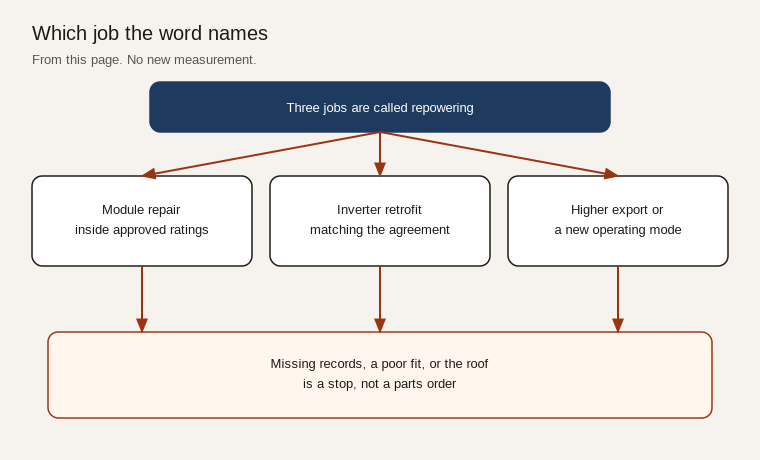
A module repair, an inverter retrofit, and a capacity or export change are different jobs, and the sort stops for missing records, a poor fit, higher export, or a roof and fire-access question.
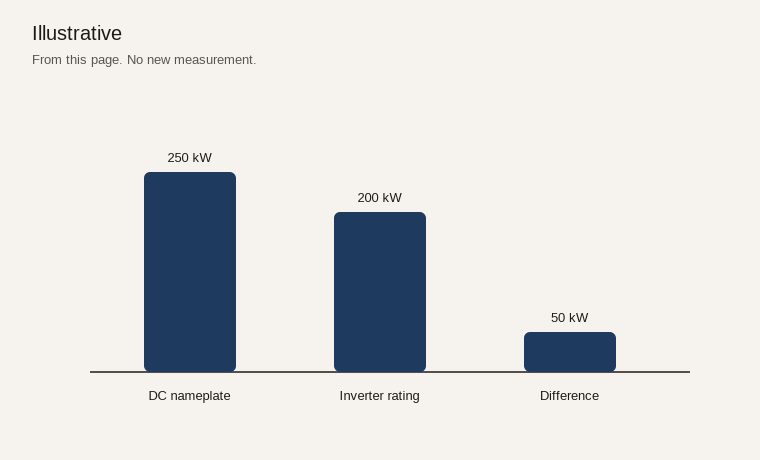
The direct-current nameplate, the inverter rating, and the difference between them are illustrative arithmetic, not a project result or a code limit.
Three changes get called by the same name
Mixing these jobs is how a module order becomes an unapproved export increase.
| Job | What actually changes | Question before anyone buys equipment |
|---|---|---|
| Module replacement | One module, a string, or much of the array | Do the new modules fit the rack, the string voltage and current, and the conductors, without changing export? |
| Inverter replacement or retrofit | The device that turns direct current into alternating current, and often its settings and monitoring | Does the replacement match the array’s DC window, the approved AC rating, and the grid behavior in the existing agreement? |
| Capacity or export change | How much power the plant can inject, or how it is allowed to operate | Does the utility treat this as a new interconnection request under the rule for this account? |
A matching warranty module can be maintenance. Replacing many sound modules for more power per area is a redesign. A similar inverter can stay a repair. A larger inverter, a new voltage class, or a higher export limit is an interconnection change. The December 2018 maintenance report from the National Laboratory of the Rockies, issued when the laboratory was the National Renewable Energy Laboratory, treats soiling as maintenance and calls inverter failure one of the most frequent causes of lost production. That report is not a current electrical code.
A laboratory definition separates redesign from repair
An October 2024 presentation from the same laboratory describes repowering as replacing outdated or damaged components, then uses a tighter definition for its research. In that framing, repowering means replacing multiple components on modules that are not damaged and not under a warranty claim. Triggers it lists are economic, more watts from the same area, or an outside event such as an inverter change or a new roof. The work entails re-engineering and new stamped drawings. Warranty replacements, weather damage, adding modules, adding batteries, and restarting a disconnected plant sit on the other side of the line.
That split is not a statute, and the presentation says US evidence on how often plants are repowered is anecdotal. Interview comments in that October 2024 presentation put re-engineering above $1 per watt in some utility-scale cases, which is an anecdote, not a commercial-roof price and not a Soleil Energy quote.
The same interviews called incentive treatment of repowering unclear. As of November 2026, do not assume a replacement qualifies for a federal or state incentive. A qualified tax professional has to apply the current statute and the facts of what was replaced. This page states no credit rate and no eligibility rule.
Records come before a parts list
Collect the interconnection agreement, permission to operate, one-line, nameplates, as-builts, warranties, and later changes before anyone orders parts. Production and fault history show whether the loss is one inverter, a few strings, shade, soiling, or a slow decline.
The 2018 report says an inverter repair-or-replace choice depends on size, type, parts, and cost, and that an upgrade may not match the old footprint, conduit, or wiring. Soleil Energy’s inverter replacement guide covers an inverter-only job. What a commercial maintenance scope covers fits inspection and repair rather than a redesign. The Department of Energy’s inverter overview, updated March 31, 2025, says an inverter can also be the monitoring path.
Module replacement has to fit the rack and the circuit
Frame size, clamps, weight, and thickness have to suit the rack, and a ballasted array has to stay within the roof design. This page does not rate a roof.
String voltage and current have to stay inside the inverter, the conductors, and the overcurrent devices unless those are redesigned. The Department of Energy’s performance overview, updated May 5, 2026, says higher temperature slightly raises current while cutting voltage by more, so voltage rises as the module gets colder. A qualified designer checks the new module’s listing at the site. Do not mix old and new modules in one string because the labels look close.
Warranty language can hide a capacity change. The 2018 report says some manufacturers may satisfy a performance warranty by supplying extra modules to make up lost output, rather than replacing the weak ones. It then notes the limits: there may be no rack space or electrical room, and expanding nameplate capacity would generally trigger a new interconnection agreement and new permitting even if the plant would not produce more than it was originally expected to produce. That “generally” is a 2018 observation, not a finding that every utility uses the same trigger.
The 2018 report says a roof that stays under warranty needs the solar team and the roofing team to agree on access, including removal so a roofer can reach the membrane. Who pays is a contract question.
An inverter retrofit can be a swap or a different machine
The Department of Energy’s inverter overview separates central, string, and microinverters. Storage runs through an outage only if the equipment is designed for that, so a replacement inverter does not add backup. Grid-following units need a grid signal. The same overview says smart inverters ride through small disturbances, disconnect when a disturbance is large or long, and can supply or absorb reactive power. Those functions follow the utility’s profile.
The 2018 report says a central inverter is a single point of failure whose parts can often be repaired, while string inverters and microinverters are usually swapped whole. Some makers of that period took about a month to ship a warranty string inverter.
IEEE 1547-2018 is the active standard for distributed-resource interconnection at typical distribution voltages. Its public scope covers performance, abnormal conditions, power quality, and islanding, and it supersedes the 2003 edition. Amendment IEEE 1547a-2020 changes allowable trip-time ranges for one category. The catalog is not the clause text. UL Solutions describes testing to Supplement A/B of UL 1741 against IEEE 1547.1. See that grid-code description. Maryland, below, names UL 1741-SB with IEEE 1547-2018. Read the listing for the model. A 600-volt array does not automatically suit a 1,000-volt inverter. Forcing that match is re-engineering, not a box swap.
Raising export can reopen the interconnection
Module capacity, inverter capacity, and permitted export are different numbers. As of November 22, 2026, the texts below are not a ruling for one account. The District of Columbia has its own rules. A federally jurisdictional project follows that tariff rather than these state chapters.
Maryland’s chapter is COMAR 20.50.09. The chapter history read on November 22, 2026 shows a revision effective December 12, 2024, and later amendments effective July 7, 2025. Confirm whether any later order changes the text the utility applies. In the definitions, an interconnection request includes a request to increase the capacity or operating characteristics of a facility already interconnected. Nameplate capacity is the maximum rated output at the point of common coupling, under the manufacturer’s conditions. Net system capacity is export at that point as limited by controls or similar settings. A direct-current module total is not, by itself, either defined term.
COMAR 20.50.09.06 requires an interconnection request to increase total exports, to change the energy sales strategy, or to change the proposed use of an existing facility, as well as to interconnect a new one. On a new request, the utility applies the standards then in effect and, if it approves, a new agreement is required. Evaluation uses total net system capacity. Once a request is complete, a material modification other than a minor equipment modification needs a new request unless the utility agrees in writing. A minor equipment modification is defined as a change to the proposed facility that does not significantly affect distribution safety or reliability. That definition does not let an owner declare an in-service change minor.
After January 1, 2024, a facility that needs an inverter and submits an interconnection request must use a smart inverter on the utility’s default or site-specific profile. The same section says a facility may replace an existing inverter with a similar spare bought before that date, and that this requirement does not apply to manufacturer-warranty replacements. COMAR 20.50.09.07 says an inverter submitted with an interconnection request after that date is deemed certified and approved if it meets IEEE 1547-2018 and UL 1741-SB, except inverters purchased under a cross-reference to .06N(2). In the text read on November 22, 2026, the spare-inverter sentence is in .06O(2), not .06N(2). The utility has to say which sentence covers a warranty replacement. Neither sentence is a building permit, and neither lets a larger export skip review.
Soleil Energy’s commercial interconnection guide explains how a Maryland application differs from maintenance and tells owners to get the rule version in writing. Use it for the application path, not as a substitute for the regulation.
Virginia’s 20VAC5-314-10, amended effective September 1, 2026, does not apply to net-metered customer-generators under the commission’s net-metering chapter, or to facilities under Federal Energy Regulatory Commission jurisdiction. It also does not apply to facilities already interconnected as of October 15, 2020, unless the customer proposes a material modification or both parties agree in writing. Where it applies, inverter-based facilities must support stated IEEE 1547-2018 categories, and each utility publishes its own settings.
20VAC5-314-39, also effective September 1, 2026, lists material modifications. Replacing inverters, transformers, relaying, or controls is material when it is not a like-kind substitution in size, ratings, impedances, efficiencies, or capabilities. A change to certified inverters with different specifications or control settings is material unless a stated exception applies. An increase in maximum generating capacity is material. The section excludes a like-kind substitution, which can include solar panels; a one-time change of certified inverters that remain UL 1741 certified, do not increase maximum AC output, and change the transformer only as the new inverter requires; and an increase in the DC-to-AC ratio that does not increase maximum AC output. 20VAC5-314-150 evaluates a capacity increase on the new total capacity and on what the plant can inject. A control limit counts only with the utility’s agreement, and the utility may still study a higher output for protection.
Ask the utility in writing before buying. Like-kind in that Virginia section is a defined term, not a synonym for newer, and the section’s informal inquiry is not a field procedure.
Permits and energized work stay outside this page
The authority having jurisdiction decides whether an alteration needs a permit or inspection and which code edition applies. Utility permission does not replace that permit, and an inspection does not replace utility permission. Energized direct-current work is not an owner task. The 2018 report points it to training and protective equipment under NFPA 70E and OSHA rules, and it cites a 2012 edition of NFPA 70E. Employers follow the editions that apply in 2026.
Stop, then choose one scope
- If the one-line, the agreement, or the nameplates are missing, stop and recover them.
- If the finding is soiling, a communications fault, or one failed device with a compatible listed replacement inside the approved ratings, scope that repair. Still ask whether the utility wants notice.
- If the module does not fit the rack, or the string no longer fits the inverter, stop for electrical and structural design. Do not lengthen strings to chase a new voltage window without that design.
- If the proposal raises export, AC capability, or operating mode, treat it as an interconnection change under the rule for that account.
- If the roof, structure, or fire-access path is why the work is happening, stop for the qualified designer those questions require.
This illustrative example is arithmetic only, not a Soleil Energy project, a quote, or a forecast. Modules total 250 kW of direct-current nameplate behind an inverter rated 200 kW of continuous alternating current, with export limited to 200 kW. The illustrative difference is 250 kW minus 200 kW, or 50 kW of direct-current nameplate above that inverter.
Questions that change the work order
Does a monitoring device count as repowering?
A portal, gateway, or data logger reports production. Replacing it leaves module nameplate, inverter rating, and approved export as they are. If the hardware is the utility revenue meter, leave it alone and ask the utility which device is theirs. This page does not describe meter wiring.
What if that inverter model is no longer sold?
An identical spare is the narrow case. A later model can share the old alternating-current rating and still differ in direct-current window, fit, or grid settings. Check that match against the existing agreement. The job becomes a capacity change only when the new unit or its control limit can inject more than the plant is allowed to inject.
Who orders parts under a lease or power-purchase contract?
The contract can name who owns the equipment, who may alter it, and who must notify the utility. A complaint that output looks low is not authority to raise export. Get written direction from the party the contract names, and match that direction to the interconnection agreement. The offtaker and the interconnection customer may be different entities.
Does a replacement module keep the old performance warranty?
The performance warranty covers the modules it names. A new module can arrive with separate product terms. Neither document is the interconnection agreement. Read both before installing every module in a warranty shipment. This page states no term of years.
What should a buyer verify if the seller says the plant was repowered?
Ask for the as-built that matches the nameplates on site, and for any utility writing that accepted a change in export or operating characteristics. A sales sheet that uses the word repowered is not that file. If the one-line and the equipment disagree, reconcile them before closing. A qualified professional compares the paperwork with the plant.
Bring the records to an assessment
Soleil Energy’s monitoring and O&M service covers performance monitoring, preventive maintenance, fault diagnosis, and repair, including systems another company installed, for facilities in its Mid-Atlantic service area. An assessment can start from nameplates, fault history, and the interconnection paperwork, and it can separate a repair from a change that needs design and a new utility conversation. It does not replace the utility’s classification, the permit decision, or a tax opinion.
Bring the agreement, permission to operate, production and alarms if they exist, nameplate photos taken from a safe place, and any roof notes. If the only fact is that output seems low, say that.
Project requirements depend on the site, equipment and applicable rules. Confirm design and installation decisions with the appropriate qualified professional.