
Substation design-build is a project delivery method in which one party contracts both to design a substation and to build it. The owner sets the required results, the constraints, and the tests that define acceptance. The design-builder turns those requirements into drawings and then constructs the station. Unlike design-bid-build, the owner does not hold separate contracts with a designer and a builder. The method does not replace utility standards, permits, or a qualified review of the actual site.
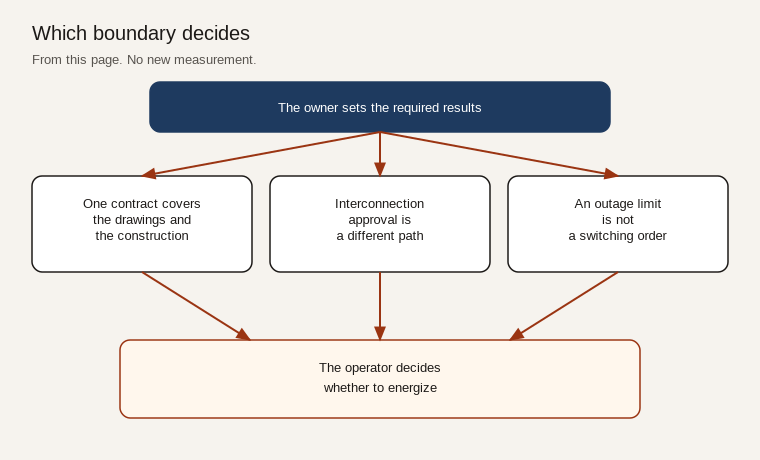
Design-build puts drawings and construction in one contract, and the owner still keeps the required results, while interconnection approval and the operator’s decision to energize remain different boundaries.
How the contract splits design and construction
A substation is the facility. Design-build is only how the owner buys the work. The Occupational Safety and Health Administration’s illustrated glossary describes a substation as a high-voltage facility used to switch generators, equipment, and circuits, and to change voltage. The delivery method does not choose which station you need.
As of November 2026, section 36.102 of the Federal Acquisition Regulation, displayed as FAC Number 2026-01 with an effective date of March 13, 2026, defines design-build as combining design and construction in a single contract with one contractor. It defines design-bid-build as design and construction in sequence, under two contracts and two contractors. That text governs federal acquisition. A private owner or a utility is not inside it merely because a contract borrows the words.
The Design-Build Institute of America’s explanation of design-build treats that single contract as the difference from other methods. It then separates two-step best-value selection, which evaluates design and price after a qualifications screen, from progressive design-build, which selects on qualifications and develops design and price together.
Design-bid-build keeps design with the owner
The owner hires the designer. Contractors price the plans and specifications that designer produces, and the owner stands between the two contracts. A station that misses the drawings is a construction problem. Drawings that cannot produce the needed station are a design problem.
The usual reference is the 1918 Supreme Court decision United States v. Spearin. The Court stated that a contractor bound to build from the owner’s plans and specifications is not responsible for defects in those plans and specifications. In that case, prescribing a sewer’s character, dimensions, and location imported a warranty of adequacy, and site-check clauses did not remove it. The decision is a federal contract case, not a substation code, and states do not apply it uniformly. It still marks the design-bid-build split: the party who prepares the design and requires the builder to follow it carries that design.
Design-build moves design into the builder’s contract
The design-builder produces the design it will build. The American Institute of Architects’ instructions for A141-2024, checked in November 2026, describe an agreement in which the owner provides Owner’s Criteria. The design-builder reviews them, develops a preliminary design, and proposes a contract sum. A design-build amendment then sets the sum and records the information it assumes. Unless a written amendment changes the criteria, the design-builder must design and construct to them. The design-builder may be a contractor, a design firm, or a joint venture the jurisdiction allows. Errors in its own design are its problem, not a dispute between a separate engineer and a separate builder.
The shift stops where the owner prescribes the method. AIA’s discussion of design-build risk distinguishes a performance requirement, which states the result and leaves the method open, from a design requirement, which tells the builder how to build. Bridging packages often mix the two and never mark which sentence is which. Spearin’s logic can return on the prescribed pieces even when the cover says design-build.
Price and procurement are separate from the label
DBIA’s progressive path develops the price with the design. A141-2024 can lock the sum later, as a stipulated sum or as the cost of the work plus a fee, sometimes with a ceiling. A number offered before the utility states its interface prices a different project. Retitling the package engineer-procure-construct does not say who buys the transformer or a spare. Put that list in the agreement.
What the owner still has to decide
Design-build transfers production of the design. It does not decide what the station is for, which rules are mandatory, or which risks the owner keeps. Write the criteria so a reader can tell a required result from a prescribed method. Results include the nominal voltages, the lines that must be served, what must stay in service if one major component is out, the parcel boundary, and environmental limits the site cannot cross. Prescribe a method only when the owner means to own it. A utility structure standard, or a relay family the operator already maintains, may be mandatory because that operator will live with the station. A sketch that only explains intent should say so. One prescribed bus detail can force the rest of the yard.
The owner may keep a consultant to write criteria, check proposals, or watch tests. That role should not become a second engineer of record. Say who seals the issued-for-construction drawings, and say whether the station is a generator interconnection, a utility rebuild, or service to a plant. Disclose surveys, soil data, known contamination, and access, and assign any investigation still open. Unknown soil does not move to the design-builder just because the method is design-build.
Operating limits stay with the owner or the utility that operates the line. A limit is an outage window, not a switching order. This page does not describe work on energized equipment. OSHA’s substation eTool explains that the electric-power generation, transmission, and distribution standard applies to substations, including added requirements in 29 CFR 1910.269(u) for access, working space, and who may enter spaces with energized supply equipment. Those are work-practice rules for qualified people. The host’s operating authority controls any energized switching. A qualified professional has to apply the current rule to the actual yard.
Define “finished” in the same exhibit. Record drawings show the completed work, which is not the same as the plans used to build. Add the test reports, the relay files in the operator’s format, and which studies were rerun after final nameplate data. Energization stays with the operator. If the contract carries a bond, a performance bond and a payment bond are separate instruments, and the amount and beneficiary belong in the agreement.
The label does not select the equipment
OSHA’s glossary lists functions such as voltage change, switching, measurement, connecting generation, and reactive-power control, plus equipment such as transformers, breakers, buses, a control house, and relays. Not every station needs every item, and the voltage examples there are examples, not a definition of high voltage. A station may be indoors or outdoors, metal-clad or open bus. The owner can require one of those arrangements. The design-builder has to show it meets the standards the contract names.
Name the studies and who accepts them: short-circuit duty, a grounding study, protection coordination, and the civil design. Each depends on utility data and soil the page does not have. This page gives no settings, no grounding design, and no device ratings. Say which data controls before equipment is released. A factory test and a site test are not permission to energize, and settings stay with the qualified engineer and the operator.
Interconnection is a different approval
A design-build contract does not interconnect a project. The Federal Energy Regulatory Commission’s Order No. 2023 explainer summarizes reforms issued on July 28, 2023: cluster studies replace serial first-come studies, with stricter readiness and site control. Providers comply by tariff filing and may deviate. Regional transmission organizations face an independent-entity variation standard; others face a “consistent with or superior to” standard. As of November 2026, the explainer is not a provider’s accepted tariff, and the pro forma timeline is not the local calendar.
Order No. 2023-A, issued March 21, 2024, clarified the option to build. FERC’s 2023-A explainer says an interconnection customer may construct certain network upgrades and interconnection facilities, with a substation at the point of interconnection given as a stand-alone example. A shared upgrade qualifies only if every affected customer in the cluster agrees. That right does not rebuild unrelated utility stations or rewrite the customer’s design-build contract. The explainer allocates those substation costs by the number of connecting facilities and by voltage level. As of November 2026, the 2023-A explainer still describes 90% site control with the request and 100% site control at the facilities study agreement, with a deposit only where regulation blocks control. Use the accepted tariff, not that summary alone.
A utility’s own station follows that utility’s planning criteria. Retail service follows extension rules, often under state regulation, not a FERC pro forma. Commercial solar under a state small-generator rule is a third path. Soleil Energy’s commercial solar interconnection guide covers Maryland review for that solar work, not substation delivery. Name the path and who files.
Standards and licenses follow the site
As of November 2026, the IEEE catalog entry for IEEE C2-2023 lists the 2023 National Electrical Safety Code as active, published August 1, 2022, superseding the 2017 edition. The catalog scope is safeguarding people at electric supply stations and on overhead and underground supply lines, including work rules. That is not the code text and not a clearance table. A utility may require that edition, an older one, or a stricter company standard. Name the edition. This page states no clearance and no grounding value.
Reliability rules do not cover every yard. NERC’s Bulk Electric System definition reference, version 3, dated April 30, 2026, quotes a core definition that, unless inclusions and exclusions modify it, covers transmission elements operated at 100 kV or higher and real-power and reactive-power resources connected at 100 kV or higher. Local distribution is outside that core. The paper is a registration reference, not a design guide. Ownership does not decide the classification, and inclusions or a radial exclusion can move a station either way. The registered entity and its Regional Entity apply the current glossary. Do not treat the phrase “NERC compliant” as a scope.
Licensing is separate. As of November 2026, COMAR 21.05.11.01 defines design-build, for that Maryland procurement chapter, as one entity responsible for both design and construction. COMAR 21.05.11.03 requires the design-builder to have at least one Maryland-licensed design professional as an employee, partner, member, officer, joint-venture partner, or subcontractor. In that chapter the design professional is an architect or professional engineer licensed to conduct business in the state. The chapter does not automatically govern a private contract, and it does not set Virginia or District of Columbia rules. Whoever seals the drawings still needs authority to practice where the project sits. Name that person.
An illustrative split, not a project record
This split is illustrative. It is not a Soleil Energy project and uses no site measurements.
An owner needs a station so a utility line can serve a plant. The criteria state the offered service voltage, require supply to continue if one transformer is out, name the parcel and access, and make the utility’s structure and protection standards mandatory where they conflict with a preference. The owner does not draw the bus or issue settings. The design-builder proposes the yard and buys only the equipment the contract assigns. If the owner instead issues a finished yard plan, a grounding layout, and a settings file, and orders them built unchanged, design responsibility has moved back toward design-bid-build even if the cover still says design-build.
| Decision | Stays with the owner | Passes to the design-builder unless the criteria prescribe it |
|---|---|---|
| Purpose and voltages | Names the function and the required nominal voltages | Develops the arrangement that meets them |
| Utility rules | Names the compulsory standards and the edition | Designs what those rules leave open |
| Unknown conditions | Discloses known data and assigns the rest | Performs the investigation the contract assigns |
| Major equipment | Lists any owner-furnished items and their data | Buys the rest and runs the named factory tests |
| Outage limit | States when existing equipment may be out | Plans the work inside that limit |
| Energization | The operating authority decides | Turns over the records that authority required |
The rows compare proposals. They are not a construction procedure.
Questions that change the contract
These questions are editorial. They are not a record of search results.
Who seals the drawings when the builder leads?
One owner contract can still leave the seal with an engineering firm the design-builder hired. Ask whether that firm may practice in the project state, and which stamp governs if the owner’s consultant also marks drawings. The Maryland procurement sentence above is not a private-work rule for every state.
What belongs in the criteria for protection and grounding?
Name the operator’s standard, the study, the fault-current source, and who accepts the study. Do not insert a resistance, a pickup, or a grid layout without soil data and a verified duty. If a utility standard already prescribes the method, label it as owner-furnished criteria.
Which approval actually governs this station?
A transmission tariff, a utility capital project, and retail extension rules are different approvals. Where an accepted tariff offers an option to build, it covers defined interconnection facilities and network upgrades, not the surrounding system. A state small-generator solar review is another process. Say who files, and what added facilities do to the price.
When is the station actually finished?
Handover, the operator’s written acceptance, and energization are separate events. Transformer delivery and the outage window can each set the date. A record set is not permission to energize.
Should the price be fixed before the design exists?
A141-2024 can set the sum in a later amendment, after criteria and a preliminary design. Progressive design-build develops the price with the owner. A single number while the utility interface is still open prices uncertainty, not a defined station.
Bring the interface to the scope talk
Bring the voltage under discussion, any one-line already issued, the outage limits, equipment already purchased, and the approval path. Say which decisions the owner will keep. A qualified engineer still has to assess the site. Nothing on this page is a setting, a grounding design, or a sequence for energized work.
Soleil Energy’s power practice describes substation design and construction, including civil, structural, and electrical scopes, and asks for the voltage class and the work window before planning a job. The same page states a service range from 600 V to 230 kV. That range is the company’s description of its service. It is not a definition of voltage class, and it is not evidence that any named station was built. Use the conversation to test the utility interface and the outage constraint against the decisions that stay with the owner.
Project requirements depend on the site, equipment and applicable rules. Confirm design and installation decisions with the appropriate qualified professional.
