
A substation retrofit changes equipment, connections, or ratings inside a substation that already exists, while part of the station and often some circuits must stay available or return on a limited window. It is not the same task as designing and building a new yard on a cleared site. The fit depends on as-built conditions, the outages an operator will grant, fault duty, and the physical space that is actually there.
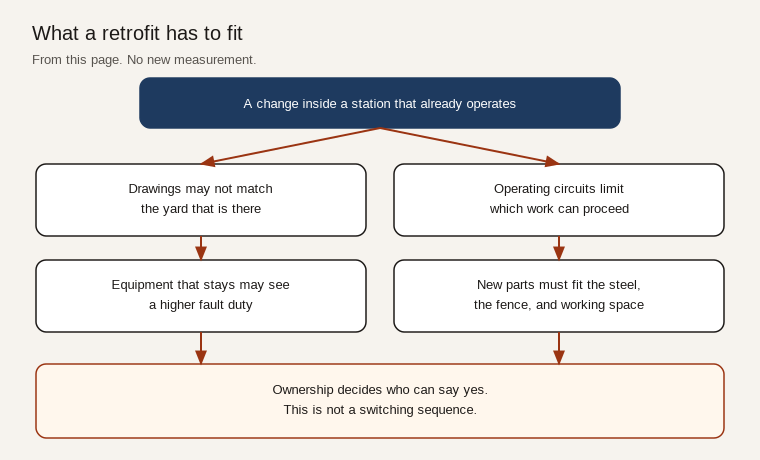
A retrofit is sorted by whether the drawings match the yard, whether the operator will release the circuits, whether remaining equipment still matches the duty, and whether the new work fits the fence and working space.
A retrofit is judged by the station that is already there
A new design-build yard starts from a site that can be graded, fenced, and arranged around the equipment the studies select. A brownfield substation stays in the operating system. Steel, bus, trenches, foundations, the control house, and the fence already occupy the land. Some of those parts stay energized, or are released only for a window the operator controls.
Added load, generation, or a stronger source can require more transformer capacity, a different bus, or higher-rated interrupting equipment. Replacing breakers, changing protection, enlarging a control house, or moving a fence can be the same kind of job when nameplate capacity does not rise.
| Decision | Existing-yard retrofit | New design-build yard |
|---|---|---|
| Records | Drawings may not match the yard | The design can become the record |
| Outage | Operating circuits limit the sequence | Work is not threaded through a live bus |
| Fault duty | Remaining breakers, bus, and the ground grid may see a higher duty | Ratings are chosen for the studied system |
| Clearance | New parts must fit the steel, fence, and working space that exist | Spacing is set on an open layout |
What the station still has to do
A substation is a high-voltage facility used to switch generators, equipment, and lines in and out of a system, and often to change voltage. OSHA’s illustrated glossary lists functions a station may perform: changing or regulating voltage, switching circuits, measuring power, connecting generation, interconnecting utilities, and managing reactive power. Not every station does all of them.
OSHA’s functions summary places stations at transmission switching points, at voltage transformation, and as sources of distribution circuits. They may be indoors or outdoors, metal-clad or open bus. Those are functions, not a voltage-class code. A retrofit still has to keep the functions the system needs. Adding a bay does not retire switching, transformation, or supply for the circuits that remain.
Unknown as-builts are a design input
The original construction set describes an intention, not the yard after later taps, relay replacements, cable reroutes, and repairs. An unchecked scan will order steel and cable for a station that may not be there.
A field check covers nameplates, bus and breaker arrangements, known cable routes, foundations, fence lines, and the control house. Where a drawing and the yard disagree, the yard controls until a qualified person resolves the difference. Buried grounding conductors and private cables are easy to miss. A public locating service may not mark private facilities inside the fence. A new yard can write its record as it is built. A retrofit inherits a record that is often incomplete.
Outage windows shape the sequence
On a cleared site, sequence can follow cranes, deliveries, and crew size. In an operating station, sequence follows the circuits that can be released and the circuits that must stay in service. An outage that looks available early can later be shortened or refused. Two outages a builder hoped to overlap may be unacceptable together.
That is a scope decision, not a switching procedure. This page does not describe how to de-energize a bus, tag a device, or set a work-area boundary. Those steps belong to the operator and to people qualified for the equipment. What can be settled early is narrower:
- Which elements must stay in service, and which can be out together.
- Who can grant, move, or cancel the window.
- What can be finished before the window, and what can happen only inside it.
- What the station must do when the window ends, even if later phases remain.
If the only path to a new breaker crosses a bus the operator will not release, that package is not constructible.
Fault duty can rise without replacing the yard
Available fault current is what the system can deliver into a fault, not a breaker nameplate. Eaton’s August 2017 consulting application guide uses short-circuit analysis so apparatus stays within its limits. When sources are paralleled, load-side fault current includes each source plus motor contribution, and bus and breaker ratings should cover that increase. For medium-voltage breakers and fuses, the guide calls for both symmetrical and asymmetrical values.
The catalog scope of IEEE C37.010-2016, as read in November 2026, includes system short-circuit current and X/R compensation for high-voltage breakers above 1000 Vac. The abstract is not a site calculation, and an active revision is listed. Name the edition used.
Duty on equipment that stays can still rise when a source is strengthened, a transformer is paralleled, or generation is added. Eaton’s guide, quoting the 2014 National Electrical Code, says a modification that changes available fault current at service equipment calls for the calculation to be checked again. As of November 2026 that quotation is of the 2014 edition, not the edition Maryland, Virginia, the District of Columbia, or a transmission owner has adopted.
A 2001 IEEE interpretation, pointing to IEEE Std 80-2000, says the grounding guide uses acceptable touch and step potentials. Soil resistivity, available fault current, and grid layout determine a safe design. Low resistance is not proof of safety. As of November 2026, IEEE 80-2013 is inactive-reserved, inactivated in March 2024, with an active revision, while OSHA’s notes still name the 2000 guide. Name the document the study used.
The ANSI listing for IEEE 605-2023 says the bus guide’s calculations cover bus size, structural forces, mounting structures, and hardware. Compare calculated duty with the rating of each device that remains, and say what the model left out.
Physical clearance is whether the work fits
Electrical clearance is the space that keeps people and live parts out of an unsafe position. OSHA’s construction rule and its operation-and-maintenance rule both require sufficient access and working space and point to editions of the National Electrical Safety Code for dimensions. Where the station does not match the cited edition, the notes say OSHA will consider the edition in effect when it was built, whether workers can maintain the employer’s minimum approach distances, and whether protection is equivalent. As of November 2026 those notes are in 29 CFR 1926.966 and 29 CFR 1910.269(u). Moving a breaker, a bus, or a fence can remove what made the old layout acceptable. Confirm the edition with the utility and the authority having jurisdiction.
Physical fit is separate. The new gear has to pass the gate, bear on a foundation the ducts and soil will accept, and leave a path out later. Sagging strain bus or supported rigid bus can already occupy that volume. IEEE project P4133, PAR approval dated June 4, 2026, lists expansion of existing stations, property and fence area, maintenance access, and fitting newer standards into older stations. As of November 2026 it is a project, not a published requirement.
Ownership decides who can say yes
A one-line from generation to load can cross several owners. A generator, a collector station, a transmission station, a distribution station, and a facility’s own gear may share a diagram and still need different approvals. Work on one side of the point of interconnection can require another party’s study or outage.
For new generating facilities, FERC’s Order No. 2023 explainer describes cluster studies, a facilities study, and an interconnection agreement, and it calls certain transmission work network upgrades. The Order No. 2023-A explainer, issued March 21, 2024, allocates substation network-upgrade costs by the number of interconnection facilities at that substation, including across voltage levels. Its example of a stand-alone network upgrade is a substation at the point of interconnection. A shared upgrade may qualify only if every affected customer in the cluster agrees to the option to build.
Both explainers say they are not legal documents. As of November 2026 the provider’s approved tariff governs and may deviate. The orders do not design an existing customer station and do not cover every retail distribution connection.
NERC’s March 2023 FAQ, read in November 2026, summarizes the Bulk Electric System as transmission elements operated at 100 kV or higher and real and reactive resources connected at 100 kV or higher, excluding local distribution. Distribution is outside NERC except for certain load-shedding relays, and facilities in the Bulk Electric System that affect reliability are subject to mandatory Reliability Standards. The FAQ assigns no Regional Entity to Maryland, Virginia, or the District of Columbia. A voltage label is not a registration.
Soleil Energy’s utility-scale solar page describes substation and utility coordination as part of building a plant and its interconnection. That is not a substitute for the transmission provider’s study, and it is not the same job as altering a utility station the developer does not own.
What the study must show, and what this page will not set
A fault-duty comparison is not a protection design. A relay is not a breaker, and a setting is not a rating. A newer scheme can still be the wrong scope if the current transformers, the station DC supply, or the communications path cannot support it. This page does not provide settings or coordination steps. A qualified engineer calculates those for the scheme, and the operator or registered entity approves them under its own procedures.
Handling, sampling, and disposal of insulating oil or insulating gas are outside this explanation. A qualified person has to assess the actual equipment before either is treated as routine.
Work rules apply, and this page is not a procedure
29 CFR 1910.269 covers operation and maintenance of generation, control, transformation, transmission, and distribution, including equivalent industrial installations. OSHA’s scope eTool adds certain complexes that distribute power metered at the utility’s primary tap, or that generate and distribute power inside the complex. Construction is under 29 CFR Part 1926. Where both rules cover the same hazard, the eTool says OSHA will generally accept compliance with 1910.269 for transmission and distribution work. As of November 2026 that is the eTool’s explanation, not a ruling for a named crew. The employer decides which standard fits.
1926.966 and 1910.269(u) both address access and working space, draw-out breakers, conductive fences, guarding, and the job briefing. An expanded or opened fence must have its sections isolated or grounded, and electrically connected as necessary, against hazardous potential differences. The notes point to IEEE Std 80-2000 for that guidance. Live parts above 150 volts to ground need guards unless an insulating covering or the location already provides clearance, and the briefing has to cover energized equipment beside the work.
None of that is a switching sequence or an entry procedure. A qualified person has to assess the actual site. The eTool also sends contracting owners and contractors to OSHA’s multi-employer worksite policy.
What to settle before a price
Bidders can be compared only when they are pricing the same constraints.
| Item to pin down | Why it changes the retrofit |
|---|---|
| Present one-line and nameplates | Shows what is installed, not what a folder claims |
| Field check of the yard | Catches conflicts among steel, cable, and the fence |
| Ownership at the interconnection | Shows who must approve studies, outages, and facilities |
| Outage limits | Sets which work can be phased and which cannot start |
| Fault-study basis | Shows whether equipment that remains still matches the duty |
| Space to install and to remove | Tests working space and later removal, not only a footprint |
| Evidence of completion | Names the studies, tests, and records the operator will accept |
An illustrative bay the drawing says will fit
Illustrative only: a plant has one transformer and a line of breakers. A second transformer looks easy because the scan shows open gravel. A walkdown finds a cable trench in that gravel and a control house blocking the crane. The operator will release the incoming line only when the plant can run on the remaining source, and will not release that line with the bus the new transformer must join. Breaker nameplates predate a utility reinforcement that is not in a fault study. The ground-grid drawing has no record of later cuts.
Ask whether the transformer fits without moving the fence, whether the tie fits the window, and whether equipment that stays matches the future duty. A cleared parcel next door trades those problems for land, a new interconnection, and a new ground grid. Open gravel on a scan is not evidence the bay fits. Nothing in the scene is a Soleil Energy project.
Questions that change the scope
Is a single breaker replacement a retrofit?
It can be. The outage and the working space still govern it if the yard stays energized around the device. A matching nameplate does not show that present duty is covered. Compare the new device and the devices that remain.
Does a newer clearance rule rewrite the whole station?
Not by itself. OSHA’s notes, as of November 2026, look at the National Electrical Safety Code edition in effect when the station was built and at whether workers are still protected. Geometry that changes reopens the question for the parts that moved. The notes do not publish a yard clearance.
Does Order No. 2023 design the station?
No. The explainers describe studies and some network upgrades for new generating facilities. The tariff may differ, and a customer station outside that interconnection is outside the story until a study says otherwise.
Does a facility station fall under NERC?
Only if the current Bulk Electric System definition and the entity’s registration say so. The March 2023 FAQ leaves local distribution outside NERC except for stated load-shedding relays. A voltage label is not that decision.
Which facts belong in the first scope conversation?
Bring voltage class, the one-line and nameplates on hand, known drawing gaps, stated outage limits, and who owns each side of the interconnection. Those facts open the discussion. They are not the studies.
Start from the constraints, not from a bill of material
A list of breakers and a transformer is a late place to discover the yard. Settle what must stay in service, what the records omit, whether remaining equipment still matches the duty, and whether the new work fits the fence and the working space.
Soleil Energy’s power group describes engineering and construction for new and existing substations, including studies, protection, and commissioning, and asks for the voltage class and the work window. For a station already built, that discussion also needs the as-built gaps, the outage limits, and the ownership boundary. A qualified professional has to assess the actual site before those facts become a design.
Project requirements depend on the site, equipment and applicable rules. Confirm design and installation decisions with the appropriate qualified professional.